
At the executive level, finding your next opportunity is rarely just about submitting a resume.
Senior professionals compete in a market where experience alone may not be enough. Companies want leaders who can solve specific business problems, create measurable value, manage complexity, and lead through change. At the same time, many executive opportunities are developed through relationships, executive search firms, referrals, and direct conversations rather than traditional job applications.
That is where executive career coaching services can make a meaningful difference.
Executive coaching can help you clarify your career direction, strengthen your leadership positioning, improve your executive resume, build a stronger LinkedIn presence, prepare for high-level interviews, expand your network, and approach compensation discussions with a clearer strategy.
This guide explains what executive career coaching is, who needs it, what services typically include, how much executive coaching may cost, how to evaluate the potential ROI, and how to choose the right executive career coach.
What Are Executive Career Coaching Services?
Executive career coaching services are specialized professional services designed to help senior leaders manage career decisions, job searches, career transitions, leadership positioning, and professional advancement.
Unlike general career coaching, executive coaching typically addresses the challenges that come with greater responsibility and visibility.
An executive career coach may help with:
- Executive career planning
- Executive job search strategy
- Career transitions
- Executive resume development
- LinkedIn positioning
- Leadership positioning
- Executive interview preparation
- Networking strategy
- Personal branding
- Compensation negotiation
- Offer evaluation
- Board and C-suite positioning
- Professional value statements
The exact services vary between providers. Some focus heavily on leadership development while others specialize in executive job searches and career transitions. The key is finding a coach whose expertise matches your specific objective.
Why Executive Career Coaching Matters More at Senior Levels?
A senior executive’s career search is different from an entry-level job search.
When you have 15, 20, or 25 years of experience, your challenge is not necessarily proving that you can work hard. You need to demonstrate the business value of your leadership experience.
For example, consider two executives applying for the same Chief Operating Officer position.
Executive A describes 20 years of experience managing operations.
Executive B explains how they:
- Scaled operations across multiple markets
- Reduced operating costs
- Improved customer retention
- Built leadership teams
- Integrated acquisitions
- Improved margins
- Managed organizational change
Both may have similar experiences. But Executive B has positioned that experience around business outcomes. That distinction can influence how recruiters, hiring executives, boards, and other decision-makers perceive the candidate.
LinkedIn’s 2026 research also shows why senior professionals need to keep evolving. The company reported that 90% of C-suite leaders say their roles now require continuous skill building as technology and workforce expectations change. It also found that 82% say AI is already creating roles that did not exist just a few years ago.
For executives, staying relevant is no longer only about accumulating years of experience. It is about showing how that experience applies to the problems organizations are solving today.
Who Needs Executive Career Coaching Services?
Executive career coaching is not only for executives who have lost their jobs. It can be useful at several stages of a senior professional’s career.
Executives Considering a Career Transition
You may have reached a point where your current role no longer matches your goals. Perhaps you want to:
- Move into a larger organization
- Change industries
- Move from private to public companies
- Move into a C-suite position
- Transition into consulting
- Pursue board opportunities
- Move into a startup
- Leave corporate leadership
- Find more meaningful work
A coach can help you evaluate which options are realistic and determine how to position your experience for the new direction.
Executives Searching for a New Job
Executive job searches can be frustrating because applying to more positions does not necessarily produce better results. Senior leaders often need a broader strategy involving:
- Executive recruiters
- Professional networks
- Former colleagues
- Industry contacts
- Board relationships
- Direct outreach
- Target-company research
- Referrals
Executives Preparing for a Promotion
You may not be looking for a new company at all. You might be preparing for:
- VP to SVP
- SVP to C-suite
- Division leader to enterprise leader
- Functional leader to general manager
- Executive to board member
In these situations, coaching can help you identify the leadership capabilities and professional narrative needed for the next level.
What Does an Executive Career Coach Actually Do?
A strong executive career coach does more than review your resume. The work often starts with understanding your career story.
1. Career Strategy
Your coach helps you define what you want next. That might sound simple, but experienced professionals often have several possible directions. For example:
“I could become a COO, join a PE-backed company, take a consulting role, or pursue a board position.”
Each option requires a different strategy. A coach can help you compare those options based on your experience, goals, strengths, market demand, lifestyle preferences, and financial objectives.
2. Executive Resume Development
An executive resume should not read like a list of responsibilities. It should communicate leadership scope and business impact. Instead of:
Managed a sales organization of 75 employees.
Consider:
Led a 75-person sales organization across three regions and increased annual revenue by 28% through channel expansion and sales-process redesign.
The second version gives decision-makers more information. An effective executive resume should generally make it easy to understand:
- Your leadership scope
- Industries and markets you know
- Business problems you solve
- Major accomplishments
- Scale of responsibility
- Financial impact
- Strategic capabilities
- Leadership strengths
The goal is not to make the resume longer. It is to make your value clearer.
Executive LinkedIn Positioning
Your LinkedIn profile is another important part of executive positioning. Many senior professionals treat LinkedIn as an online copy of their resume. That can be a missed opportunity.
Your LinkedIn profile should help communicate your professional identity to recruiters, hiring executives, industry contacts, and people in your network. A strong executive LinkedIn strategy may include:
- A focused headline
- A compelling About section
- Achievement-focused experience
- Relevant skills
- Leadership themes
- Industry expertise
- Thought leadership
- Recommendations
- Professional networking activity
Your profile should answer a basic question quickly:
“What kind of leadership value does this person bring?”
This is especially important as AI increasingly becomes part of recruiting workflows. LinkedIn’s Future of Recruiting research draws on billions of LinkedIn data points, a survey of more than 1,000 talent professionals, and input from talent leaders to examine how AI is changing recruitment.
That does not mean executives should write profiles for algorithms. It means your positioning should be clear enough for both technology and people to understand your skills and experience.
Executive Interviews Require a Different Approach
At senior levels, interviewers are often evaluating more than whether you can perform the job. They may be asking:
- Can this person lead through uncertainty?
- Can they influence the board?
- Can they build an effective leadership team?
- Can they make difficult decisions?
- Can they create measurable business value?
- Can they handle organizational change?
- Can they work with investors?
- Can they operate at enterprise scale?
This means executive interview preparation should go beyond rehearsing standard questions. You should be prepared to tell concise stories about:
- Major transformations
- Difficult decisions
- Business failures
- Turnarounds
- Conflict
- Organizational change
- Team development
- Strategic growth
- Crisis management
- Measurable accomplishments
A useful framework is:
Situation → Challenge → Action → Result → Leadership Lesson The final element is particularly valuable for executives. Do not just explain what happened. Explain what you learned and how it shaped your leadership approach.
Networking Is a Core Part of an Executive Job Search
Networking should not begin after you lose your job. It should be part of your ongoing career strategy. A strong executive network may include:
- Former colleagues
- Former managers
- Industry peers
- Recruiters
- Investors
- Board members
- Clients
- Vendors
- Professional associations
- Alumni networks
The goal is not to send hundreds of generic messages. It is to build genuine professional relationships. For example, instead of writing:
“I am looking for a new opportunity. Please let me know if you hear anything.”
Try starting a conversation around an industry trend, business challenge, shared connection, or professional interest. The strongest executive networks are built before they are needed.
Leadership Positioning: What Do You Want to Be Known For?
One of the most important elements of executive career coaching is leadership positioning. Ask yourself:
What do I want people to immediately associate with my name? Perhaps it is:
- Scaling companies
- Digital transformation
- Revenue growth
- Turnaround leadership
- Mergers and acquisitions
- Global expansion
- Operational excellence
- Building high-performance teams
- Technology transformation
- Change management
You do not need to be known for everything. You need to be memorable for the areas where you create the most value. For example:
“Technology executive who helps traditional businesses modernize operations and scale digital revenue.”
That is more distinctive than:
“Experienced technology leader with 20 years of experience.”
Your positioning should influence your resume, LinkedIn profile, networking conversations, interviews, and executive introductions.
Executive Compensation and Career Coaching
Compensation becomes more complex as you move into senior leadership. An executive offer may include more than base salary. It could involve:
- Annual bonus
- Long-term incentives
- Equity
- Stock options
- Sign-on compensation
- Severance
- Retirement benefits
- Deferred compensation
- Car or travel benefits
- Performance incentives
This is why executives should evaluate the entire package rather than focusing only on base salary.
A career coach can help you prepare for the conversation and understand what you bring to the negotiation.
However, compensation advice should be based on your situation and market evidence. A coach should not promise a specific salary increase.
What Is the ROI of Executive Career Coaching?
One of the most common questions is: “Is executive career coaching worth the investment?”
There is no universal answer. The potential ROI depends on your goals, the quality of the coach, the length of the engagement, and the financial value of the outcome.
For example, if coaching helps an executive:
- Avoid accepting a poor-fit position
- Find a role faster
- Secure a promotion
- Improve an executive offer
- Transition into a higher-value role
- Build stronger long-term positioning
The financial impact could be significant. Research from the International Coaching Federation provides useful context. Its Global Coaching Client Study found that 68% of individual coaching clients who could assess financial return said they had at least recovered their initial investment. Among clients who reported a financial benefit, the median reported ROI was approximately 344%.
That should not be interpreted as a guarantee for executive career coaching.
Instead, it demonstrates why ROI should be considered in terms of specific outcomes rather than simply asking whether coaching “works.” Before hiring a coach, define what success would look like.
How Much Do Executive Career Coaching Services Cost?
There is no single standard price. Costs vary depending on:
- Coach experience
- Executive level
- Coaching specialization
- Program length
- Number of sessions
- Resume and LinkedIn services
- Interview preparation
- Networking support
- Compensation support
- Access between sessions
- Additional resources
Some coaches charge by session. Others offer packages lasting several weeks or months. Before comparing prices, compare what is actually included. A $500 package and a $5,000 package may be solving completely different problems.
Ask: “What outcome is this program designed to help me achieve?”
That question is often more useful than asking only for an hourly rate.
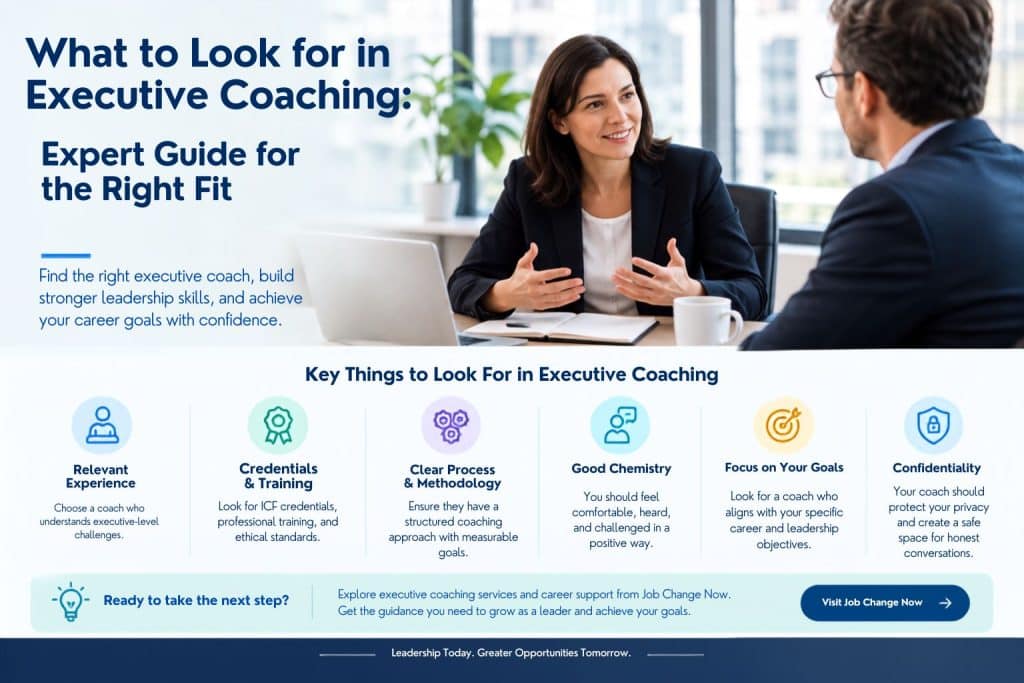
How to Choose an Executive Career Coach
Choosing an executive career coach requires careful evaluation.
Look for Relevant Executive Experience
If you are a C-suite executive, someone who only works with college graduates may not understand your challenges.
Ask about the coach’s experience with:
- Your career level
- Your industry
- Your target roles
- Executive job searches
- Career transitions
- Leadership positioning
Ask About Their Methodology
A good coach should be able to explain how they work. Ask what happens during the first few sessions. You should understand how they move from assessment to strategy to execution.
Evaluate Their Perspective
- Do they understand hiring from the employer’s side?
- Can they explain how recruiters and hiring executives may interpret your experience?
- Can they challenge your assumptions?
Good coaching should not simply confirm everything you already believe.
Be Careful With Guarantees
Avoid coaches who promise:
- A guaranteed job
- A guaranteed salary
- Guaranteed interviews
- Guaranteed executive offers
No legitimate advisor controls the final hiring decision. Professional guidance should improve your strategy and preparation. It cannot eliminate market uncertainty.
How Job Change Now Supports Executive Career Development
For senior professionals who need support across multiple parts of the career transition process, Job Change Now focuses on areas including professional value, personal branding, career transitions, hiring-manager perspective, interviews, and compensation strategy.
That broader approach can be useful because an executive job search is rarely solved by improving one document.
Your resume, LinkedIn profile, networking strategy, interview story, leadership positioning, and compensation strategy should reinforce one another.
Job Change Now also provides resources around executive career coaching services and salary negotiation coaching.
If you are already considering a career move, it is also worth reviewing guidance on how to handle recruiters and get the best job offers.
The goal should be to create one consistent professional story that makes your leadership value easier to understand.
Final Thoughts
The executive job market rewards more than experience. It rewards clarity.
Hiring decision-makers need to understand what you have accomplished, what problems you solve, how you lead, and why your experience is relevant to the organization’s current needs.
That is the real purpose of executive career coaching services. The right coach can help you turn years of experience into a clear professional position. They can help strengthen your executive resume, improve LinkedIn positioning, prepare you for interviews, expand your network, plan a career transition, and approach executive compensation with greater confidence.
But choosing a coach should be a strategic decision. Look for relevant experience. Ask about the process. Understand the deliverables. Define your desired outcome. And avoid anyone promising results they cannot control.
For senior professionals, your career should not be managed only when you need a new job. Build your positioning before you need it. Maintain your network before you need it. Understand your value before you negotiate it.
That preparation can make your next executive career move more intentionally, more confident, and more valuable.
FAQ
What are executive career coaching services?
Executive career coaching services help senior professionals manage career decisions, executive job searches, career transitions, leadership positioning, resumes, LinkedIn profiles, interviews, networking, and compensation discussions.
Who needs executive career coaching?
Executives may benefit from coaching when they are changing careers, pursuing a C-suite role, searching for a new position, preparing for promotion, repositioning themselves after a layoff, or struggling to communicate their leadership value.
How is executive career coaching different from regular career coaching?
Executive career coaching is generally designed for senior professionals and focuses on issues such as leadership positioning, executive search, enterprise-level accomplishments, senior-level networking, executive interviews, and compensation.
How much does executive career coaching cost?
There is no universal price. Cost depends on the coach, program length, executive level, and services included. Compare the scope and expected outcomes rather than looking only at the hourly rate.
Is executive career coaching worth it?
It can be worthwhile when the coaching addresses a specific high-value career objective. Define your desired outcome first and compare the potential financial and professional impact with the cost of the coaching engagement.
Also Read: How to Change Career Path at 30