
Choosing an executive coach is a bigger decision than just searching for someone with a coaching certification and calling it done. The right coach can help you think through genuinely difficult decisions, sharpen your leadership approach, prepare for a transition, or position yourself for a bigger role. The wrong fit can leave you with generic advice and an expensive pile of worksheets you never open again.
So what should you actually be looking for?
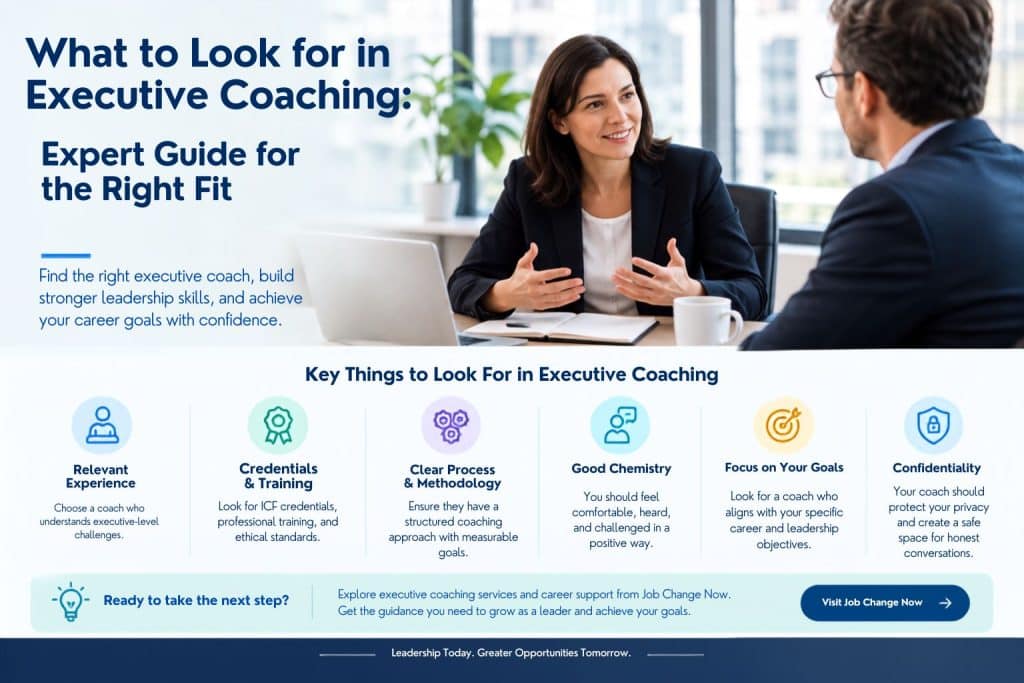
Start with what genuinely matters: relevant experience, a clear coaching process, real communication, confidentiality, measurable goals, and a genuine fit between you and the person you’re working with.
With more coaches entering the market every year, executives genuinely have more choices than ever. Which makes knowing how to actually choose one that much more important.
Before You Even Start Comparing Coaches
Before you look at a single provider, get clear on what you’re actually trying to accomplish.
Are you trying to become a stronger leader? Prepare for a promotion? Handle a genuinely difficult relationship with a colleague or stakeholder? Sharpen your communication? Change careers entirely? Get ready for a C-suite seat?
Your answer here should shape the type of coach you go looking for. A strong coaching relationship is built around your actual situation, not a generic program you’re being slotted into. Here’s what’s worth weighing.
1. Look for Genuinely Relevant Experience
One of the first things worth checking: has this coach actually worked with people at your level?
A coach who mostly works with early-career professionals probably isn’t equipped for the challenges facing a VP, a founder, a CEO, or a senior director. Executive-level problems tend to look pretty different managing other leaders, navigating board or stakeholder relationships, organizational politics, high-stakes strategic decisions, succession planning, executive presence, high-pressure communication, career positioning, compensation negotiation, organizational change.
You don’t necessarily need someone who’s held your exact title. But they should genuinely understand the complexity of the environment you’re actually operating in. Ask directly about the kinds of executives they’ve coached and the problems they typically help clients work through.
2. Check Credentials, but Don’t Stop There
Credentials aren’t the only measure of a good coach but they’re useful evidence of real professional training and a commitment to ethical practice.
ICF’s 2025 study found 73% of coaches agreed that clients and organizations increasingly expect them to hold a genuine coaching certification or credential of some kind.
Worth looking for: relevant coaching credentials, formal coach training, membership in a professional association, ongoing education, real experience with executive clients, and clear standards around ethics and confidentiality.
Don’t assume a long list of certificates automatically means someone’s the right coach for you specifically. Credentials should be one part of the decision, not the whole thing.
3. Actually Understand How They Work
One of the most useful questions you can ask outright: “How does your coaching process actually work?”
A genuine professional should be able to explain this in plain language, not vague generalities. A real engagement might include an initial assessment, goal setting, identifying strengths and development areas, regular coaching conversations, practical exercises or action steps, progress reviews, and adjustments as your needs shift over time.
Be cautious if a provider can’t clearly explain what actually happens after you sign up. You should know exactly what you’re paying for and what the relationship is realistically expected to accomplish. A genuinely individualized process matters here, because executive-level challenges rarely fit neatly into a template built for someone else’s situation.
4. Pay Real Attention to Chemistry and Trust
This one’s easy to underrate, but it matters enormously. You’ll likely end up discussing career mistakes, difficult relationships, confidence issues, leadership weaknesses, compensation worries, and major professional decisions with this person. You genuinely need to feel comfortable being honest with them.
During an introductory conversation, check in with yourself:
- Do I feel actually listened to?
- Are they asking thoughtful questions, not just nodding along?
- Do they seem to genuinely understand my situation?
- Can I disagree with them comfortably?
- Do they push back on me without being dismissive about it?
- Do I trust them with information I’d rather not share broadly?
The best coaching relationship isn’t necessarily the one where you agree with everything the coach says. Sometimes a good coach should genuinely challenge your assumptions. The key is whether that challenge feels constructive and relevant, not just contrarian for its own sake.
5. Ask How Progress Actually Gets Measured
This ties directly into accountability. “Become a better leader” is a fine starting point, but it’s not a real measurement of anything.
Compare vague: “I want to improve my leadership.” with something sharper: “I want to delegate more effectively so my senior team can own operational decisions while I focus on strategic growth.”
Other genuinely measurable goals might include preparing for a promotion within a defined window, improving executive presentations, delegating more effectively, prepping for a specific hard conversation, building confidence in high-pressure meetings, building a career transition strategy, or developing a stronger professional brand.
Ask any potential coach how they actually track progress. If every session is just a conversation with no real direction underneath it, you may not be getting the full value out of what you’re paying for.
6. Think About Their Actual Specialization
Executive coaching is a genuinely broad category. Coaches specialize differently in leadership coaching, career transitions, executive presence, communication, performance improvement, onboarding new executives, C-suite development, career advancement, founder-specific coaching, work-life effectiveness.
Think about your actual, immediate need. An executive preparing for a CEO role probably needs leadership and strategic coaching specifically. A senior professional trying to leave an industry entirely might get more value from career-focused executive coaching instead.
Which is exactly why the best coaching services aren’t necessarily the most expensive or the most famous; they’re the ones that genuinely match what you’re actually trying to solve.
7. Ask the Right Questions Before Committing
Worth preparing a few specific questions ahead of that first conversation.
- What type of executives do you normally work with? Helps you gauge whether they genuinely understand your professional environment.
- How long do engagements typically run? No universal answer here: some goals need a few focused sessions, others benefit from months of ongoing support.
- How do you structure each session? Ask whether sessions include goal reviews, action planning, exercises, feedback, or follow-up between meetings.
- How do you handle confidentiality? Especially important if you’re working inside a genuinely sensitive organizational environment.
- How do you actually measure progress? A credible coach should have a real, clear way to evaluate whether things are moving in the right direction.
- Can we talk before I commit to anything? A genuine introductory conversation lets both sides figure out whether this is actually a good fit.
8. Look for Someone Who Understands Career Positioning, Not Just Leadership
Executive coaching doesn’t have to stop at leadership skills. For executives weighing a career move, the coaching relationship often needs to address professional positioning too.
You might have a genuinely impressive career behind you and still struggle to explain your value quickly and clearly. That becomes a real problem during executive interviews, networking conversations, resume reviews, LinkedIn positioning, compensation discussions, transitions, and promotion conversations.
A hiring-manager-focused approach to career development one built around value identity, brand identity, communicating your professional value clearly, and genuine hiring-manager insight can matter a lot here. That broader lens is genuinely useful when your goal isn’t just “become a better leader,” but figuring out what you actually want your next professional chapter to look like.
9. Look Past the Testimonials
Testimonials can be useful, but don’t base your decision entirely on them. “Great coach!” tells you almost nothing on its own.
More useful evidence explains the actual problem the client faced, what the coaching process specifically addressed, what genuinely changed, what the client learned, and what the real professional outcome was. Ask for examples without expecting confidential client details, since a genuinely reputable coach should be protecting client privacy, not handing out names and specifics.
Also be wary of anyone promising guaranteed outcomes. No ethical coach can guarantee you a promotion, a specific executive role, or a particular salary far too much of that sits outside their control. Good coaching should sharpen your preparation, your clarity, your decision-making, and your ability to actually act. It shouldn’t be promising results nobody can genuinely control.
What Good Coaching Actually Looks Like?
Take a senior director who’s being considered for a VP role. They’re technically strong, but feedback suggests they sometimes dominate meetings and struggle to genuinely delegate.
Rather than waiting to see how the promotion decision plays out, they start coaching now. Together, they work on listening more during senior meetings, delegating actual ownership rather than just handing off tasks, giving clearer feedback, communicating strategic priorities more effectively, handling disagreement without shutting it down, and building real trust with their direct reports.
Over several months, the executive can genuinely evaluate whether these behaviors are actually shifting. That’s a much stronger objective than a vague “I want to be a better leader” — and it illustrates why good coaching should always tie directly back to real, specific professional situations, not abstract self-improvement.
Red Flags Worth Watching For
Knowing what to avoid matters just as much as knowing what to look for. Be cautious of any coach who:
- Guarantees a job or a promotion outright
- Promises a specific salary increase
- Can’t clearly explain their own process
- Runs the exact same program regardless of who they’re working with
- Talks a lot more than they actually listen
- Dodges questions about their own credentials or experience
- Pushes you to buy immediately, with no room to think it over
- Makes unrealistic claims about the results you’ll see
- Never really explains how confidentiality actually works
- Has no clear way to evaluate whether progress is happening
A genuinely strong coach should be confident enough to explain their real value without leaning on unrealistic promises to close the sale.
Where Job Change Now Fits Into This?
For professionals who want executive coaching paired with broader career strategy, Job Change Now offers a wider approach to career development.
Its executive career coaching is built around senior professionals navigating career changes, promotions, leadership challenges, or genuine uncertainty about their next move described as personalized, and focused on helping executives take real control of their professional direction, rather than just reacting to whatever comes next.
It also pairs career positioning with practical job-search support value development, brand positioning, hiring-manager insight, career transition guidance, and training resources. That combination matters if your coaching goal reaches beyond pure leadership development.
You might want to sharpen your executive presence while also prepping for a new role. Or you might need real leadership development while simultaneously planning a transition. The right service should reflect the full scope of what you’re actually trying to solve, not just one slice of it.
Conclusion
The biggest lesson here is simple: don’t pick a coach based purely on a credential, a polished website, or an impressive title. Look at the full picture instead.
You want someone who genuinely understands the level of responsibility you’re carrying, asks thoughtful questions, respects confidentiality, has a real methodology they can explain clearly, understands what you’re actually trying to achieve, and can help turn insight into something you actually act on.
You should also feel genuinely comfortable pushing back on them, and being pushed back on in return that back-and-forth is often where the real value shows up.
For executives weighing advancement or a real professional transition, it’s especially worth choosing a service that understands both leadership development and career positioning together, rather than just one half of the picture.
Before you commit to anything, have a real conversation. Explain where you actually are right now and what you’re genuinely trying to accomplish. Ask direct questions, and pay close attention to how they’re answered, not just what’s said.
The right coaching relationship should leave you with more than a burst of motivation. It should leave you with real clarity, sharper decisions, practical strategies you can actually use, and a much clearer sense of where you want your career to go from here.
FAQ
What should I actually look for in executive coaching?
Genuinely relevant executive experience, real professional training, a clear methodology, confidentiality, measurable goals, strong communication, and a coaching style that actually fits your needs. Specialization matters a lot too if you’re facing a specific career or leadership challenge.
How do I actually go about choosing one?
Start by defining your goal clearly. Then compare coaches on experience, credentials, specialization, methodology, how well you actually click, confidentiality, pricing, and how they measure progress. Schedule a real introductory conversation before making a final call.
What questions should I actually ask a potential coach?
Their experience with executives like you, their coaching methodology, typical engagement length, how they handle confidentiality, how progress gets measured, their specialization, their fees, and what actually happens between sessions.
Are the best coaching services always expensive?
Not necessarily. Pricing shifts based on the coach’s experience, engagement length, specialization, and what’s actually included. Focus on the value and relevance of the program rather than assuming the highest price automatically means the best service.
Also Read: 10 Resume Mistakes to Avoid