You have years of experience, valuable skills, and professional achievements. But when you start preparing your resume, one question can become surprisingly difficult: Should everything fit on one page, or is a two-page resume acceptable?
For years, job seekers have heard that a resume should always be one page. But hiring practices have evolved. Professionals now have more varied career paths, technical projects, certifications, and transferable skills to communicate.
So, how long should a resume be in 2026?
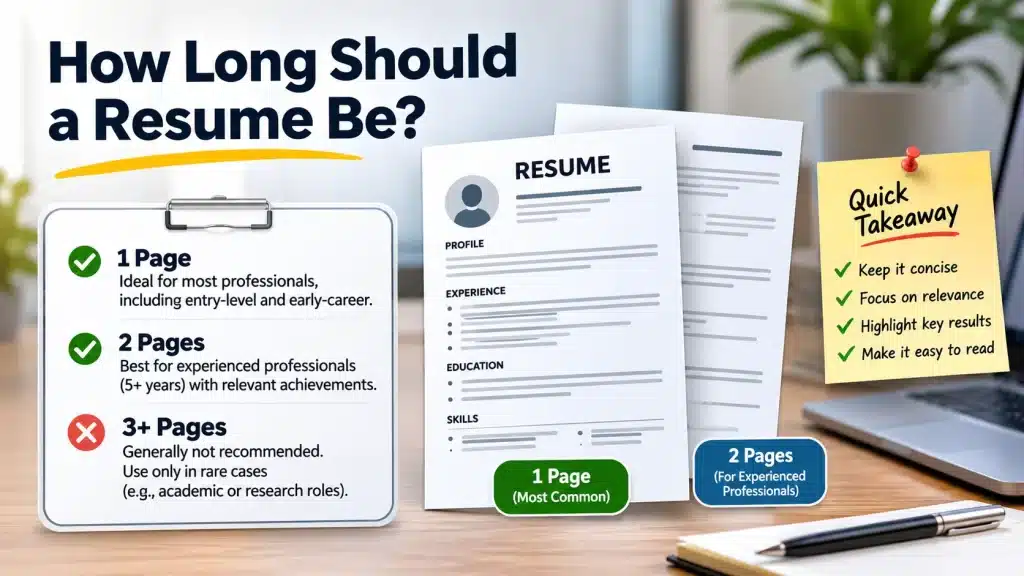
For most U.S. job seekers, a one-page resume works well for students and recent graduates. Experienced professionals can use two pages when they need the additional space to demonstrate relevant qualifications and accomplishments. The goal is not to meet an arbitrary page limit. It is to present your strongest professional value clearly.
In this guide, you’ll learn how to choose the right resume length, what to include on each page, when to remove unnecessary information, and how to create a resume that gets your qualifications noticed.
How Long Should a Resume Be in 2026? The Quick Answer
Here is a practical guideline for U.S. job seekers:
| Career Stage | Recommended Resume Length |
| College students | 1 page |
| Recent graduates | 1 page |
| Entry-level professionals | Usually 1 page |
| Mid-career professionals | 1–2 pages |
| Experienced professionals | 2 pages when relevant |
| Senior managers and executives | Usually 2 pages |
| Academic and research applicants | Follow CV requirements |
| Federal government applicants | Maximum 2 pages under current OPM guidance |
These are general recommendations, not universal rules for every private-sector employer. Your experience, industry, job requirements, and accomplishments should determine the final length.
Is a One-Page Resume Still the Best Choice?
A one-page resume remains a strong option, particularly when you have limited professional experience.
It gives recruiters a concise overview of your education, skills, employment history, and achievements without making them search through unnecessary details.
A one-page resume is particularly suitable for:
- College students applying for internships.
- Recent graduates entering the workforce.
- Professionals with limited work experience.
- Job seekers with a straightforward employment history.
- Candidates applying for roles where only a few qualifications are relevant.
For example, imagine a recent business graduate applying for an entry-level marketing position.
The candidate has completed an internship, worked on two university projects, earned a degree, and developed skills in Google Analytics, Excel, and content marketing.
A focused one-page resume can communicate all these qualifications without needing additional space.
The important point: A one-page resume should be complete enough to demonstrate your suitability. Do not remove important achievements simply to meet a page limit.
When Should You Use a Two-Page Resume?
A two-page resume makes sense when one page cannot communicate your relevant experience clearly.
This is common among professionals who have developed specialized knowledge, managed complex projects, led teams, or worked across several organizations. Consider a project manager with 12 years of experience.
Their background might include:
- Managing multiple business projects.
- Leading cross-functional teams.
- Controlling large project budgets.
- Implementing process improvements.
- Managing vendors and stakeholders.
- Delivering projects across different industries.
Trying to fit all these achievements onto one page may result in tiny text, crowded sections, or incomplete explanations.
A two-page resume provides room to show relevant experience while keeping the document readable.
Signs You Need a Two-Page Resume
Consider using two pages when:
- You have substantial relevant professional experience.
- You have several major accomplishments worth highlighting.
- You have managed important projects or teams.
- Your target position requires specialized technical knowledge.
- You are changing careers and need to explain transferable experience.
- You have relevant certifications, professional training, or publications.
However, do not use the second page simply because you want to include everything you have ever done. Every section should support your application.
What Does Recent Resume Research Say About Resume Length in 2026?
The debate between one-page and two-page resumes continues, but recent research provides useful context.
For candidates with 10 or more years of experience, the reported interview rates were:
- One-page resumes: 5.8%
- Two-page resumes: 6.4%
- Three-or-more-page resumes: 5.7%
These results come from Huntr’s platform data rather than a nationally representative experiment. They do not prove that adding a page causes more interviews. However, they challenge the idea that every candidate must fit their experience onto one page.
The practical lesson is straightforward: focus on relevant content and readability rather than reducing your resume to an arbitrary word or page count.
How to Organize a One-Page Resume?
If you decide to use one page, you need to prioritize information carefully. A strong one-page resume can follow this structure:
1. Contact Information
Include:
- Full name
- Professional email address
- Phone number
- City and state
- LinkedIn profile URL, when relevant
You generally do not need your full residential address.
2. Professional Summary
Write two or three concise sentences explaining your background, major strengths, and the type of value you bring.
For example:
“Digital marketing specialist with three years of experience in SEO, content strategy, and campaign analysis. Experienced in improving organic visibility and supporting lead-generation initiatives through data-driven marketing.”
3. Core Skills
Include skills that match the job description.
For example:
SEO | Google Analytics | Content Strategy | Keyword Research | Reporting | Campaign Management
4. Work Experience
Prioritize your most relevant positions. Use bullet points to explain accomplishments rather than simply listing daily responsibilities.
5. Education and Certifications
Include your relevant qualifications and professional certifications. Remove outdated or unrelated information when space is limited.
How to Organize a Two-Page Resume
A two-page resume needs a clear structure. The second page should provide additional evidence of your qualifications rather than repeat information.
A useful approach is:
Page 1: Your strongest qualifications
- Contact information
- Professional summary
- Core skills
- Most recent and relevant work experience
- Major accomplishments
Page 2: Supporting professional experience
- Additional relevant employment history
- Significant projects
- Certifications
- Professional development
- Relevant education
- Publications or technical achievements where applicable
Keep the most important information on the first page. For a two-page document, include your name and page number in the header or footer of the second page. This helps keep the pages identifiable if they become separated.
How Long Should a Resume Be for Different Experience Levels?
The best resume length depends on your career stage.
Students and Recent Graduates
A one-page resume is generally sufficient. Include education, internships, part-time employment, relevant projects, volunteer experience, technical skills, and certifications.
You do not need to apologize for limited experience. Focus on demonstrating what you have learned and accomplished.
Professionals With 3–5 Years of Experience
One page may still be enough if your experience is focused. A second page can be useful when you have several relevant achievements, technical responsibilities, or projects that strengthen your application.
Professionals With 5–10 Years of Experience
Both one-page and two-page resumes can work. Think about whether your experience includes different roles, important projects, leadership responsibilities, or measurable business results.
If those details help demonstrate your suitability, use the additional space.
Professionals With 10+ Years of Experience
A two-page resume is often reasonable. Focus on your most recent and relevant positions. Older experience can be summarized when it still supports your career story.
Do not include every responsibility from every role. Highlight the achievements that demonstrate your professional growth.
Executives and Senior Leaders
Senior professionals may need additional space to communicate organizational leadership, strategic initiatives, business performance, team development, and major accomplishments.
Two pages are often practical for a private-sector executive resume. The key is to demonstrate leadership impact rather than create a long list of responsibilities.
What About Federal Resumes in 2026?
There is an important change U.S. federal job seekers should know about.
The Office of Personnel Management introduced a two-page resume limit for federal job applications beginning September 27, 2025.
According to OPM guidance, resumes must be no longer than two pages and must address the minimum qualifications and other requirements listed in the job announcement.
Federal applicants should therefore carefully follow the current OPM two-page resume guidance.
This federal requirement should not be confused with general private-sector resume recommendations.
For private-sector roles, the appropriate length still depends on the employer, position, and relevant experience.
Common Mistakes That Make Your Resume Too Long
Sometimes a resume becomes lengthy because it contains information that does not help the candidate.
Avoid these mistakes:
- Including every previous job: Older positions that have no connection to your target role may not need detailed descriptions.
- Repeating responsibilities: If several jobs involve similar tasks, focus on the progression of your responsibilities and achievements.
- Using lengthy paragraphs: Short bullet points are easier to scan.
- Adding irrelevant skills: Include abilities that genuinely support your application.
- Shrinking the font: Do not use extremely small text just to squeeze everything onto one page.
- Adding unnecessary personal information: Details such as marital status, age, or unrelated personal interests generally do not belong on a U.S. private-sector resume.
- Using generic descriptions: Replace vague statements with specific accomplishments and measurable results wherever possible.
A useful test is to ask: Would this information help an employer understand why I am qualified for this particular job? If not, consider removing or shortening it.
How to Make Your Resume the Right Length?
Use this practical process before submitting your application.
Step 1: Read the job description.
Identify the experience, qualifications, and skills the employer considers important.
Step 2: Select relevant experience.
Prioritize roles, projects, and achievements that support the position.
Step 3: Write accomplishment-focused bullets.
Explain what you did and what changed because of your work.
Step 4: Remove repetition.
Avoid describing the same skill or responsibility multiple times.
Step 5: Check readability.
Use clear headings, consistent formatting, readable fonts, and sufficient white space.
Step 6: Review the final document.
Check spelling, dates, contact information, page breaks, and formatting.
Step 7: Tailor it for the next application.
You do not necessarily need to rebuild your resume from scratch. Adjust the summary, skills, and experience bullets to match the opportunity.
How Job Change Now Can Help You Strengthen Your Resume?
Choosing the right resume length is only one part of presenting yourself effectively. A two-page resume filled with generic responsibilities may be less persuasive than a focused one-page document that communicates clear achievements.
This is where professional guidance can be useful. Job Change Now helps professionals communicate their experience, skills, achievements, and professional value to hiring managers.
Its approach includes developing a Value Statement that highlights career accomplishments and measurable results. The goal is to help employers understand what makes a candidate valuable rather than simply reading a list of previous job duties.
You can also explore its resume and LinkedIn guidance to learn more about the support available for improving professional documents and positioning your experience.
For professionals considering a career change, career transition support can also help identify transferable strengths and present previous experience in a way that is relevant to a new opportunity.
Whether your resume is one page or two, the objective remains the same: make it easy for an employer to understand the value you can bring.
Conclusion
So, how long should a resume be in 2026? For most students and recent graduates, one page is a practical choice. For experienced professionals, two pages can provide the space needed to demonstrate relevant skills, achievements, and career progression.
Do not sacrifice important information simply to meet an outdated one-page rule. At the same time, do not add unnecessary details just because you have room.
Review your resume against the position you want. Remove repetition, highlight measurable accomplishments, and organize your strongest qualifications where employers can find them quickly.
Remember, your resume is not a complete record of your working life. It is a focused professional document designed to show why you are a strong candidate for a specific opportunity.
Make every section count. Whether your final resume is one page or two, it should communicate your value clearly and give employers a reason to learn more about you.
Frequently Asked Questions
Is a two-page resume acceptable in 2026?
Yes. A two-page resume is acceptable for many experienced professionals, managers, executives, technical candidates, and career changers when the additional content is relevant. Recent graduates generally benefit from a focused one-page resume.
Is a one-page resume better than a two-page resume?
Not automatically. A one-page resume is useful for presenting a concise professional summary. A two-page resume is better when additional relevant experience and accomplishments need space. Quality and relevance matter more than page count.
Should a 10-year experienced professional have a two-page resume?
Often, yes. Professionals with 10 years of relevant experience may have enough accomplishments, projects, and responsibilities to justify two pages. However, they should still remove outdated and unrelated information.
Can a resume be three pages long?
A three-page resume is generally unnecessary for most private-sector applications. Consider it only when your profession or application requirements genuinely call for extensive documented experience. Academic CVs are a separate document and can be longer. For U.S. federal applications, follow the current two-page limit.
Also Read: Career Advice for Engineers