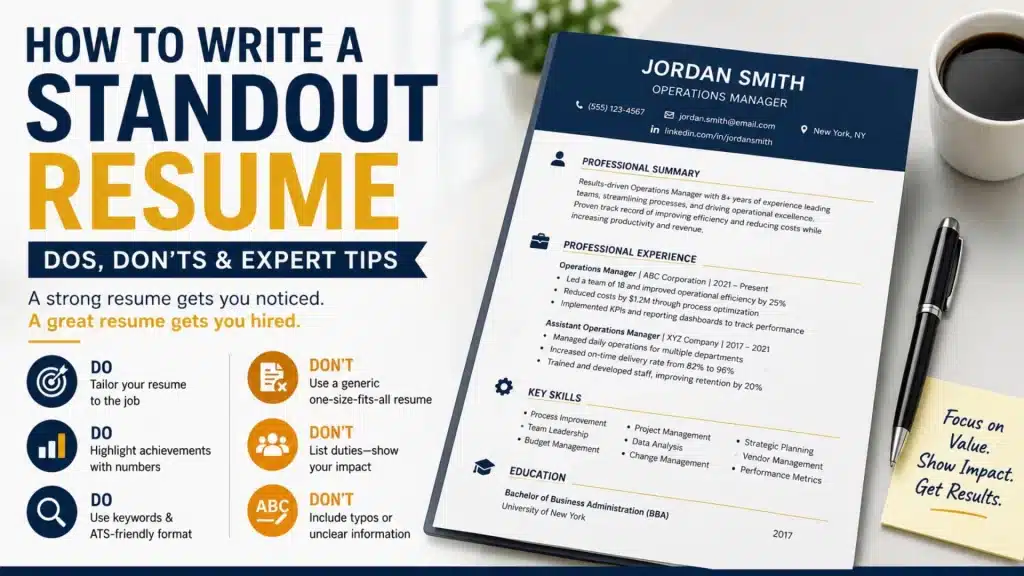
Your resume has exactly one job that makes a hiring manager want to know more about you. Sounds simple enough. And yet a lot of genuinely qualified professionals struggle to land interviews because their resumes focus too much on duties and not nearly enough on actual value.
If you’re trying to figure out how to make yours stand out, the answer isn’t more buzzwords, a flashier template, or padding it out to look more substantial. A genuinely strong resume connects your experience directly to the specific role you’re going for, makes your accomplishments easy to grasp at a glance, and still has to hold up against today’s applicant tracking systems.
Hiring’s gotten both more competitive and more automated at the same time. Jobscan’s 2026 research found 97.4% of Fortune 500 companies had a detectable ATS in place.
So your resume genuinely has to satisfy two audiences at once: the software processing it and the person deciding whether you’re worth a call.
What Actually Makes a Resume Stand Out?
A standout resume isn’t necessarily the most creative one. It’s the one that quickly answers three questions: what kind of professional are you, what have you actually accomplished, and why are you relevant to this particular job?
Think of your resume less as a full career history and more as a marketing document. You don’t need to tell an employer everything you’ve ever done, you need to show the experience that matters most for the role sitting in front of you right now.
Compare:
Weak: “Responsible for managing a sales team and developing sales strategies.”
Stronger: “Led a 14-person regional sales team and increased annual revenue by 27% through territory redesign, account expansion, and improved pipeline management.”
The second version gives an employer something concrete to grab onto leadership, scale, and an actual outcome. That’s the real difference between listing duties and demonstrating value.
Open With a Summary That Actually Says Something
Your summary sits right near the top, often the first real chunk of information a recruiter actually reads. Don’t waste that space on something like:
“Hardworking professional with excellent communication skills seeking a challenging position.”
Nearly every candidate on earth could write that exact sentence. Instead, explain who you actually are professionally and what you genuinely bring:
“Operations leader with 12+ years of experience managing multi-site teams, improving operational efficiency, and reducing costs. Proven record of leading process improvements that generated more than $5M in annual savings across regional operations.”
Specific. Concrete. Gives the reader an actual reason to keep going. This is exactly where a real value statement helps connect your experience, your strengths, and your results directly to what a potential employer actually needs.
Summary or Objective?
For most experienced professionals, a summary beats an objective. An objective tells the employer what you want. A summary tells the employer what you offer. That distinction matters more than it seems one is about you, the other’s about them.
Lead With Accomplishments, Not Duties
This might be the single most important tip on this whole list. A lot of resumes read like job descriptions — “Managed customer accounts,” “Prepared monthly reports,” “Supervised employees,” “Created marketing campaigns,” “Worked with senior management.” These explain what you did. They say nothing about whether you did it well.
Turn responsibilities into actual accomplishments instead. Before: “Managed customer service operations.”
After: “Managed customer service operations for 3 regional teams and reduced average response time by 32% while improving customer satisfaction scores.”
A simple formula helps here: action + task + result.
Action: Led. Task: A cross-functional process improvement initiative. Result: Reduced product delivery delays by 22%. Combined: “Led a cross-functional process improvement initiative that reduced product delivery delays by 22%.”
Use numbers wherever you genuinely can, revenue generated or increased, costs reduced, percentage improvements, team size, customer growth, time saved, projects completed, budgets managed, geographic scope, productivity gains. You don’t need a number in every single bullet, but measurable results make your strongest accomplishments a lot easier for someone to actually absorb.
Tailor It to the Actual Job Description
One of the biggest mistakes out there: sending the exact same resume to every employer, unchanged.
Your core experience can stay consistent. What you emphasize shouldn’t.
Read the job description closely and pull out the required skills, preferred skills, specific terminology, responsibilities, industry knowledge, certifications, leadership expectations, and technical requirements. Then compare all of that against your own background.
If the employer keeps mentioning project management, stakeholder management, and cross-functional leadership, those concepts should show up naturally in your resume but only if they genuinely reflect what you’ve actually done. Don’t just copy the posting word for word; use relevant language where it’s honestly true to your experience.
This matters extra given how much ATS software shapes how employers organize and search through applications. A clean, ATS-friendly approach means using clear formatting and naturally weaving in language from the posting, not turning your resume into a pile of disconnected keywords.
Getting the Formatting Right for ATS Systems
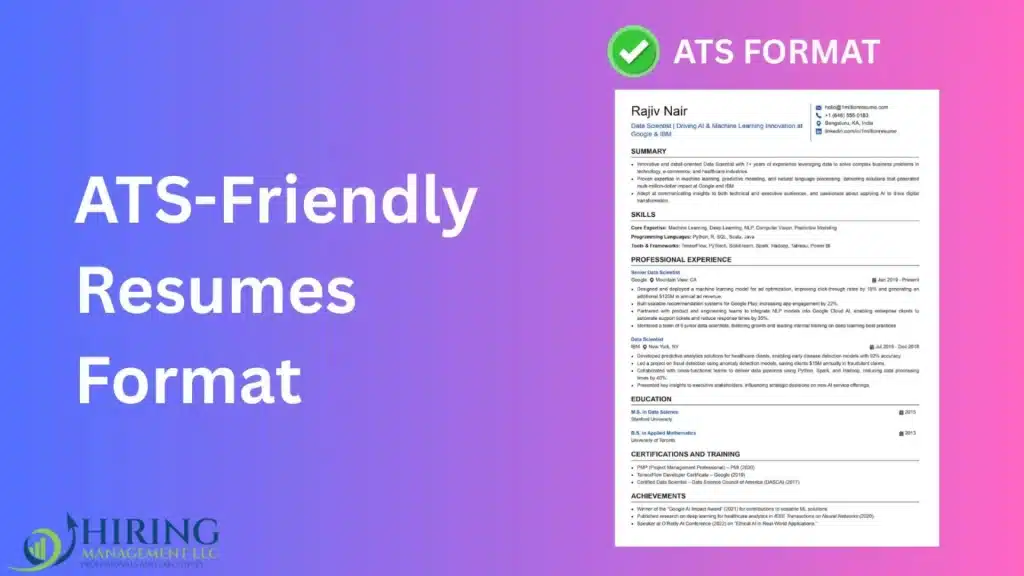
An ATS-friendly resume doesn’t have to look boring. It just has to be genuinely readable.
Stick with standard section headings, simple formatting, readable fonts, clear job titles, consistent dates, normal bullet points, a standard document structure, relevant keywords, and in most cases a reverse-chronological layout.
Be cautious with large graphics, text embedded inside images, complicated tables, multiple text columns, decorative icons, unusual section names, heavy design flourishes, or important information tucked into headers and footers where it might get missed entirely. There’s no universal “ATS score” that guarantees you an interview if different employers run different systems.
Figuring Out the Right Length
There’s no single correct answer here. Early in your career, one page can absolutely be enough. With 10, 15, or 20+ years of relevant experience, two pages is completely reasonable. Monster’s 2026 research found 49% of surveyed job seekers were using resumes longer than one page, including 30% running two pages or more.
The better rule: use as much space as it genuinely takes to communicate real value, and no more than that. Don’t stretch to two pages just because you think executives are “supposed to” have two pages. And don’t cram a 20-year career onto a single page if it means cutting achievements that actually matter. Every section should be earning its place on the page.
What Sections a Strong Resume Actually Needs?
- Contact information. Full name, city and state, phone number, professional email, and your LinkedIn profile where relevant. You generally don’t need your full street address anymore.
- Professional summary. Two to four lines establishing your identity and strongest qualifications.
- Core skills. Relevant skills matched to your target roles are things like strategic planning, revenue growth, operations management, team leadership, business development, change management, or project management, depending on your background.
- Professional experience. Start with your most recent role. For each one, include the company, your title, location where useful, dates, and the accomplishments that actually matter.
- Education. Relevant degrees and academic credentials.
- Certifications. Only the ones that matter for your target role don’t clutter the page with unrelated courses.
Sharpening Every Bullet Point
A few things worth applying right away. Lead with stronger verbs. Swap out weak phrases like “helped,” “worked on,” “responsible for,” “assisted with,” and “participated in” for stronger, accurate ones led, directed, built, negotiated, increased, reduced, developed, implemented, launched, improved, managed, delivered.
Weak: “Responsible for improving the company’s hiring process.”
Better: “Redesigned the hiring workflow and reduced average time-to-hire by 18%.”
The second version communicates action and impact immediately, without any extra effort from the reader.
Cut the repetition. If every single bullet opens with “Managed,” the resume starts to blur together. Vary the language while staying accurate to what you actually did.
Weight your most recent, most relevant experience. Your oldest roles don’t need the same level of detail as your recent ones. With 15 years of experience, your last five to ten probably deserve the most real estate; older roles can be summarized more lightly once they’re no longer central to what you’re targeting now.
Mistakes That Quietly Undercut Strong Candidates
- Writing something generic enough to fit 50 different jobs: Which usually means it doesn’t strongly fit any of them.
- Listing duties with no results attached: The employer already has a rough idea what someone in your role generally does. Show them what you actually accomplished with it.
- Learning too hard on buzzwords: Words like “results-driven,” “strategic thinker,” and “team player” aren’t inherently bad; they just go weak without something backing them up. Skip “results-driven leader” and just show the result directly.
- Including every job you’ve ever had: Your resume isn’t your autobiography. Keep the focus tight on what’s genuinely relevant.
- Over-designing the template: A beautiful-looking resume can still create real parsing problems underneath. Clean, simple design tends to win out.
- Making claims you can’t back up: Don’t stretch revenue numbers, titles, responsibilities, certifications, or accomplishments. A standout resume should build credibility, not raise questions.
- Letting LinkedIn tell a different story: If your resume says you’re an operations executive but your LinkedIn still reads like you’re a coordinator from five years ago, that gap actively works against your positioning.
For Career Changers Specifically
Career changers face a unique version of this problem: your previous title might not match the role you’re going for at all. That doesn’t mean the experience lacks value. It means you need to actively explain the connection instead of hoping it’s obvious.
Take a teacher moving into corporate learning and development. Instead of leaning purely on classroom teaching, the resume could highlight training development, presentation skills, curriculum design, stakeholder communication, performance measurement, coaching, and facilitation all genuinely part of the job, just reframed for a different audience.
The goal is making what actually transfers obvious to someone who’s never seen your world firsthand. If you’re navigating a bigger career shift, it’s worth pairing this resume work with a broader transition strategy rather than tackling the resume in total isolation.
A Quick Example of the Difference This Makes
Two candidates applying for the same sales director role.
- Candidate A: “Sales manager responsible for managing a team, developing sales strategies, and meeting revenue goals.”
- Candidate B: “Directed a 12-person sales organization across three regions and increased annual revenue 31% by restructuring territories, expanding strategic accounts, and introducing a data-driven pipeline review process.”
Both candidates might genuinely have similar underlying experience. But Candidate B makes the value dramatically easier to see — leadership scale, geographic scope, revenue impact, strategic thinking, process improvement, and measurable results, all in one sentence. That’s exactly what a standout resume is supposed to accomplish.
Should You Use AI to Write It?
AI can genuinely help with brainstorming, spotting repetitive phrasing, catching grammar issues, and organizing information. What it shouldn’t do is invent your accomplishments for you.
There’s a real reason to be careful here beyond just accuracy. Research from Criteria and Lighthouse Research & Advisory in 2026 found only about a third of employers surveyed felt highly confident that resumes accurately reflected candidates’ actual abilities and 92% of recruitment leaders believed AI-generated resumes had become genuinely commonplace.
Which means authenticity carries real weight right now. Use AI as a tool, not a replacement for your own judgment. Your resume should sound like a credible, honest version of you, not a version of you that got a little too creative with the truth.
How Job Change Now Can Help You Build a Stronger Resume?
Writing a resume becomes much easier when you first understand your professional value. That is an important part of the approach used by Job Change Now.
The company focuses on helping professionals communicate their value to hiring managers through career strategy, professional positioning, resume development, interview preparation, and broader job-search support. Its approach includes hiring-manager expertise and resources designed to help professionals navigate career changes and advancement.
For professionals who need help specifically with resume positioning, you can also explore resume optimization services from Job Change Now.
The important point is that resume improvement should not happen in isolation. Your resume should support the same professional story you communicate in:
- Networking
- Interviews
- Recruiter conversations
- Cover letters
- Salary discussions
When all of these pieces communicate the same value, your overall positioning becomes stronger.
A Quick Self-Check Before You Submit
- Does the top section clearly explain who I am professionally?
- Is this tailored to the specific job, or just generic?
- Do my bullets focus on accomplishments, not just duties?
- Have I included measurable results wherever they genuinely apply?
- Are relevant keywords woven in naturally, not stuffed in?
- Is the formatting genuinely easy to read?
- Could an ATS parse this without trouble?
- Have I cut anything irrelevant?
- Any spelling or grammar slips left?
- Does it make clear, at a glance, why I’m qualified for this specific role?
If most of these come back, yes, you’re in solid shape.
Making Your Resume Actually Earn Its Keep
Figuring out how to write a standout resume isn’t really about finding the perfect template. It’s about learning to communicate your actual professional value clearly.
Start with what the employer needs. Then connect that directly to your own experience. Show what you actually accomplished. Use numbers where they genuinely add credibility. Choose relevant language without cramming it into every sentence. Keep the formatting clean enough that both a piece of software and an actual human can make sense of it quickly.
Above all, don’t try to sound impressive, try to be specific. “Experienced leader” is vague and forgettable. “Led a 50-person organization through a restructuring that reduced operating costs by 18%” is evidence anyone can evaluate. That evidence is exactly what makes a resume memorable.
If your resume isn’t producing the opportunities you’d hoped for, resist the instinct to just apply to more jobs. It might genuinely be a positioning problem instead. Revisit your target role. Rework your summary. Strengthen your accomplishment bullets. Cut anything outdated. And make sure the whole thing tells the same story your LinkedIn and interview answers are telling too.
A standout resume doesn’t guarantee an interview on its own. But a clear, relevant, genuinely credible one gives an employer a much better reason to actually consider you which, in the end, is really all it was ever supposed to do.
FAQ
How do you actually write a standout resume?
Focus on relevant accomplishments over job duties, use measurable results wherever they genuinely apply, tailor the content to each specific role, write a clear professional summary, weave in relevant keywords naturally, and keep the formatting clean and ATS-friendly.
What actually makes a resume stand out to employers?
Fast, clear communication of real value. Strong accomplishments, measurable results, relevant skills, clean formatting, and specific examples of impact tend to beat decorative design or generic self-description every time.
How long should a resume actually be?
One page can work well early in a career. Experienced professionals often need two pages to properly present relevant accomplishments. The real rule is using exactly the space it takes to communicate what matters, without padding it further than that.
What are the biggest resume mistakes people make?
Sending a generic, one-size-fits-all resume, listing duties instead of results, stuffing in keywords, using formatting that’s hard to parse, including irrelevant experience, making claims you can’t back up, and skipping tailoring entirely.
Does a resume actually need to be ATS-friendly?
Yes, a lot of employers run applicant tracking systems to process applications. That means clean formatting, standard headings, readable text, and keywords that genuinely reflect your real qualifications, not just terms lifted wholesale from the posting.
Also Read: Salary negotiation coaching