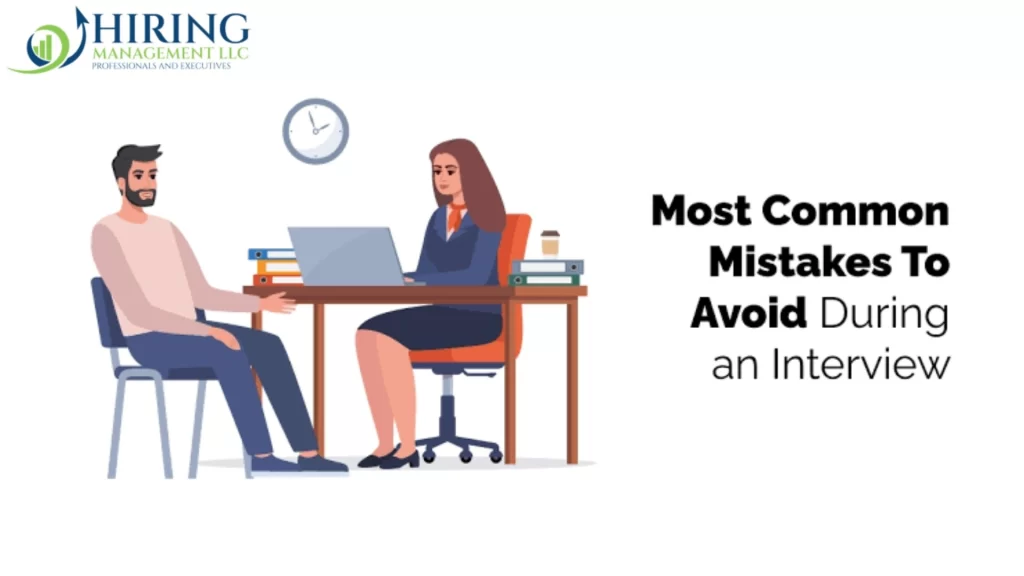
You can have the right experience, a strong resume, and the skills an employer needs and still hurt your chances during the interview.
Sometimes it is not a lack of qualifications. It is a small mistake that changes how the interviewer sees your preparation, communication, or judgment.
That is why knowing the common interview mistakes to avoid is just as important as practicing interview questions.
U.S. Department of Labor resources recommend researching the employer and the job, practicing answers out loud, and preparing real examples that show how you handle challenges. NACE’s 2026 research also found that employers want new graduates to do more than simply list skills. They want candidates to provide examples that demonstrate those skills.
The good news is that most interview problems are fixable. In this guide, we will cover the most common interview errors, explain why they hurt, and show you what to do instead.
What are the 12 Common Interview Mistakes to Avoid?
1. Showing Up Without Researching the Company
One of the most common job interview mistakes is walking into the interview knowing very little about the employer. You should know more than the company’s name and industry.
Before the interview, research:
- What the company does
- Its products or services
- The customers it serves
- Recent company developments
- The responsibilities of the position
- The skills emphasized in the job posting
CareerOneStop, sponsored by the U.S. Department of Labor, specifically recommends researching both the employer and the job before an interview.
You do not need to memorize the company’s entire website. You just need enough information to have a meaningful conversation.
For example, instead of asking:
“So what does your company do?”
you could say:
“I noticed your company recently expanded its customer support operations. How is this role involved in that growth?”
That shows preparation and curiosity.
2. Giving Generic Answers
Another common interview error is answering every question with broad claims.
- “I’m a hard worker.”
- “I’m a great communicator.”
- “I’m a team player.”
These statements are easy to say. They are also easy for an interviewer to forget. A better approach is to give evidence.
Instead of:
“I’m good at solving problems.”
Try:
“Our reporting process was creating delays every month. I mapped the workflow, removed two unnecessary steps, and reduced the reporting time by about 30%.”
The example gives the interviewer something concrete. This aligns with NACE’s 2026 findings that employers want candidates to provide examples instead of simply listing their skills.
3. Talking Too Much
One of the most overlooked common interview mistakes to avoid is giving answers that never seem to end.
Nervous candidates often keep talking because silence feels uncomfortable. The problem is that longer answers can bury your strongest point.
A useful approach is:
Answer → Example → Result → Stop
Suppose you are asked:
“Tell me about a time you handled a difficult customer.”
You do not need to tell the interviewer the entire history of the customer relationship. Give enough context to explain the situation. Explain what you did. Finish with the result. Then stop and let the interviewer ask the next question.
4. Giving Answers That Are Too Short
The opposite problem can be just as damaging. Responding to every question with “yes,” “no,” or a one-sentence answer can make it difficult for the interviewer to understand your experience. This is particularly risky with behavioral questions.
A strong answer usually includes enough detail to show:
- What happened
- What your responsibility was
- What action you took
- What changed because of your action
Think about interviews as conversations rather than tests with one-word answers.
5. Not Having Examples Ready
You may know your accomplishments well, but remembering them under pressure is another matter. Prepare five or six stories before the interview.
Choose examples that demonstrate:
- Leadership
- Problem solving
- Teamwork
- Conflict management
- Adaptability
- A measurable accomplishment
- A mistake or setback you learned from
A simple method is the STAR format:
- Situation: What was happening?
- Task: What needed to be done?
- Action: What did you personally do?
- Result: What happened afterward?
You do not have to announce each STAR section during the interview. Use it as a structure for keeping your answer focused.
6. Speaking Negatively About a Previous Employer
This is one of the classic job interview blunders.
- Maybe your former manager was difficult.
- Maybe the company had poor communication.
- Maybe you genuinely disliked the job.
- Even so, avoid turning the interview into a complaint session.
Instead of:
“My old manager was terrible and had no idea how to run the department.”
try:
“I was looking for an environment with clearer communication and more opportunities to take ownership of projects.”
You can be honest without being hostile. The interviewer is not only listening to your story. They are also thinking about how you may talk about their company someday.
7. Pretending You Know Something You Do Not
Interviewers may ask about software, processes, or technical concepts you have limited experience with. Do not bluff.
A better answer is:
“I have not worked directly with that platform yet. I have used a similar system and I am comfortable learning new tools.”
That response is more credible than pretending to have expertise you do not have. Honesty does not mean underselling yourself. It means accurately describing what you know and what you are still developing.
8. Failing to Listen Carefully
An interview is not a speech you memorized. You need to listen to the question that was actually asked.
For example:
Question: “Tell me about a time you disagreed with your manager.”
Weak approach:
Spend three minutes explaining how well you work in teams.
Better approach:
Explain the disagreement, how you handled it, and what happened.
Active listening also helps you notice what the interviewer seems to care about.
If they repeatedly ask about customer retention, leadership, or process improvement, those themes may be important to the role.
9. Forgetting to Ask Questions
When the interviewer says:
“Do you have any questions for us?”
saying “No, I think I’m good” can waste an important opportunity.
Good questions show that you are evaluating the opportunity seriously.
Ask questions such as:
- What would success look like in the first 90 days?
- What are the biggest challenges facing this role?
- How is performance measured?
- What does the team structure look like?
- What separates strong performers from average performers in this position?
Avoid asking questions that could easily be answered by reading the company’s website. You also do not need to ask ten questions. Two or three thoughtful questions are enough.
10. Focusing Too Early on Salary and Benefits
Compensation matters. However, making salary your main topic before you have discussed the role can shift the conversation in an unhelpful direction.
Early interviews are usually better used to establish fit, understand the position, and demonstrate the value you could bring.
When compensation comes up, answer professionally and consider the full package rather than focusing only on base salary.
Later in the process, you can have a more detailed compensation conversation.
11. Arriving Late or Being Technically Unprepared
For an in-person interview, plan your route ahead of time. For a virtual interview, test your:
- Camera
- Microphone
- Internet connection
- Lighting
- Background
- Meeting link
Join early enough to deal with unexpected problems. A technical problem does not automatically mean you will lose an opportunity. How you handle it matters.
If your connection fails, communicate quickly and professionally. Do not disappear without explanation.
12. Trying to Be Perfect Instead of Being Prepared
One of the more subtle common interview mistakes to avoid is trying to give an absolutely perfect answer to every question. Real interviews do not always work that way. You may need a moment to think.
It is completely reasonable to say:
“That’s a good question. Let me think about the best example.”
Taking a few seconds can produce a clearer answer than speaking immediately and then getting lost.
Preparation should give you confidence. It should not turn you into someone reciting memorized scripts.
How to Recover From a Mistake During an Interview?
Not every mistake means the interview is over. Sometimes the best thing you can do is correct yourself.
For example:
“Let me clarify that because I don’t think I answered your question directly.”
Then answer the question.
- If you realize you gave the wrong figure, correct it.
- If you misunderstood a question, ask for clarification.
- Interviewers understand that candidates can be nervous.
- What matters is how professionally you respond.
In fact, handling an unexpected moment calmly can give you a chance to demonstrate communication and judgment.
A Realistic Example of Common Interview Mistakes
Consider a candidate applying for an operations manager position. They have ten years of experience and meet nearly every technical requirement.
During the interview, however, they make several mistakes:
- They arrive five minutes late.
- They know little about the company.
- When asked about leadership, they speak for five minutes without giving a clear example.
- When asked why they left their previous employer, they spend most of the answer criticizing their former manager.
- At the end, they have no questions.
None of these mistakes alone proves the candidate cannot do the job. But together, they make it harder for the employer to see the candidate’s actual strengths.
Now imagine the same candidate preparing differently.
- They research the company.
- They prepare six examples.
- They use concise answers.
- They discuss their previous employer professionally.
- They ask thoughtful questions.
The underlying experience has not changed. The presentation has. That is an important lesson for anyone preparing for an interview.
How Can a Job Change Now Can Help You Prepare?
Preparing for an interview is easier when you know what you want the interviewer to understand about you.
Job Change Now focuses on helping professionals communicate their value to employers through its career and job-change support. The company’s current site emphasizes Value Identity, Brand Identity, and presenting education, skills, experience, and accomplishments clearly to hiring managers.
Its career coaching resources also address interview preparation, resume development, recruiter engagement, and career transitions. For example, interview preparation and follow-up support is included among the services described by Job Change Now’s Toledo career advisor page.
For professionals who need broader career positioning, professional development coaching can help connect career goals with skills, performance, and practical next steps.
The bigger idea is simple: interview preparation should not start with memorizing answers. It should start with understanding your own value.
A 24-Hour Interview Preparation Checklist
The day before your interview, review the following:
Research
Know the company, role, industry, and major responsibilities.
Examples
Prepare several stories that demonstrate your skills.
Questions
Write down at least three questions for the interviewer.
Logistics
Confirm the time, location, link, technology, and contact details.
Resume
Review every major point on your resume. Be prepared to discuss anything you included.
Opening
Practice a clear answer to:
“Tell me about yourself.”
Keep it relevant to the position.
Closing
End with confidence.
You can say:
“Thank you for the conversation. Based on what I’ve learned about the role, I’m very interested in the opportunity and believe my experience in [relevant area] could be useful to the team.”
A Note About Interview Questions and Legal Boundaries
Most candidates focus entirely on their own answers. It is also useful to understand that employers have legal obligations during hiring.
For example, the EEOC says employers generally cannot ask applicants disability-related questions or require medical examinations before making a job offer. Applicants can be asked whether they can perform the job and how they would perform its functions, with or without reasonable accommodation.
Federal employment laws also prohibit discrimination in hiring and recruitment based on protected characteristics covered by applicable law.
Conclusion
The goal of an interview is not to sound perfect. It is to make it easy for the employer to understand your experience, skills, judgment, and potential value.
Knowing the common interview mistakes to avoid gives you a practical advantage because it lets you prepare for problems before they happen.
- Research the company.
- Understand the job.
- Prepare real examples.
- Answer the question that was asked.
- Listen carefully.
- Keep your answers focused.
- Avoid unnecessary negativity.
- Ask thoughtful questions.
- And prepare for the logistics as seriously as you prepare for the conversation.
The strongest interview preparation is not about memorizing a script. It is about knowing your own career story well enough to explain it clearly.
That is where Job Change Now can be useful. Its career support emphasizes communicating your value and presenting your experience in a way that helps hiring managers understand what you bring to the table.
Before your next interview, take 30 minutes to identify your five strongest career examples and connect each one to a skill the employer needs. Then practice saying those stories out loud.
That simple exercise can help you avoid many of the common interview mistakes to avoid and walk into the conversation better prepared.
Frequently Asked Questions
What are the most common interview mistakes?
The most common mistakes include failing to research the company, giving vague answers, talking too much, not providing examples, speaking negatively about previous employers, failing to listen, arriving unprepared, and not asking thoughtful questions.
What is the biggest interview mistake to avoid?
There is no single mistake that affects every candidate the same way. However, going into an interview without understanding the role or preparing examples makes it much harder to communicate your qualifications clearly.
How can I avoid common job interview mistakes?
Research the company and job, practice answers out loud, prepare specific examples, listen carefully, keep answers focused, prepare questions, and test your interview logistics in advance. These steps are consistent with U.S. Department of Labor career guidance.
What should I do if I make a mistake during an interview?
Do not panic. Pause, correct the answer if necessary, and continue. You can also politely ask the interviewer to repeat or clarify a question. A calm recovery is usually more helpful than trying to hide the mistake.
This does not mean every unusual interview question is illegal. Laws and circumstances can vary. But candidates should understand that interview questions are supposed to be connected to legitimate employment considerations.
Also Read: What Are Soft Skills