
You can be genuinely good at your job and still get overlooked not because your work is bad, but because nobody quite understands what you’re telling them. A vague email, a rushed explanation in a meeting, a presentation that buries the point on slide fourteen. None of that reflects your actual skill. It just gets in the way of people seeing it.
Here’s the encouraging part: communication isn’t some fixed trait you either have or don’t. It’s closer to a muscle. You can build it.
And it’s worth building this isn’t just a “nice to have.” NACE’s Job Outlook 2025 research found that 96.1% of employers rate communication as very or extremely important. Only 53.5% thought recent graduates were actually proficient at it.
That’s a big gap, and it’s exactly the kind of gap that creates opportunity for anyone willing to close it whether you’re just starting out, angling for a promotion, or trying to lead a team more effectively.
Why Communication Actually Matters More Than People Think?
It’s tempting to think of communication as “being good at talking.” It’s really much broader than that. It covers how you listen, how you write, how you ask questions, how you take and give feedback, how you run a meeting, and how differently you show up depending on who you’re talking to.
NACE describes it as the ability to clearly exchange information, ideas, and perspectives with people both inside and outside your organization and their framework leans heavily on things like active listening, organized thinking, and knowing when to ask for help instead of guessing.
The real goal isn’t talking more. It’s getting the right message to the right person in a way they can actually use.
Ten Things That Actually Move the Needle
Big personality overhauls aren’t the answer here. Small, repeatable habits are. Here’s where to focus.
1. Get Serious About Active Listening
Most people, if they’re honest, spend conversations half-listening and half-drafting their response. It’s a natural habit and it costs you details you’ll wish you’d caught.
Active listening just means giving someone your actual attention instead of a performance of attention. In practice:
- Put the phone away during conversations that matter
- Let people finish before you jump in
- Ask a follow-up instead of assuming you understood
- Repeat back the key point to confirm you got it right
- Pay attention to tone, not just words
- Summarize decisions before the conversation ends
Say your manager tells you, “We need this sooner than expected.” The instinct is to say “I’ll try.” Better move: “Just to confirm, do you need the finished version by Friday, or would a working draft be enough for now?” One question like that can save hours of work built on the wrong assumption.
This isn’t just a soft skill, either. Gallup’s research has tied regular manager-employee check-ins to meaningfully higher engagement. Communication that flows both ways changes how people actually feel about their work.
2. Pause Before You Respond
Stressful moments push people toward fast reactions, a defensive comment, a message sent in frustration, an argument nobody needed to have.
Before you respond to something pointed, take half a beat and ask yourself:
- What is this person actually asking?
- What do they need from me right now?
- What outcome am I going for?
Compare “That wasn’t my fault” with “Here’s what happened on my end, and here’s what I think would prevent it next time.” Same underlying situation. Very different conversation that follows.
3. Write Emails People Can Actually Use
A confusing two-line email can do more damage than a ten-minute conversation. Structure helps: purpose, context, action, deadline.
Subject: Client Proposal – Friday Review
Hi Sarah,
I’ve finished the first draft of the client proposal. The pricing and timeline sections still need a look.
Could you review those two sections and send feedback by Thursday afternoon?
Thanks.
Before hitting send on anything important, run through a quick check: Is the main point obvious? Does the reader know exactly what you need from them? Is there a deadline if one matters? Could any of this be misread?
Clear writing is one of the easiest habits on this list to actually practice. You get a rep every time you write an email.
4. Ask Sharper Questions
There’s a real difference between “What should I do?” and something like: “I see two paths here: Option A gets us done by Friday, Option B gives us more room for testing. Which matters more for this project?”
The second version shows you’ve already thought it through, and it makes it far easier for the other person to give you something useful back.
5. Don’t Ignore Your Nonverbal Signals
Words are only part of the message. Posture, eye contact, tone, and pace all carry information too sometimes more than the words themselves. Telling a coworker “I’m interested in your idea” while scrolling your phone communicates the opposite of what you’re saying.
In meetings, a few small things go a long way: open posture, natural eye contact, putting the phone down, a speaking pace people can actually follow. You don’t need to become a different person. You just want your body language to back up what you’re saying instead of undercutting it.
6. Learn to Give Feedback That Lands
Bad feedback goes after the person. Good feedback goes after the behavior, its impact, and what could change.
“Your presentation was confusing” doesn’t give anyone anywhere to go. Try something closer to: “There was good information in there, but the recommendation was hard to spot. Putting it near the top would make it easier to follow.”
A useful shape to borrow: observation, impact, recommendation. “The report went out without the final numbers, which made it hard for the team to sign off. Next time, let’s review the numbers together before it goes out.” That kind of feedback tends to land without triggering defensiveness because it’s about the work, not a verdict on the person.
7. Get Better at the Conversations You’d Rather Avoid
Missed deadlines. Disagreeing with a manager. Discussing performance. Asking for a raise. These conversations don’t get easier by putting them off, usually the opposite.
Before you walk in, jot down what happened, why it matters, what you’re hoping to achieve, and what solution you’re proposing. Then keep the conversation on the issue, not the person. “I want to talk about the timeline we’ve missed two deadlines recently, and I want to understand what’s causing it so we can find something that works better.” That framing turns a confrontation into a problem to solve together.
8. Read the Room and Adjust
Not everyone wants the same thing from you. Some people want the short version and a fast decision. Others want the full picture before they’ll commit to anything. Some prefer talking it out face to face; others would rather you just send the email.
Talking to an executive usually means leading with the core issue, the business impact, the key numbers, and the decision you need from them. Talking to a teammate on the same project usually means giving more context to the details, the deadlines, who owns what next.
Adjusting your style isn’t the same as being fake. It’s just meeting people where they actually are and it becomes especially valuable once you start managing others.
9. Build Confidence Through Preparation, Not Volume
You don’t need to be the loudest voice in the room to come across as confident. You need three points: you actually know the cold.
A simple shape for any presentation: problem, evidence, recommendation. “We’re losing time in the approval process; our last three projects were delayed at that stage. I’d recommend a standard approval checklist for every project going forward.” That’s a lot easier to follow than a scattershot list of everything that’s on your mind.
10. Ask People How You’re Actually Coming Across
You genuinely can’t see your own communication style from the inside. Ask someone you trust a manager, mentor, coworker a few direct questions: Do I explain things clearly? Do I actually listen, or just wait to talk? Are my emails easy to follow? How do I handle disagreement?
You’ll probably hear something you weren’t expecting. That’s the point. It’s especially worth doing before you step into a bigger leadership role, where blind spots get more expensive.
Why Does This Matter Beyond Your Current Job?
Communication doesn’t just help you do your job better today it shapes how people read your potential for the next one.
You can be the most technically capable person in the room, but if you can’t explain your solution, bring stakeholders along, or work well with the people around you, that expertise doesn’t always get the credit it deserves. NACE’s more recent research keeps flagging communication, teamwork, and critical thinking as the traits employers weigh most heavily and they increasingly want concrete examples, not just claims.
That means communication isn’t only a workplace skill. It’s part of how you present yourself during a job search too. This is where working with a career advisory service like Job Change Now can help their approach centers on helping professionals actually communicate their value to hiring managers rather than just listing it on a resume. If you’re eyeing a career move, their career counselor and career coaching services are built around exactly this kind of work.
A 30-Day Plan, If You Want Structure
You don’t need to reinvent yourself. Four weeks, one focus area at a time, works well.
Week 1 — Listening: Don’t interrupt. Ask at least one real follow-up question a day. Summarize important conversations before they end.
Week 2 — Writing: Cut anything unnecessary from your emails. Lead with the main point. Add clear next steps and deadlines where they matter.
Week 3 — Speaking: Walk into meetings with one prepared point. Cut the filler words. Practice explaining something complicated in plain language.
Week 4 — Feedback: Ask one person you trust for honest input on how you communicate. Pick the one weakness that comes up and work on just that. If you tend to bury your point under background info, practice leading with the conclusion instead.
Small changes, repeated on purpose, turn into habits faster than people expect.
The Difference Clarity Makes: A Quick Comparison
Two project managers, same underlying situation.
Manager A writes: “We need to make some changes to the project because there have been a few issues recently. Please look at everything and let me know what you think.” Reasonable-sounding message. The team has no idea what to actually do with it.
Manager B writes: “We missed the last two delivery dates because client approvals took longer than expected. Starting this week, we’ll send approval requests every Tuesday and follow up after 48 hours. Please flag any approval risk in Monday’s meeting.” Same underlying skill level, arguably. The difference is entirely in the clarity of what happened, why, what’s changing, and what the team needs to do next.
That gap is the whole game.
Habits Worth Watching For
Even people who’ve been doing this a long time slip into the same traps: talking more than listening, leaning on jargon, writing emails nobody has time to fully read, assuming people already know what you expect, avoiding the hard conversation, reacting emotionally instead of pausing, cutting people off, letting decisions go unconfirmed, giving feedback too vague to act on.
Nobody’s aiming for flawless communication here, that’s not really a realistic bar. The actual goal is intentional communication: knowing what you’re trying to get across and giving it a real chance of landing.
Communicating Your Value, Not Just Your Work
Getting better at communication pays off in your current role. It also matters a lot the next time you’re job hunting.
Job Change Now’s approach focuses on helping people build a clear sense of their own professional value and communicate it well to hiring managers through their professional development coaching or, for people aiming higher, their executive career coaching for leadership presence, interviews, and senior-level communication.
The point underneath all of it: communicating well isn’t really about sounding confident. It’s about being understood, and being able to show people, clearly, the value you actually bring.
Conclusion
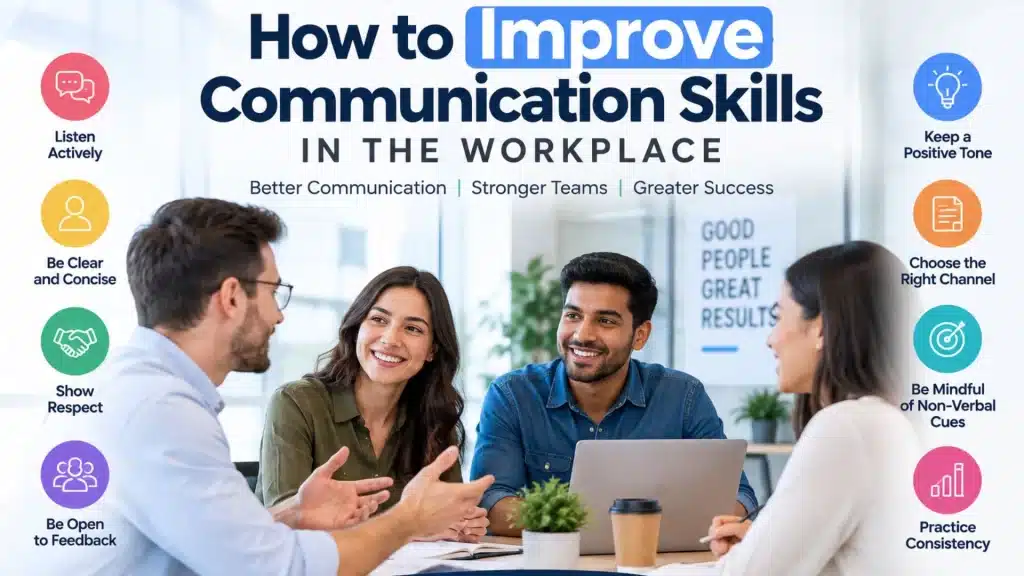
Don’t try to fix everything about how you communicate at once. Pick one thing. Listen more carefully. Clean up your emails. Ask better questions. Sit with a hard conversation instead of avoiding it. Explain your ideas in fewer words. Ask someone how you’re actually coming across. Then move to the next thing.
The best communicators aren’t usually the ones talking the most. They’re the ones who understand what’s being asked of them, say what they mean clearly, and adjust to whoever’s in front of them.
For anyone trying to move their career forward, this isn’t a soft skill sitting off to the side, it’s one of the most practical advantages you can build. One clearer conversation at a time.
Frequently Asked Questions
What’s the best way to improve communication skills at work?
Consistent, small practice, active listening, clearer writing, sharper questions, feedback that’s specific instead of vague, and adjusting your style to the person in front of you. Ask people you trust for honest feedback so you know what to actually work on.
What are the five most important workplace communication skills?
Active listening, clear speaking, effective writing, nonverbal awareness, and constructive feedback. As you move into leadership, problem-solving and conflict management start to matter just as much.
How can I get better at this quickly?
Three habits, starting today: pause before you respond, listen without planning your reply while the other person is still talking, and lead with your main point before adding the supporting details.
Why does communication matter for career growth specifically?
It’s how you explain ideas, build trust, resolve friction, influence decisions, and lead people. Employers consistently rank it near the top of what they’re actually looking for.
Does career coaching actually help with this?
It can structure feedback on how you come across in interviews, meetings, and day-to-day conversations often surfaces habits you genuinely can’t see on your own. The right coach also helps you connect communication skills to how you present your value to employers.
Also Read: How to Negotiate Salary