Career growth doesn’t just happen because you work hard. You can genuinely be good at your job and still feel uncertain about what comes next. Maybe you want a promotion but aren’t sure how to position yourself for it. Maybe your responsibilities have shifted and your skills haven’t quite caught up. Or maybe you’re ready for a career change but can’t figure out how to turn what you already know into a new opportunity.
This is where professional development coaching genuinely earns its place.
It gives you structured support for building skills, sharpening your performance, setting real career goals, and making smarter decisions instead of relying on trial and error. You’re working with someone who helps you understand where you actually stand and builds a realistic plan for where you want to go.
For U.S. professionals navigating a shifting job market, this kind of support matters more than it used to. The World Economic Forum’s Future of Jobs Report 2025 found nearly 39% of the skills required on the job are expected to change by 2030, and 85% of surveyed employers expect to prioritize workforce upskilling going forward.
Professional growth isn’t just about getting better at your current job anymore. It’s about staying genuinely ready for whatever’s next.
What Professional Development Coaching Actually Is?
At its core, it’s a personalized coaching program built to help professionals improve their skills, performance, confidence, career direction, and long-term employability.
A coach works with you to identify real goals and turn them into practical action. This is genuinely different from a class or online course, because the guidance is built around your actual situation, not a generic curriculum.
Depending on what you need, coaching can touch career planning, leadership development, communication skills, executive presence, professional confidence, career advancement, job-search strategy, interview prep, resume positioning, networking, time management, decision-making, workplace relationships, career transitions, and transferable skills.
The point was never just collecting more certifications to pad a resume. Effective coaching helps you understand which skills actually matter for your specific goals, and how to demonstrate them in a way that actually lands with the people evaluating you.
That distinction genuinely matters. An IT manager aiming for a director role probably doesn’t need another general management course; they likely need to sharpen strategic communication, delegation, stakeholder management, and executive-level decision-making instead. A good coach is what actually identifies that gap for you.
Why Does This Matters So Much Right Now?
The workplace is shifting fast. Technology’s reshaping job responsibilities while employers lean harder into adaptable, transferable skills.
LinkedIn’s 2025 Workplace Learning Report backs this up from another angle. 91% of learning and development professionals agree continuous learning matters more than ever for career success, and career progress ranks as the number one motivator for why people actually choose to learn something new.
Which means you can’t always count on your employer to chart your development path for you. You need a real sense of your own direction.
That’s really where professional development coaching earns its keep; it connects learning directly to a specific professional goal. Instead of asking “what skill should I learn next,” a more useful question becomes: “what skill will actually make me more competitive for the role I want?” That’s a much sharper question to be working from.
What a Coach Actually Does?
A professional development coach functions as a structured thinking partner, someone who helps you examine where you actually stand, spot real opportunities, work through obstacles, and build a plan you can actually follow.
Identifying Strengths and Gaps You Might Be Underselling
You probably already have valuable skills you’re quietly discounting. A project manager might think of themselves purely as “someone who manages projects” a coach might help them recognize they’ve also built real experience in stakeholder management, risk assessment, cross-functional leadership, budgeting, and strategic planning along the way. Those turn out to be genuine career assets, once you actually name them.
Setting Goals Specific Enough to Actually Work Toward
Vague goals are hard to hit. “I want to advance my career” doesn’t give you much to aim at.
A sharper version might be: move from manager to director within 12 months, transition from finance into corporate strategy, build stronger executive communication skills, get more confident in leadership meetings, prepare for a senior-level search, or build a real plan for switching industries. Specificity gives the whole coaching process something concrete to point toward.
Building an Actual Action Plan
A coach helps break a big objective down into manageable steps: identify the target position, research what it actually requires, compare that against your current experience, spot the real gaps, gather evidence of relevant accomplishments, update your positioning, strengthen your network, prepare for interviews, and track progress along the way. All of that turns a vague ambition into something a lot more manageable to actually work through.
The Real Benefits
What you get out of coaching depends on your goals and how actively you engage but a few benefits show up consistently:
1. Genuine Career Clarity
A lot of professionals know they want something different without being able to name exactly what that is. Coaching helps you actually evaluate your interests, experience, strengths, priorities, and real options — especially useful if you’re weighing a career change and need help sorting through it methodically rather than just guessing.
2. Stronger Professional Positioning
Your experience has real value, but employers need to grasp it quickly. A coach helps you communicate your accomplishments more effectively across your resume, LinkedIn, interviews, and networking conversations.
Skip “Managed a sales team” and get to the actual business impact: “Led a 12-person sales team and increased regional revenue by 18% over two years.” The second version gives an employer something measurable to actually evaluate.
3. Sharper Leadership Skills
Professional development isn’t limited to technical ability. As you move up, communication, leadership, collaboration, and decision-making matter more and more. Coaching helps build these capabilities in the context of your actual, real work, not abstract theory.
4. Genuine Confidence in Hard Decisions
Career decisions come loaded with uncertainty:
- Take the promotion or not?
- Apply elsewhere? Switch industries?
- Push for more responsibility?
- Negotiate harder on pay?
- A coach doesn’t make the call for you.
They help you evaluate the options with a lot more objectivity than you’d manage entirely on your own.
5. Real Accountability
Knowing what to do and actually doing it are two very different things. You might know you should update your resume, reconnect with former colleagues, sharpen your presentation skills, or start applying somewhere new but daily responsibilities have a way of pushing all of that aside indefinitely. Coaching builds in a regular structure for actually reviewing progress and keeping momentum going.
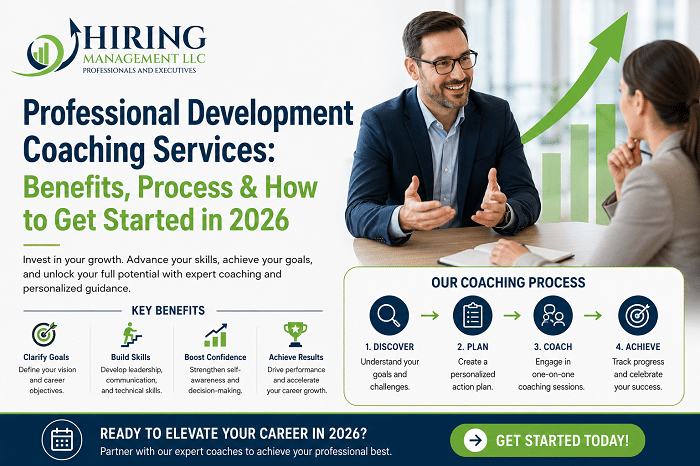
How Does the Process Usually Work?
Programs vary, but most follow a fairly similar shape.
- Initial assessment: You talk through your current role, career history, real strengths, genuine challenges, and goals giving the coach a real starting point to work from.
- Goal setting: You define what success actually looks like, specific enough to measure securing a leadership role, improving presentation confidence, building an executive career strategy, prepping for a transition, or strengthening your professional brand.
- Development planning: Your coach helps figure out which skills, behaviors, and strategies deserve real attention leadership coaching, communication practice, career planning, or job-search support, depending on what actually matters most.
- Coaching sessions: These give you real time to work through actual situations, maybe a hard conversation with your manager one week, prepping for an important interview the next. The most useful coaching stays tied to real problems, not generic theory disconnected from your day-to-day.
- Review and adjustment: Your goals shift as your career develops, and a good process should genuinely allow your plan to evolve alongside them, not stay locked to whatever you said in session one.
Who Actually Benefits From This?
- Early-career professionals: Might need help figuring out a direction, building confidence, and developing basic workplace skills.
- Mid-career professionals: Might be ready for a promotion, a leadership role, a career change, or a shift into a new industry entirely.
- Senior leaders: Might need support with executive presence, strategic leadership, career positioning, or a genuinely major decision.
- Professionals returning to work: After time away can use coaching to identify what actually transfers and rebuild their positioning from there.
- Career changers: Often struggle because their past experience doesn’t immediately read as relevant to a new field. Coaching helps translate what you already know into language that actually makes sense to new employers.
Coaching vs. Traditional Training
These aren’t the same thing. Training generally teaches a defined subject to a group or individual. Coaching is a lot more personalized.
A leadership training course might teach delegation techniques in the abstract. A coach helps you apply those same techniques to your actual team, in your actual situation. Training asks “what do you need to learn?” Coaching asks “how will you actually apply what you already know to your specific situation?” Both have real value and in a lot of cases, they genuinely work best together, not as substitutes for each other.
How to Actually Choose a Provider?
Picking the right one takes more than searching for whoever’s cheapest.
- Experience: Look for background relevant to your career level and goals, specifically someone who mostly coaches college students probably isn’t the right fit for a senior executive.
- Their actual approach: Ask how sessions work. Will you get assignments? How are goals measured? How often do you actually meet? Is the style highly structured or more flexible?
- Relevant expertise: Look for real experience in the specific area you need career development, leadership, executive coaching, job-search strategy, or transitions specifically.
- Practical support: Ask whether the service goes beyond just talking. For a lot of professionals, actual resume reviews, interview prep, positioning work, or practicing hard conversations adds a lot more value than conversation alone.
- Credentials and standards: These don’t automatically guarantee quality, but real training and recognized credentials are useful additional evidence of preparation. Ask about education, certifications, experience, and specialization directly.
- Fit: Maybe the most overlooked factor of all. You need to feel genuinely comfortable being honest about real challenges. A coach can have impressive credentials on paper and still not be the right match for your communication style or your actual goals.
What Does This Look Like in Practice?
Take a marketing manager who’s spent eight years in the same industry, wants a director-level role, and keeps getting passed over for it.
Through coaching, she realizes her resume leans heavily on tasks rather than leadership outcomes. Her coach helps her pull out real examples of revenue growth, team leadership, cross-functional projects, budget management, strategic planning, process improvements — and she changes how she actually presents that experience.
The coaching didn’t magically invent new qualifications for her. It helped her recognize and communicate leadership experience she already genuinely had. That’s an important distinction: good coaching should help you make better use of the strengths you already possess, while developing whatever you genuinely need next.
Where This Connects to Career Positioning?
Professional development and career positioning are tightly linked. You can build genuinely excellent skills and still struggle to advance if employers simply don’t understand your value clearly.
This is exactly where a hiring-manager-focused approach helps combining value identity, professional branding, career coaching, interview prep, and career transition support, all built around helping professionals understand and communicate the value they genuinely bring to an employer.
If you’re preparing for a move, it’s also worth looking at resume optimization support specifically, since how your experience is actually presented can matter as much as the experience itself. And if you’re weighing a bigger career shift, dedicated career counseling resources are a useful additional starting point.
The broader lesson underneath all of this: professional development should always connect back to a real career objective, not exist as improvement for its own sake.
Bringing It All Together
Your career was never obligated to follow one fixed path. Skills shift. Industries evolve. Companies restructure without warning. New opportunities show up when you least expect them. And your own priorities change too, sometimes more than you’d expect.
Which is exactly why professional development works best as an ongoing process, not something you scramble to think about only once you need a new job.
The right coaching can genuinely turn career uncertainty into a real, practical development plan. A qualified coach can help you identify your actual strengths, close the skill gaps that genuinely matter, sharpen your professional positioning, and make career decisions with a lot more confidence than you’d manage alone.
Start with one clear objective:
- Do you want a promotion?
- A leadership role?
- A full career change?
- Better communication? More confidence in the room?
- A stronger professional brand?
Once you know what you’re actually working toward, it gets a lot easier to figure out what development you genuinely need to get there.
The most useful coaching was never about changing who you are. It’s about helping you recognize the strengths you already have, build the capabilities you actually need next, and present your value with a lot more clarity than you had before you started.
FAQ
What are professional development coaching services, exactly?
Personalized guidance built to help professionals improve their skills, clarify career goals, strengthen their performance, prepare for advancement, and navigate genuine career changes.
Is this actually worth it?
It can be, especially when you have a real goal and want structured guidance, genuine accountability, and an outside perspective. The value depends on your goals, the coach’s actual expertise, and how actively you apply what comes out of it.
What does a coach actually do, in practice?
Helps you identify real strengths and gaps, set genuine career goals, build an action plan, work through actual professional challenges, and stay accountable for real progress along the way.
How long does this typically take?
With no universal timeline some professionals need just a handful of sessions to address one specific goal, while others benefit from ongoing coaching through a promotion, a transition, or a longer leadership development plan.
What’s the difference between career coaching and professional development coaching? Career coaching tends to focus on direction, job searches, transitions, and specific career decisions. Professional development coaching often has a broader scope — skill-building, workplace performance, leadership, confidence, and longer-term growth. In practice, the two overlap a lot.
Your next opportunity might depend less on what you already know today, and more on how intentionally you prepare for what’s coming.
Also Read: 10 Resume Mistakes to Avoid