
Career decisions rarely come with a clear instruction manual. You may know you want a better job but not know what direction to take. You may be qualified for a promotion but struggle to communicate your value. Or you may be doing well in your career while wondering what your next step should be.
This is where professional coaching services can provide useful structure.
A professional coach gives you an outside perspective and helps you turn a general goal into a practical plan. Depending on the type of coaching you choose, the work may focus on career growth, leadership, executive performance, job searching, communication, or a major professional transition.
The coaching industry has also become much more established. According to the International Coaching Federation’s 2025 Global Coaching Study, there were an estimated 122,974 coach practitioners worldwide, up 15% from 2023.
But a growing industry also means more choices.So how do you know which professional coaching services are right for you? What does coaching actually include? How much does it cost? And how can you avoid paying for a service that does not match your goals?
What Are Professional Coaching Services?
Professional coaching services are structured, goal-oriented programs that help individuals improve their professional performance, make career decisions, develop skills, or reach specific career goals.
A professional coach does not simply tell you what career to choose or give you a list of jobs to apply for. The better approach is collaborative.
A coach may help you:
- Clarify your professional goals
- Identify strengths and development areas
- Recognize career obstacles
- Improve leadership skills
- Build confidence
- Prepare for interviews
- Strengthen your professional positioning
- Navigate a career change
- Improve workplace communication
- Prepare for a promotion
- Develop an actionable career plan
- Stay accountable to your goals
The exact service depends on the type of coaching and the provider. This distinction is important because professional coaching is not the same as therapy, consulting, or traditional mentoring.
A therapist generally focuses on mental health and emotional well-being. A consultant is typically hired to provide expertise and solutions to a business problem. A mentor often shares personal experience and advice.
A professional coach generally helps you think through your own situation, identify possibilities, establish goals, and take action.
What Are the Main Professional Coaching Types?
One of the first decisions you need to make is choosing the right type of coaching. There is no single form of professional coaching that works for everyone. Your goal should determine the service you choose.
1. Career Coaching
Career coaching is useful when you are unsure about your direction, searching for a new role, considering a career change, or preparing for advancement.
A career coach may help with:
- Career planning
- Job-search strategy
- Resume positioning
- Interview preparation
- Career transitions
- Professional branding
- Promotion strategy
- Salary discussions
For example, imagine a marketing manager who has spent 10 years in the same industry but wants to move into a director-level role. A career coach can help identify the experience that supports the move and develop a strategy for presenting that experience to employers.
Job Change Now takes a career-focused approach that includes value identity, brand identity, hiring-manager insight, and career support. Its career coaching services are designed around helping professionals communicate their value and navigate career decisions.
2. Executive Coaching
Executive coaching is designed for senior professionals such as directors, vice presidents, CEOs, and other organizational leaders.
Common areas include:
- Executive presence
- Strategic decision-making
- Leadership effectiveness
- Communication
- Team management
- Delegation
- Stakeholder relationships
- Career advancement
- Executive transitions
Executive coaching may be especially valuable when the consequences of a decision are significant.
For example, a newly promoted VP may be excellent at technical work but need to develop a different leadership style for managing senior managers. Coaching can provide a confidential environment to work through those challenges.
3. Leadership Coaching
Leadership coaching focuses on how professionals lead and influence others.
It can benefit:
- New managers
- Department heads
- Directors
- Emerging leaders
- Senior executives
Leadership coaching may address delegation, difficult conversations, feedback, conflict management, team motivation, and decision-making.
The goal is not simply to become a more confident manager. It is to become more effective at helping other people perform well.
4. Performance Coaching
Performance coaching focuses on improving specific professional behaviors or results.
For example, an employee may consistently meet technical expectations but struggle with presentations. A professional coach can help the person prepare, practice, receive feedback, and develop a repeatable approach. This type of coaching works particularly well when the goal is specific and measurable.
5. Career Transition Coaching
Career transition coaching is useful when you are moving between industries, roles, companies, or professional identities.
Consider an experienced operations manager who wants to move into consulting. The person may already have valuable skills but need help identifying transferable experience and repositioning their background.
A coach can help turn “I have never worked in consulting” into a stronger professional story based on problem-solving, leadership, client communication, and business results.
For professionals considering a major career change, Job Change Now also provides career transition support.
What Are the Benefits of Professional Coaching?
The biggest coaching benefits depend on your goals and how actively you participate in the process. However, several benefits appear consistently across professional coaching situations.
Greater Clarity
Career problems often become confusing because too many issues are mixed together. You may dislike your manager, but the deeper problem could be a lack of growth. You may think you need a new industry when you actually need a different role. A professional coach can help separate the symptoms from the underlying issue.
Better Decision-Making
Important career decisions deserve more than an emotional reaction. A coach can help you compare options, identify risks, consider long-term consequences, and create a decision-making framework.
This is particularly useful when you have two or three attractive opportunities and cannot determine which one fits your long-term goals.
Stronger Accountability
Knowing what you should do and actually doing it are two different things. You may know that you need to update your resume, contact your network, prepare for interviews, or ask for a promotion. Weeks can pass without meaningful progress. Regular coaching creates an external accountability structure.
Improved Professional Confidence
Confidence becomes stronger when it is based on evidence. A good coach can help you identify accomplishments that you have overlooked and understand the skills behind those accomplishments. This becomes particularly valuable during interviews and compensation discussions.
A More Focused Career Strategy
Instead of applying for every job that looks remotely relevant, you can develop a more targeted strategy.
For example:
Weak approach:“I am open to anything in business.”
Stronger approach:“I help technology companies improve operational efficiency through process improvement, cross-functional leadership, and scalable systems.”
The second statement gives employers a much clearer reason to remember you.
What Does a Professional Coaching Program Include?
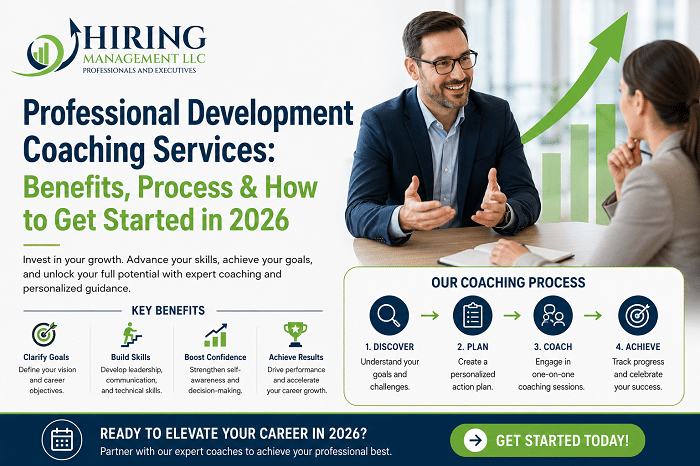
There is no universal format. However, many professional coaching services follow a structure similar to this:
Step 1: Assessment
The coach learns about your background, goals, challenges, strengths, and priorities.
Step 2: Goal Setting
You identify specific outcomes.
Instead of saying “I want career growth,” you might set a goal such as:
“I want to position myself for a director-level role within the next 12 months.”
Step 3: Action Planning
The coach helps you identify the steps needed to move forward. These may include networking, skill development, professional branding, interview preparation, leadership development, or job-search activities.
Step 4: Coaching Sessions
Sessions provide space to review progress, discuss obstacles, challenge assumptions, and adjust your strategy.
Step 5: Accountability
You track what you agreed to do and evaluate what happened. This cycle repeats until you reach your objective or determine that the goal needs to change.
How Much Do Professional Coaching Services Cost?
There is no standard price for professional coaching. The cost can vary significantly depending on:
- The coach’s experience
- Type of coaching
- Client’s career level
- Program length
- Number of sessions
- Individual or corporate sponsorship
- Assessments included
- Additional career services
- Level of ongoing support
Instead of asking only, “How much does a professional coach cost?” ask, “What am I receiving for the investment?”
A low-cost session may not be useful if you need months of structured support. Conversely, an expensive program may not be worthwhile if it provides generic advice.
For context, Job Change Now currently packages list a $499 one-time annual subscription and includes access to hiring-manager staff, email advice and document review, answers to job-search questions, 12 digital Member Reports, and a 111-page Member Handbook.
That model is different from traditional hourly coaching, so it is important to compare the scope of service rather than price alone.
How to Choose the Right Professional Coach
Choosing a professional coach should be treated like any other important professional decision.
Start with your goal.
Do you need help changing careers? Are you preparing for a promotion? Are you trying to become a better leader? Are you looking for help with a job search? Your answer will narrow the field.
Look at Relevant Experience
A coach who specializes in executive leadership may not be the best fit for someone trying to select their first career.
Likewise, a coach who primarily works with college graduates may not understand the complexity of a C-suite transition. Look for experience that matches your situation.
Ask About the Coaching Process
A credible provider should be able to explain what happens during the engagement.
Ask:
- How are goals established?
- How often do sessions occur?
- How is progress measured?
- What happens between sessions?
- What support is available?
- How long does a typical engagement last?
Avoid providers who cannot explain their process clearly.
Consider Credentials and Professional Standards
Credentials are not the only indicator of quality. However, professional training and ethical standards matter.
Credentials should therefore be one factor in your evaluation rather than the only factor.
Evaluate the Chemistry
Coaching requires honesty.
You may need to discuss mistakes, weaknesses, career fears, difficult relationships, or decisions that you have been avoiding.
If you do not trust the person you are speaking with, the coaching relationship may never reach its full potential.
An introductory consultation can help you determine whether the relationship feels natural and productive.
A Practical Example: When Coaching Makes a Difference
Consider a 42-year-old sales director who has been successful for years but feels stuck.
She earns a good salary. Her performance is strong. Yet she has not been promoted and does not know why.
Instead of immediately searching for another job, she works with a professional coach.
During the process, she realizes that most of her professional story focuses on individual sales achievements. Her target VP positions require evidence of organizational leadership.
The coaching process helps her reposition her experience around:
- Revenue growth
- Team development
- Cross-functional leadership
- Strategic planning
- Customer retention
- Organizational impact
She then changes how she presents her experience in her resume, interviews, networking conversations, and LinkedIn profile.
The lesson is important.
Sometimes the problem is not a lack of experience. It is a failure to communicate the experience you already have.
How Job Change Now Fits Into Professional Coaching
Job Change Now approaches career development from a hiring-manager perspective.
The organization was founded by Larry Anderson after a 45-year professional career that included 30 years in business executive roles. The company was created to provide job seekers and professionals with career guidance and access to hiring-manager expertise.
Its approach emphasizes areas such as:
- Value Identity
- Brand Identity
- Value Statements
- Hiring-manager perspective
- Interview preparation
- Career transitions
- Compensation discussions
- Long-term career support
This can be particularly useful for professionals who do not simply want to talk about their career but want practical help positioning themselves in the employment market.
The Job Change Now career coaching approach focuses on helping professionals understand and communicate their value.
Executives can also explore executive career coaching services when preparing for senior-level transitions and leadership opportunities.
When Should You Hire a Professional Coach?
You do not need to be struggling to benefit from coaching. Consider professional coaching if:
- You feel stuck in your career.
- You are preparing for a promotion.
- You want to change industries.
- You are searching for a new job.
- You have difficulty communicating your professional value.
- You are entering a leadership role.
- You need accountability.
- You are facing a major career decision.
- You want an outside perspective before making an important move.
The best time to seek help is often before a problem becomes expensive. For example, getting career advice before accepting a poor-fit leadership position may save you months of frustration.
Final Thoughts
The right professional coaching services can give you something that is difficult to create alone: a structured space to think clearly about your career and take deliberate action.
Coaching is not a magic solution. It cannot guarantee a promotion, job offer, or specific salary. What it can provide is perspective, accountability, strategy, and a clearer way to approach important professional decisions.
That growth gives professionals more choices. It also makes careful selection more important. Before hiring a coach, define what you want to change.
Then find a professional coach whose experience, process, and communication style match that goal.
For professionals who want career guidance that combines professional positioning with hiring-manager insight, Job Change Now offers a broader career advisory approach. You can review its benefits and pricing or contact Job Change Now to discuss your career objectives.
The most valuable coaching is not about giving you all the answers. It is about helping you ask better questions, recognize your value, make smarter decisions, and take the next step with greater confidence.
FAQ
What are professional coaching services?
Professional coaching services provide structured guidance to help people achieve career and professional goals. Depending on the service, coaching may focus on career planning, leadership, executive development, job searches, performance, communication, or career transitions.
What are the main types of professional coaching?
The most common professional coaching types include career coaching, executive coaching, leadership coaching, performance coaching, and career transition coaching. The best option depends on your specific goals and career stage.
Is professional coaching worth the cost?
Professional coaching can be worthwhile when it addresses a specific problem or goal and provides practical support and accountability. The value depends on the coach, your objectives, the quality of the relationship, and how consistently you apply the coaching.
How do I choose a professional coach?
Start by identifying your goal. Then evaluate the coach’s relevant experience, credentials, methodology, communication style, client feedback, pricing, and level of support. A consultation can help determine whether the coach is a good fit.
How long does professional coaching take?
There is no universal timeline. Some people need a few sessions for a specific issue. Others benefit from several months of support while navigating career changes, leadership development, or a major job search.
Also Read: 10 Resume Mistakes to Avoid