When a recruiter reaches out about a job, it can feel like a genuinely big deal. But getting a message from a recruiter isn’t the same thing as getting a great offer.
How you actually handle those conversations shapes the entire process that follows. Your first call can influence how the recruiter presents you to the employer. How you answer salary questions can shape everything that comes after in negotiations. Even the questions you ask can determine whether you learn something important about the role before sinking hours into interviews for it.
Which is exactly why learning to handle recruiters well is such a genuinely useful part of a job search.
Recruiters aren’t just people who schedule interviews. They can be a real source of insight into the employer, the role, the pay, the process, and what’s actually expected. But it’s worth remembering a recruiter usually works for the employer, not for you. Your interests and the company’s often overlap, but they’re not identical, and it helps to keep that in mind throughout.
The goal was never avoiding recruiters or treating them like an opponent. It’s building a genuine professional relationship while still protecting your own interests along the way.
Why Does This Actually Matters?
The U.S. job market is still competitive. LinkedIn reported 58% of people surveyed expected to be job hunting in 2025, and 73% of HR professionals said fewer than half the applications they received actually met all the listed criteria.
That gap creates real opportunity for candidates who are genuinely qualified. If a recruiter is reaching out to you specifically, they likely already believe your background lines up with an actual opening which means you shouldn’t approach the call like you’re just asking for any job that’ll take you.
Treat it instead as an evaluation running in both direct
ions. You’re trying to figure out: is this job actually right for me? What does the company genuinely need? What’s the real pay range? Why was I specifically contacted? Who’s the hiring manager? What are the biggest challenges baked into this role? How does my experience actually solve those? What does the interview process look like?
Handling the First Conversation
That first call usually isn’t the moment to tell your entire career story. The recruiter’s trying to figure out whether you’re a real match. You’re trying to figure out whether this is even worth your time.
Let Them Actually Describe the Opportunity First
Start by asking the recruiter to walk you through the role. Useful things to ask:
- What’s the actual title?
- Why is the company hiring for this now?
- Is it a new role or a replacement?
- Who would I report to?
- What are the most important responsibilities?
- What matters most to the hiring manager specifically?
- Where’s it based, and is it remote, hybrid, or fully onsite?
- What’s the expected salary range?
- What does the interview process actually look like?
These questions often surface details you’d never get from the posting alone.
Don’t Rush to Say Yes
One of the most common mistakes is getting overly enthusiastic before you actually understand the opportunity. You can be interested without committing on the spot. Something like:
“This sounds interesting. I’d like to understand the role and compensation structure a bit better before deciding whether it’s a strong fit.”
keeps things professional. You’re not rejecting the recruiter, you’re just gathering information before making a real decision.
Ask Why They Actually Reached Out to You
One of the most genuinely useful questions you can ask in this whole process:
“What specifically about my background caught your attention?”
The answer tells you what the recruiter thinks your strongest selling point actually is. If they mention your leadership experience, technical background, industry knowledge, or revenue results, you now know exactly what to lean into for the rest of the process and it can quietly inform your broader career strategy too.
Handling the Salary Question
This is usually the most uncomfortable part of dealing with recruiters. A lot of candidates either blurt out a number too fast, or refuse to engage with the topic at all. Neither approach really works.
The better move is understanding the role and doing your own market research before committing to a firm number. Indeed’s current guidance backs this up by researching your comp early so you’re not stuck inventing an expectation on the spot during a call, and weighing the whole compensation package, not just base salary.
If you genuinely don’t know enough about the role yet, you can say:
“I’d like to learn more about the responsibilities and expectations before giving a specific number. What salary range has the company budgeted for this position?”
That puts the conversation back into proper context. Once they give you a range, you can compare it against your own research.
If you already know your target, be ready to explain why you are grounded in your relevant experience, specialized skills, leadership scope, industry background, geographic market, certifications, measurable accomplishments, the actual scope of the role, and current market rates.
Skip:
“I need $120,000 because my expenses are high.”
Go with:
“Based on the scope of the position, my experience leading similar projects, and market compensation for comparable roles, I’m targeting the $115,000 to $125,000 range.”
The second version ties your expectation directly to your professional value, not your personal budget.
Handling the Actual Negotiation
This gets easier once you stop thinking purely about salary. Your total compensation can include base pay, an annual bonus, a signing bonus, equity or stock, PTO, retirement contributions, health benefits, remote or hybrid flexibility, professional development funding, relocation help, severance terms, and performance-based pay. Indeed’s current guidance echoes this to weigh benefits and other forms of compensation alongside the base number.
Say you get an offer of $105,000 base, a 10% bonus, 15 days PTO, and a 3% employer 401(k) match but you were hoping for $115,000. Instead of rejecting it outright, ask whether there’s flexibility in the overall package:
“I’m very interested in the role. Based on the responsibilities and my experience, I was targeting something closer to $115,000. Is there flexibility in the base salary?”
If they say the base is fixed, follow with:
“If the base can’t move, would there be flexibility with the signing bonus, additional PTO, or another part of the package?”
That’s a much stronger move than a flat “can you pay me more?”
Handling an Actual Offer
Getting an offer can feel genuinely exciting, but don’t let that excitement rush you into accepting on the spot. Ask for it in writing first. You want the job title, base salary, bonus structure, benefits, start date, work location, reporting structure, PTO, any equity, employment conditions, contingencies, and the actual deadline for accepting. Indeed recommends reviewing the official offer carefully and getting the important details documented before you say yes to anything.
Don’t Negotiate Before You Actually Understand the Offer
Say a recruiter calls and says: “The company would like to offer you $95,000.” Don’t jump straight to “Can you make it $105,000?” Instead, try:
“Thank you, I’m genuinely excited to hear that. Could you send over the complete offer so I can review the full compensation and benefits?”
Once you’ve got the full picture, you’re negotiating from actual information instead of a single number floating in isolation.
A Simple Framework for This Conversation
Appreciate → Clarify → Justify → Ask → Pause.
Appreciate. Start positive: “Thank you for the offer — I’m very excited about this opportunity.”
Clarify. Make sure you actually understand the package: “Could you clarify how the annual bonus is structured?”
Justify. Tie your ask directly to your value: “Given my experience managing teams of this size and delivering similar results, I was targeting a higher base salary.”
Ask. Be specific: “Would you be able to move the base to $115,000?”
Pause. Let them respond. Don’t rush to fill the silence, candidates often quietly undercut their own negotiation just by talking past the point where they should’ve stopped.
Handling Pressure
Some recruiters will create urgency, sometimes genuinely, sometimes as a tactic. You might hear things like “we need an answer today,” “this is the best offer,” “there are other candidates,” “the company doesn’t negotiate,” or “this is already at the top of the range.”
You don’t need to get confrontational about any of it. Stay professional:
“I understand the timeline. I want to make a thoughtful decision because I’m genuinely interested in this. Could you give me until [date] to review everything?”
If the offer’s only been given verbally, ask for it in writing. If compensation feels unclear anywhere, ask for clarification. If something matters to you, get it documented rather than trusting it’ll hold up on memory alone. Indeed’s guidance is pretty direct here to be straightforward in negotiations, and avoid dragging things out unnecessarily on your end.
Handling It When You’re Genuinely Not Interested
You don’t have to take every opportunity a recruiter brings you. But declining professionally protects the relationship a recruiter with nothing for you today might have exactly the right thing six months from now.
Something like:
“Thank you for reaching out. This position isn’t the right fit for me right now, but I appreciate you thinking of me. Feel free to reach out if you have future opportunities that align with my experience in [field].”
Don’t burn bridges you don’t need to. The recruiting world is genuinely smaller than most candidates realize.
Handling Multiple Opportunities at Once
Having more than one opportunity in play can give you real leverage but only if you use it professionally rather than as a threat.
If another company’s already made you an offer, it’s usually worth being transparent about it:
“I want to be upfront that I’m currently considering another offer. I’m also very interested in this opportunity, so I’d appreciate understanding your expected timeline.”
That’s very different from:
“Company X offered me $120,000, so you need to beat it.”
Give the information and let the employer respond how they will don’t turn it into an ultimatum. And if you end up comparing multiple offers, weigh the entire package against each other, not just whichever has the biggest base number. Indeed recommends the same approach when comparing offers generally.
Mistakes Candidates Commonly Make
- Giving your absolute minimum too fast: That number’s for your own decision-making it doesn’t need to become your opening bid.
- Talking too much: Answer what’s asked directly. A recruiter call doesn’t need to turn into a 20-minute career.
- Treating recruiters like the final decision-maker: They often don’t have full authority over salary or hiring calls. Use them to understand the process and communicate clearly not as the person with the final say.
- Accepting the first offer without actually reviewing it: This is a significant professional decision. Take the time the decision deserves.
- Negotiating with nothing behind it: A strong ask explains itself lean on market data and your own real accomplishments.
- Getting aggressive: Negotiation doesn’t have to feel like a fight. You want the recruiter and employer walking away believing you’ll be a genuinely great addition to the team, not someone difficult to deal with.
What Does This Look Like in Practice?
Say a recruiter reaches out to Sarah about a senior marketing role, mentioning the company’s offering $100,000 to $110,000. Sarah currently makes $96,000, has five years of relevant experience, and has grown qualified leads by 35% in her current job.
Instead of saying “I make $96,000 now, so I need at least $110,000,” she says:
“This role sounds like a strong fit. Based on the scope of the position and my experience driving measurable lead growth, I’d be targeting the upper end of the stated range. Could you share how the company determines placement within that range?”
That’s a stronger move because she’s tying her expectation directly to her actual value, not just her current paycheck. If the eventual offer comes in at $105,000, she’s now in a solid position to make a reasonable, well-supported counter.
That’s really the whole approach in a nutshell: prepare first, communicate clearly, and always tie what you’re asking for back to the value you genuinely bring.
Where Job Change Now Fits Into This
Handling recruiters well is just one piece of a bigger career move. You also need to know how to position your experience, communicate your value clearly, prepare for interviews, and approach compensation strategically across the board.
Job Change Now focuses on helping professionals communicate their value to employers and hiring managers, with support spanning job searches, interviews, networking, recruiter engagement, and compensation positioning including a dedicated “Handling Recruiters” section within its member resources.
For anyone preparing for a bigger move, broader coaching support can help. And if you’re already sitting with an actual offer, there’s dedicated guidance on negotiating salary and countering a job offer worth a look too.
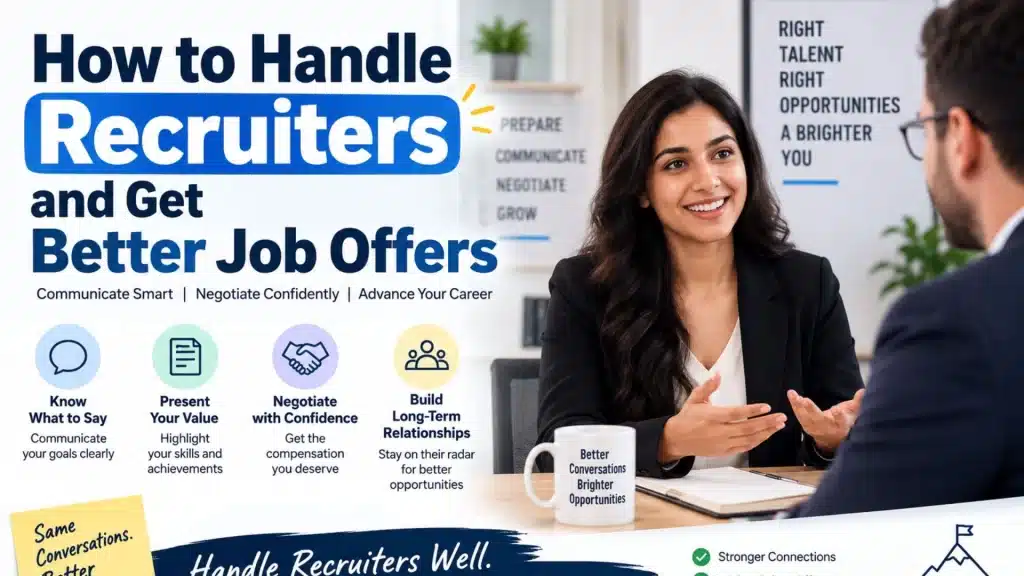
Handling Recruiters With Actual Confidence
Learning to handle recruiters well can genuinely change how you approach your entire job search.
A recruiter isn’t just someone forwarding you job descriptions. A good conversation with one can hand you real insight into the role, the employer, the pay range, and the hiring process insight you won’t get from a posting alone.
The real key is preparation. Know your professional value before you’re even on the call. Research compensation before salary comes up. Ask questions before you commit to anything. Get offers in writing. Negotiate professionally when it makes sense. And never confuse someone else’s urgency with your own need to rush a decision.
The strongest candidates don’t treat recruiters as opponents, they treat these conversations as ordinary professional business discussions, because that’s exactly what they are.
If you can clearly communicate what you bring to an employer and speak confidently about your own expectations, you’re in a much stronger position to land better opportunities and stronger offers overall.
Next time a recruiter calls, skip straight past “how much does it pay” as your first real question. Ask yourself instead: what problem does this company actually need me to solve, what value do I genuinely bring, and how do I make sure the entire opportunity, not just the number actually works for me?
That mindset alone is one of the most effective tools you have for handling recruiters and landing something genuinely better.
FAQ
Should I actually negotiate salary with a recruiter directly?
Yes, they’re often directly involved in managing or communicating compensation discussions. Research the market first, and tie your ask to your experience, skills, and the genuine value you bring.
What do I say when a recruiter asks my salary expectations?
If you don’t know enough about the role yet, ask for the company’s range first: “I’d like to learn more about the role before discussing a specific number. What range has been budgeted for this position?” If you already know the market and your target, give a reasonable range rather than an arbitrary single figure.
Should I tell a recruiter I have another offer?
Generally, yes, if you’re genuinely considering it. Be transparent without turning it into leverage or a threat just explain your timeline and your real interest in the role.
Can I actually negotiate a recruiter’s offer?
Yes, base salary and other parts of the package are often negotiable, depending on the employer. Bonuses, equity, PTO, start date, and other benefits can all be areas of flexibility, though not everything will be negotiable in every case.
What’s the biggest mistake people make with recruiters?
Treating every conversation like you have to instantly impress them or accept whatever’s offered. The better approach is listening, asking real questions, understanding the role fully, communicating your value clearly, and deciding based on the complete picture, not the pressure of the moment.
Also Read: How to Write a Standout Resume