
Succeeding as an executive was never supposed to mean figuring everything out entirely on your own. Senior leaders face genuinely complex decisions constantly managing teams, absorbing pressure from stakeholders, navigating career shifts, and making calls that ripple across an entire organization.
Which is exactly why more executives are turning to executive coaching for structured guidance and a genuine outside perspective.
Coaching can help leaders sharpen decision-making, strengthen communication, build out leadership skills, prepare for bigger roles, and navigate real career transitions. A good executive coach doesn’t just tell you what to do, they help you get clear on your goals, push back on your own thinking where it needs it, spot blind spots you can’t see yourself, and turn all of that into practical next steps.service for your specific situation.
What Executive Coaching Services Actually Are
At the core, they’re personalized development programs built to help executives and senior professionals sharpen their leadership and hit specific
The real question for executives considering coaching isn’t whether it’s valuable in the abstract. It’s whether you’re choosing the right career or business goals.
Unlike a standard training course, this is highly individualized work. Sessions typically center on your current challenges, your actual leadership responsibilities, your career goals, and wherever you genuinely want to improve.
A coach might work with you on leadership and management skills, executive presence, strategic decision-making, communication, conflict management, delegation, team development, career advancement, transitions, interview prep, compensation negotiation, professional confidence, or work-life effectiveness.
The exact shape of this varies a lot. Some executives bring in a coach for one specific challenge. Others treat coaching as part of a longer-term development strategy.
The goal was never making you dependent on a coach. Good coaching should leave you more self-aware, more confident, and genuinely more capable of handling the next challenge on your own.
Why Executives Are Actually Turning to Coaching?
Executive roles come with a strange, isolating problem the higher you climb, the fewer people around you can give you genuinely honest feedback.
A CEO might not feel comfortable discussing a leadership mistake with the people who report to them. A newly promoted VP might hesitate to admit real uncertainty to their peers. A senior executive weighing a career change might not know who they can actually trust with something that confidential.
A coach offers a genuinely confidential space for exactly these conversations. The research backs up how much this field has grown. The International Coaching Federation’s 2025 Global Coaching Study found the worldwide coaching profession had reached 122,974 practitioners, generating an estimated $5.34 billion in annual revenue based on more than 10,000 responses across 127 countries.
The takeaway here is pretty clear: executive coaching isn’t just for leaders who are struggling. Plenty of genuinely successful executives use it to sharpen their edge and get ready for whatever’s next.
What Coaching Can Actually Help You Achieve
The strongest coaching engagements are tied to measurable goals, not vague promises about “becoming a better leader.”
An executive might start coaching after being promoted into a bigger role and finding they’re struggling to actually delegate. Another might need to build up their executive presence before stepping into a C-suite seat. Here’s what this tends to look like in practice.
1. Sharpening Leadership Effectiveness
Leadership only gets more complicated as your responsibilities grow. You might need to shift from managing individual contributors to managing other managers, or find ways to influence people who don’t even report to you directly.
Coaching here typically means examining how you communicate, how you delegate, how you motivate people, how you give feedback, and how you actually handle the harder conversations that come with the territory.
2. Building Real Executive Presence
Executive presence was never really about dressing well or sounding confident in a room. It’s about how effectively you communicate ideas, hold up under real pressure, make decisions, and build genuine trust with the people around you.
A coach can help you spot behaviors that might be quietly shaping how others perceive your leadership, in ways you might not even notice yourself.
3. Making Sharper Strategic Calls
Executives almost never have perfect information going into a decision. You might be weighing a new position, restructuring a team, negotiating an offer, considering an industry switch, or deciding whether to stay put entirely.
Coaching gives you a structured space to actually work through the situation, rather than making a major call purely on emotion or whatever short-term pressure happens to be loudest that week.
4. Preparing for the Next Step Up
Sometimes advancing isn’t just about doing excellent work, it’s about knowing how to actually communicate your value to the people deciding your next move.
That can mean refining your professional brand, sharpening your resume, tightening your interview approach, and getting ready for compensation conversations. Job Change Now leans heavily into this piece specifically, helping professionals communicate their value to hiring managers through value identity, brand identity, and genuine hiring-manager insight.
5. Navigating a Real Career Transition
Executives sometimes reach a point where their current role just doesn’t fit their goals anymore moving from operations into strategy, shifting from a corporate seat into consulting, preparing for a C-suite position, or switching industries entirely.
In these moments, structured coaching can bring real shape to what would otherwise feel like a fairly disorienting transition. Job Change Now also offers dedicated career transition support built around industry moves, promotions and strategic positioning.
What a Coaching Program Actually Includes?
Every provider runs things a bit differently, but a professional program tends to follow a few consistent stages.
- Initial assessment: Usually starts with an honest conversation about your current role, real challenges, strengths, and goals. Some coaches bring in formal assessments, structured interviews, or 360-degree feedback as part of this.
- Goal setting: You and your coach nail down clear objectives together. Instead of something vague like “I want to become a better leader,” a sharper goal looks more like: “I want to improve delegation and team accountability so I can spend more time on strategic priorities.” Specific goals are just easier to actually measure progress against.
- Personalized sessions: These might run weekly, biweekly, or on whatever cadence fits your needs. A typical one might involve reviewing recent progress, digging into a current leadership challenge, working through different approaches, landing on a specific action, and agreeing on what to check back on before the next session.
- Accountability: One of the most genuinely practical benefits of coaching. It’s easy to say you’ll communicate better or delegate a lot harder to actually shift your behavior consistently over time. A coach is what turns that intention into something you actually follow through on.
Executive Coaching vs. Leadership Coaching
These terms get used interchangeably a lot, and they genuinely overlap, but they can carry different emphases.
Executive coaching tends to focus on senior leaders and the issues tied specifically to their role, career, performance, and organizational responsibilities. Leadership coaching applies more broadly, often reaching managers and emerging leaders earlier in their trajectory.
A new manager might need leadership coaching just to learn how to actually manage a team for the first time. A VP might use executive coaching specifically to prepare for a C-suite move. A CEO might work with a coach on strategic decision-making and broader executive effectiveness. Which one fits depends heavily on your level, your goals, and the specific challenge in front of you.
What Does This Actually Cost?
There’s no single standard price here. Cost shifts based on the coach’s experience, credentials, the seniority of the executive involved, the specific specialization, program length, whether it’s individually funded or company-sponsored, session frequency, and whether additional assessments or services are bundled in.
Rather than choosing purely on price, it’s worth weighing the actual value of solving the problem at hand. If you’re negotiating a major executive offer, for instance, sharper preparation can have financial significance that dwarfs the coaching fee itself many times over.
Job Change Now, for reference, currently offers a one-year membership including access to hiring-manager staff, document review and advice, 12 digital Member Reports, and a Member Handbook, currently listed at $499 annually. Worth comparing the actual scope of what’s included across providers, rather than just stacking up hourly rates side by side.
How to Actually Choose the Right Coach?
Finding the right executive coach is a genuinely important decision, chemistry matters, but so does real experience.
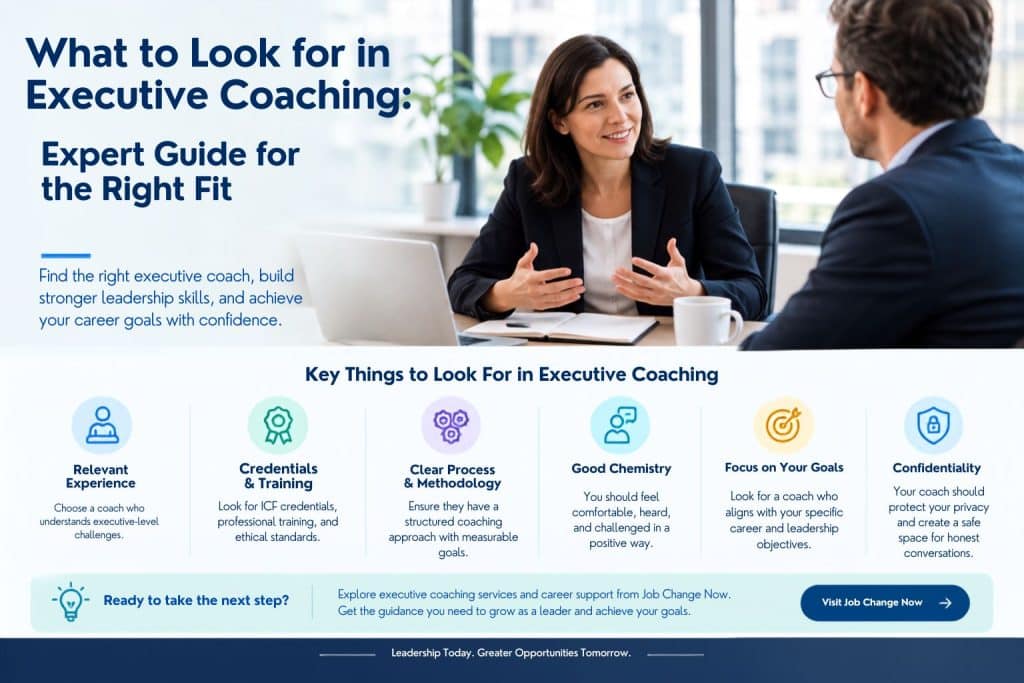
- Do they actually understand your level? A coach who mostly works with entry-level professionals probably isn’t equipped for C-suite-specific challenges. Look for experience that genuinely matches your role and stage.
- What’s their actual approach? Ask how sessions are structured, what happens between them, how goals get set, and how progress actually gets measured.
- Do they understand what you’re actually trying to achieve? Your coach should be clear on whether you’re after leadership growth, advancement, a transition, stronger executive presence, or something else entirely not applying a one-size-fits-all program regardless of what you need.
- What credentials or training do they actually have? Credentials aren’t the only signal of quality, but they’re useful evidence of real professional training.
- Can they speak to relevant experience? Ask about the kinds of executives they’ve worked with. Confidentiality means a genuinely reputable coach won’t share private client details but they should still be able to explain their broader experience and how they actually work.
What Does This Look Like in Practice?
Take a senior operations director who’s just been offered a VP role. The promotion means significantly more responsibility, and while the executive knows the technical side cold, they’re genuinely uncertain about leading a much larger organization.
Rather than waiting for problems to surface after starting, they bring in a coach before the role even begins. The work centers on delegation, executive-level communication, managing senior stakeholders, setting clear expectations, handling conflict, and building credibility with a leadership team they haven’t worked with yet.
A few months in, the executive has a much clearer leadership approach and a genuinely practical framework for handling the harder moments that come with the new role.
The real lesson here: coaching doesn’t have to start after something’s already gone wrong. It works just as well, arguably better as a proactive move.
Where Job Change Now Fits Into Executive Career Growth?
Job Change Now takes a career-focused approach that’s genuinely useful for professionals preparing for advancement, a job change or a major career decision.
The services connect career strategy with practical job-search skills, centered on value identity, professional branding, hiring-manager perspective, interviews, networking, and compensation.
For executives preparing for a real move, that broader lens matters, leadership development is valuable on its own, but if your ultimate goal is a new executive opportunity, you also need to know how to actually communicate your experience to the people deciding whether to hire you.
Job Change Now’s career coaching services focus specifically on helping professionals communicate their experience clearly, sharpen their positioning, and navigate the decisions that come with a real career move. For executives specifically prepping for compensation conversations, there’s also dedicated salary negotiation coaching built around exactly that challenge. The current membership structure and pricing are laid out on their packages page if you want the full breakdown.
Is This Actually Right for You?
The strongest executive coaching services do more than dispense advice. They build a genuinely structured space where leaders can think clearly, challenge their own assumptions, build better habits, and prepare properly for the decisions ahead of them.
You don’t have to wait until you’re struggling to bring in a coach. It’s just as useful, often more useful when you’re preparing for a promotion, stepping into a bigger leadership role, changing careers, negotiating an executive offer, or simply trying to become a more effective leader than you already are.
The real starting point is a clear objective. Ask yourself: what do I actually want to improve, change, or achieve over the next 6 to 12 months?
Once you can genuinely answer that, you’re in a much better position to evaluate executive coaching services based on real experience, methodology, support, and practical value, not just reputation or price alone.
For executives who want career guidance grounded in a real hiring-manager perspective, Job Change Now offers a broader advisory approach that connects professional development directly to career positioning and job-search strategy.
The right coaching relationship was never just about performing better today. It’s about being genuinely more prepared for whatever comes next.
FAQ
What are executive coaching services, exactly?
Personalized guidance for executives and senior professionals, covering leadership, communication, decision-making, executive presence, career advancement, transitions, and other genuinely specific professional goals.
Is executive coaching actually worth it?
It can be, especially when you have a real goal or challenge that benefits from structured guidance and genuine accountability. The value depends heavily on the coach’s quality, your own goals, how engaged you actually are, and how well you apply what comes out of it.
What does an executive coach actually do, day to day?
They help you clarify goals, examine real challenges, spot blind spots you can’t see yourself, build strategies, practice new behaviors, and stay accountable to all of it. A genuinely good coach isn’t handing out generic advice — they’re working from your specific situation.
How long does this typically take?
No universal timeline. Some executives need focused coaching for one specific challenge; others benefit from months of ongoing development. It really depends on the goal and how complex the underlying situation is.
What should I actually look for in a provider?
Relevant executive-level experience, real professional training, a coaching methodology they can clearly explain, strong communication, genuine confidentiality, relevant client experience, and a style that actually fits your personality and goals.
Also Read: 10 Resume Mistakes to Avoid