
When applying for a job, the first few lines of your resume can influence whether a hiring manager wants to keep reading. You may have strong experience, valuable skills, and impressive achievements. But if your resume introduction does not communicate your value clearly, those strengths can easily get overlooked.
This is where the resume summary vs objective question becomes important.
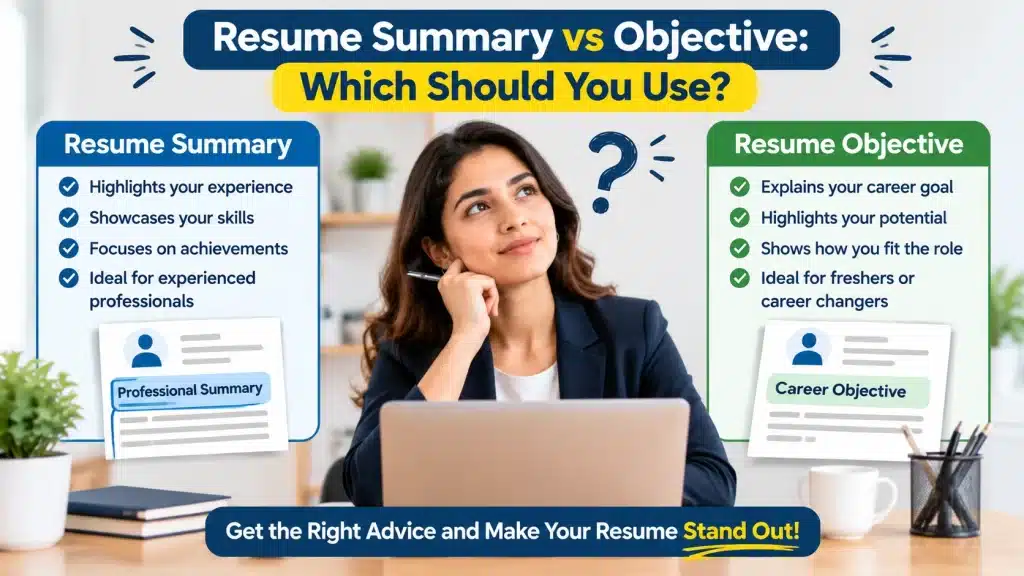
Both sections appear near the top of a resume, but they serve different purposes. A professional summary highlights what you have already accomplished and the qualifications you bring. A resume objective explains what type of position you want and how your existing skills can help you succeed in that role.
So, which one should you use?
For most experienced professionals, a professional summary is the stronger choice. Recent graduates, entry-level applicants, and career changers may benefit from a targeted objective when they need to explain their career direction.
Let’s look at the differences, practical examples, and how to choose the right option for your next job application.
What Is the Difference Between a Resume Summary and an Objective?
A resume summary highlights your professional experience, strongest skills, and relevant accomplishments. A resume objective explains the type of job you are seeking and what you can contribute to the employer.
The main difference is the focus:
- Resume summary: What you have done and what value you bring.
- Resume objective: What position you want and why your background makes you a suitable candidate.
Both are designed to introduce you to an employer quickly. However, they should not simply repeat your job history or describe what you hope to gain from the position.
According to Indeed’s June 2026 resume guidance, summaries generally focus on previous accomplishments, while objectives communicate future professional goals. Indeed also identifies career changers and people starting their careers as situations where an objective may be useful.
What Is a Professional Resume Summary?
A professional resume summary is a short introduction that highlights your most relevant experience, skills, strengths, and accomplishments.
It helps employers understand what you bring to the position before they review your employment history.
A strong summary usually includes:
- Your professional identity or current area of expertise.
- Relevant years of experience, when applicable.
- Your strongest job-related skills.
- One or two meaningful accomplishments.
- The value you can offer the employer.
Professional Summary Example
Marketing Manager with 7+ years of experience in digital marketing, SEO, content strategy, and lead generation. Skilled in developing marketing campaigns, managing cross-functional teams, and improving organic search performance. Experienced in using data-driven strategies to increase qualified traffic and support business growth.
This example gives the employer a quick understanding of the candidate’s professional background.
It is more useful than simply writing:
“Experienced marketing professional with excellent communication and leadership skills.”
The stronger version explains the candidate’s actual areas of expertise and the type of work they have performed.
When Should You Use a Professional Summary?
A professional summary is generally a good choice when:
- You have relevant professional experience.
- You are applying for a position within your current industry.
- You have measurable accomplishments to highlight.
- You are applying for a management or senior-level position.
- You want to demonstrate specialized expertise.
- You have a career history that directly supports your target role.
UCLA Career Center recommends keeping a professional summary short and tailored to the specific position. Its guidance suggests a length of approximately two to four lines and emphasizes using relevant job-description language and measurable achievements where possible.
What Is a Resume Objective?
A resume objective is a short statement explaining the position you want and how your background, education, or transferable skills relate to that opportunity.
Unlike a professional summary, it focuses more on your career direction. It can be particularly helpful when your previous experience does not immediately show why you are applying for a particular position.
Resume Objective Example
Recent Business Administration graduate seeking an entry-level Human Resources position. Offers academic knowledge of employee relations, organizational behavior, and recruitment processes, along with strong administrative and communication skills.
This objective clearly explains the candidate’s career goal and highlights relevant preparation.
A weak objective would be:
“Looking for a challenging job where I can improve my skills and achieve professional growth.”
The problem is that it focuses entirely on what the applicant wants. It does not explain why the employer should consider them.
When Should You Use a Resume Objective?
Consider using an objective when:
- You are a recent graduate.
- You have limited professional experience.
- You are applying for your first internship.
- You are changing industries.
- You are returning to work after an extended break.
- Your career direction needs additional explanation.
An objective should still communicate value. Even without extensive work experience, you can highlight relevant coursework, projects, internships, certifications, and transferable skills.
Resume Summary vs Objective: Which Should You Use? Examples by Career Stage
The best option depends on your background and the position you want. Here are practical examples for different types of job seekers.
1. Recent Graduate
Recommended: Resume Objective
A recent graduate may not have extensive professional accomplishments to summarize.
Instead, an objective can connect education and practical skills with the target position.
Example:
“Recent Computer Science graduate seeking an entry-level Software Developer position. Knowledgeable in Python, Java, database management, and software testing, with hands-on academic project experience developing web applications.”
Why it works: It communicates the candidate’s education, technical knowledge, career direction, and relevant experience.
2. Experienced Professional
Recommended: Professional Summary
An experienced candidate should focus on accomplishments and professional strengths.
Example:
“Operations Manager with 10+ years of experience in process improvement, team leadership, inventory management, and operational planning. Experienced in reducing operating costs, improving workflow efficiency, and managing cross-functional teams.”
Why it works: The summary establishes experience and demonstrates the candidate’s ability to manage important business responsibilities.
3. Career Changer
Recommended: A Targeted Summary or Objective
Career changers face a different challenge. Their previous job titles may not directly match their desired positions.
For example, a teacher moving into corporate training can use an objective to explain the transition.
Example Objective:
“Former high school teacher transitioning into Corporate Training and Development. Brings six years of experience in instructional planning, curriculum development, presentation delivery, and employee-style learning facilitation.”
Alternatively, a career changer with substantial transferable experience can use a summary.
Example Summary:
“Learning and development professional with six years of experience in curriculum design, training delivery, performance assessment, and instructional technology. Experienced in developing engaging learning programs and supporting measurable improvements in learner performance.”
Why it works: Both versions connect previous experience with the new career direction. Choose one based on whether your career goal or your existing qualifications need more explanation.
4. Senior-Level Professional
Recommended: Professional Summary
Senior professionals should use the opening section to highlight leadership experience and business impact.
Example:
“Senior Finance Executive with 15+ years of experience in financial planning, corporate budgeting, risk management, and business strategy. Experienced in leading finance teams, improving financial reporting, and supporting executive decision-making across complex organizations.”
Why it works: It positions the candidate as an experienced professional rather than someone simply searching for a new opportunity.
Professional Summary vs Objective: Key Differences
Use this comparison to make your decision.
| Factor | Professional Summary | Resume Objective |
| Main focus | Experience and achievements | Career direction and goals |
| Best for | Experienced professionals | Recent graduates and career changers |
| Main purpose | Demonstrate professional value | Explain target role and suitability |
| Typical length | 2–4 lines | 1–2 sentences |
| Writing style | Achievement-focused | Goal-focused |
| Includes metrics | When relevant | Usually not necessary |
| Career stage | Mid-level and senior | Entry-level or changing careers |
Remember that these are practical guidelines, not strict rules. Your actual experience and the employer’s expectations should determine your choice.
How to Write a Strong Professional Summary
A strong summary should quickly answer one question:
Why should an employer consider you for this position?
Follow these steps.
Step 1: Identify Your Professional Strength
Start with your professional identity.
Examples:
- Digital Marketing Specialist
- Financial Analyst
- Project Manager
- Software Developer
- Human Resources Manager
Step 2: Highlight Relevant Experience
Mention your experience level or the industries in which you have worked. Avoid adding years of experience that do not support your target role.
Step 3: Include Important Skills
Review the job description and identify the qualifications the employer emphasizes. Include relevant skills naturally rather than copying the entire job posting.
Step 4: Add an Accomplishment
Whenever possible, include a measurable result. For example:
“Improved customer retention by 18% through better account management and customer engagement strategies.”
Only use numbers that accurately represent your actual results.
Step 5: Connect Your Experience to the Position
Your summary should be tailored for the job you are applying for. A marketing manager applying for an SEO leadership position should emphasize SEO strategy, organic growth, analytics, and team management rather than unrelated marketing responsibilities.
How to Write an Effective Resume Objective
An effective objective should be brief, specific, and connected to the employer’s needs.
Use this formula:
Your Background + Target Position + Relevant Skills + Potential Contribution
For example:
“Recent Finance graduate seeking an entry-level Financial Analyst position. Offers strong analytical skills, advanced Excel knowledge, and academic experience in financial modeling to support accurate reporting and business planning.”
Avoid objectives that focus only on salary, promotions, or personal development. The employer wants to understand what you can contribute, even when you are starting your career.
Common Mistakes to Avoid When Choosing Between a Resume Summary and Objective
Both sections can help your resume. However, poorly written introductions can make it less effective.
Avoid these mistakes:
1. Using generic statements
Phrases such as “hardworking professional” and “seeking a challenging opportunity” do not communicate much about your qualifications.
2. Writing too much
Your introduction should make your strongest qualifications easy to understand. It should not become a full paragraph about your entire career.
3. Including both sections unnecessarily
A summary and objective often repeat similar information. Choose one that serves your purpose. You can also skip both when your experience and target role are already clear.
4. Repeating your resume
Do not simply copy your work experience into the summary. Highlight the most important information instead.
5. Ignoring the job description
A resume introduction should reflect the skills and qualifications that matter for the specific opportunity.
6. Making unsupported claims
Avoid statements such as “industry-leading expert” or “top-performing professional” unless you can demonstrate the evidence behind them.
Do You Always Need a Resume Summary or Objective?
No. Both sections are optional. For some candidates, a clear professional headline followed by relevant work experience and skills may be enough.
UCLA Career Center notes that professional summaries are not required elements of a resume. It also recommends considering whether a summary adds information that the rest of the document does not already communicate.
For example, an experienced accountant applying for another accounting position may not need a separate objective because the target role is already clear.
However, someone moving from teaching to human resources may benefit from a short introduction explaining the connection between their previous experience and new career direction.
The goal is not to add sections simply because a resume template includes them. Every section should make your application stronger.
How Job Change Now Can Help You Communicate Your Professional Value?
Choosing between a professional summary and an objective is only one part of creating an effective resume.
The larger challenge is communicating your professional value in a way that makes sense to hiring managers.
Job Change Now focuses on helping professionals develop their Value Identity and Brand Identity so employers can better understand their skills, accomplishments, experience, and potential contributions.
Its Value Statement for Job Applications explains how to move beyond basic job descriptions and communicate the results and value you can bring to an organization.
For professionals changing industries, career transition support can also help identify transferable skills and position previous experience for a new opportunity.
You can also explore Job Change Now’s ATS-friendly resume tips for guidance on resume structure, relevant keywords, formatting, and accomplishment-focused writing.
The goal is simple: make it easy for a hiring manager to understand what you offer and why your experience matters.
Conclusion
When deciding between a resume summary vs objective, think about what an employer needs to understand first.
If you have relevant experience and accomplishments, use a professional summary to demonstrate your value.
If you are a recent graduate, entering a new industry, or returning to the workforce, consider an objective that explains your direction and highlights transferable qualifications.
You do not have to use either section if the rest of your resume already communicates your professional story clearly.
Before submitting your next application, review your opening section and ask yourself:
- Does it match the position?
- Does it highlight my strongest qualifications?
- Does it communicate value rather than just personal goals?
- Can an employer understand my professional direction quickly?
A well-written introduction will not guarantee an interview, but it can make your qualifications easier to recognize.
Make your first few lines count. Show employers what you bring to the table and give them a clear reason to explore the rest of your resume.
Frequently Asked Questions
Is a resume summary better than an objective?
For most experienced professionals applying for roles related to their existing career, a summary is generally more useful because it highlights relevant skills and accomplishments. An objective can be better when you are entering the workforce, changing careers, or need to explain your professional direction.
Can I use both a resume summary and objective?
You generally should not use both because they can repeat the same information. Choose the section that best explains your qualifications or career direction. You can also omit both when they do not add useful information.
What is the ideal length of a professional summary?
A professional summary is usually around two to four lines. It should highlight your strongest qualifications and relevant achievements without repeating your entire work history.
Should fresh graduates use a resume summary or objective?
Recent graduates can use a targeted objective to explain the position they want and connect their education, internships, academic projects, and skills to the role. However, they can also use a short profile if it communicates their relevant qualifications more effectively.
Also Read: How Long Should a Resume Be