
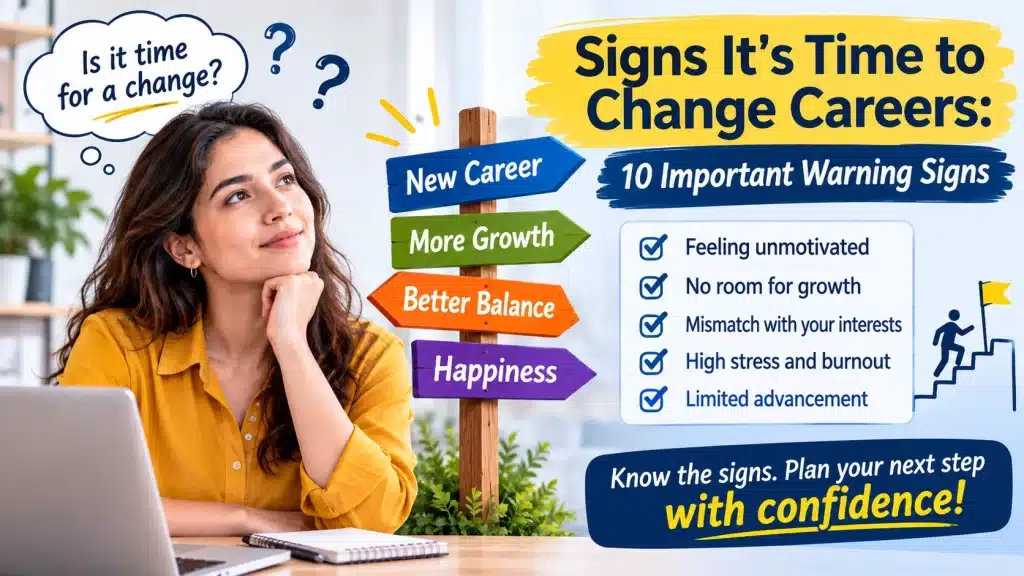
Sometimes you know something is wrong with your career, but you cannot explain exactly what it is. You wake up feeling unmotivated. Your work no longer interests you. Opportunities for growth seem limited, and even after a successful day, you do not feel satisfied.
You might tell yourself that everyone experiences difficult periods at work. Perhaps you need a vacation, a better manager, or a new challenge. But what happens when the feeling continues for months or even years?
Recognizing the signs it’s time to change careers can help you decide whether you need a different job or a completely different professional direction.
Career changes are not unusual. According to the U.S. Bureau of Labor Statistics, the median employee tenure in the United States was 4.1 years in January 2026. This measures time with an employer, not how often people change careers, but it shows that professional paths are not necessarily tied to one employer for life.
This guide explains 10 important signs that your career may no longer be right for you, how to evaluate your options, and how to prepare for a successful transition.
10 Signs It’s Time to Change Careers
Not every difficult workday means you should leave your profession. However, repeated dissatisfaction, limited opportunities, and a growing disconnect between your interests and responsibilities deserve attention.
Here are 10 signs worth considering:
1. You Feel Unmotivated Even When Work Is Going Well
Everyone has an occasional difficult day. Deadlines, demanding customers, and busy schedules can make almost any job frustrating. But there is a difference between temporary stress and persistent lack of motivation.
Consider these questions:
- Do you struggle to feel interested in your daily responsibilities?
- Do tasks that once excited you now feel like obligations?
- Do you frequently watch the clock?
- Have you stopped feeling proud of your accomplishments?
- Do you feel relieved when a project gets canceled?
For example, imagine you have worked as an accountant for eight years. You perform well, your manager appreciates your work, and your salary is competitive. Yet you feel no interest in developing further in accounting.
The problem may not be your employer. It may be that your professional interests have changed.
2. Your Current Career Offers No Room for Growth
A career should give you opportunities to develop new skills, increase responsibility, and explore new challenges.
When you repeatedly find yourself doing the same work without meaningful opportunities to advance, frustration can build.
Look at your situation:
- Have you been doing nearly identical work for several years?
- Are promotion opportunities limited?
- Does your industry offer the type of development you want?
- Are you interested in responsibilities your current career rarely provides?
For example, a customer service professional may enjoy helping people but want to move into training, employee development, or human resources.
That interest could indicate a need for a new career direction rather than simply another customer service position.
Before making a complete career change, consider whether a promotion, internal transfer, or new employer could solve the problem.
3. Your Work No Longer Matches Your Interests
Your interests can change as you gain experience and move through different stages of life.
A profession that felt exciting when you were 25 may not offer the same satisfaction when you are 35 or 45.
Perhaps you originally entered sales because you enjoyed meeting people. Over time, you discovered that you prefer analyzing customer behavior, developing marketing strategies, or managing business operations. These changing interests are worth exploring.
One useful exercise is to write down:
Work I enjoy:
- Solving complex problems
- Helping people make decisions
- Researching new ideas
- Creating strategies
Work I dislike:
- Repetitive administrative tasks
- Constant pressure to meet unrealistic targets
- Limited independence
- Work that does not use my strengths
Look for patterns. They can help identify occupations that better match your interests.
4. Work Is Affecting Your Physical and Emotional Wellbeing
Persistent work-related stress deserves attention. You may notice difficulty sleeping, constant exhaustion, irritability, reduced concentration, or an inability to disconnect from work outside business hours.
These experiences do not automatically mean you need to change careers. They may result from workload, workplace culture, management problems, or circumstances outside work.
However, when the situation continues despite reasonable attempts to improve it, you should take it seriously.
Gallup’s State of the Global Workplace 2026 report found that 50% of employees in the United States and Canada experienced significant daily stress in 2025. This is a regional finding rather than a measurement of every individual workplace.
Consider whether your difficulties are connected to:
- Excessive workloads
- Unpredictable working hours
- Poor management
- Lack of flexibility
- Unhealthy workplace expectations
- A fundamental mismatch with the profession
If stress is affecting your health, consider speaking with a qualified healthcare professional. A career change alone should not be treated as a substitute for appropriate support.
5. Your Personal Values No Longer Match Your Work
Professional satisfaction is not only about salary or job title. It also depends on whether your work aligns with what matters to you.
For example, you may value creativity, independence, and meaningful contributions. But your current profession may involve strict procedures, limited decision-making, and repetitive responsibilities.
Similarly, someone who values work-life balance may struggle in an industry where long working hours are considered normal.
Ask yourself:
- Does my work reflect my priorities?
- Am I comfortable with the way my organization operates?
- Do I believe in the value of what I contribute?
- Does my career support the life I want outside work?
A mismatch in values can become one of the strongest signs it’s time to change careers.
6. You Are Interested in a Completely Different Profession
Have you repeatedly imagined yourself working in another field?
Perhaps you are an accountant interested in data analytics. Maybe you work in retail but want to become a project manager. Or you are a teacher considering instructional design.
Occasional curiosity is normal. But if you consistently research another profession, take related courses, or look for opportunities to gain experience, your interest may be worth pursuing.
Instead of dismissing the idea, investigate it. Speak with people already working in the field. Read actual job descriptions. Understand the qualifications and daily responsibilities.
Do not assume that an attractive job title means the work itself will make you happier. Test your assumptions before making a major decision.
7. Your Skills Are No Longer Being Used Properly
Another important indicator is feeling that your abilities are being wasted. You may have strong analytical, leadership, creative, or technical skills, but your current responsibilities rarely allow you to use them.
For example, a marketing specialist may have excellent data analysis skills but spend most of the day coordinating routine administrative tasks.
A human resources professional may enjoy developing people but have little opportunity to participate in employee training or organizational strategy.
Ask yourself:
Am I using my strongest abilities regularly?
If not, consider whether another position within your profession could provide better opportunities.
If the work you actually want to do belongs to a different field, exploring a career transition may make sense.
8. Your Compensation and Career Opportunities Have Stopped Improving
Financial growth is a legitimate part of career planning. You may enjoy your profession but discover that your earning potential, available opportunities, or career progression no longer meet your expectations.
For example, perhaps you have taken on additional responsibilities but your compensation has not changed. Or your profession offers limited opportunities to reach the level of responsibility you want.
Before changing careers, research the financial outlook carefully.
Compare:
- Salary ranges in your current occupation
- Earnings in your target profession
- Training and certification costs
- Entry-level compensation
- Long-term advancement opportunities
- Benefits and retirement plans
Do not assume that a different career automatically means a higher salary. A transition may require accepting a temporary reduction in compensation while you build new experience.
9. You Stay Only Because You Are Afraid of Starting Again
Fear is one of the biggest barriers to career change. You may believe you are too old, too experienced, or too financially committed to start something different.
You may also worry about losing professional status or disappointing family members. These concerns are understandable. But staying in an unsuitable career only because change feels uncomfortable is not always the best long-term decision.
Instead, examine what you would need to make a transition realistic. Your experience may be more transferable than you think.
A project manager can move toward operations management. A teacher may transition into corporate training. A sales professional may explore account management or business development.
The goal is not to discard your entire professional history. It is to identify how your existing abilities can support a different path.
10. You Cannot See Yourself Doing This Work Long Term
Imagine looking five years into the future. Does the thought of performing your current work still feel appealing?
Can you see yourself developing further in the profession? Do you feel interested in the responsibilities you may eventually take on?
Or does the idea of continuing in the same career make you feel stuck?
This does not mean every career needs to become a lifelong passion. A profession can provide stability, income, and flexibility without being your greatest personal interest.
However, if you consistently cannot imagine a satisfying future in your current field, it may be time to explore alternatives.
How to Know When It’s Time to Change Jobs vs. Change Careers?
One of the most important questions is whether you need a new employer or an entirely different profession.
These decisions are not the same.
| Situation | Potential solution |
| You dislike your manager | Consider another employer or team |
| You enjoy your profession but dislike your salary | Explore better-paying employers |
| You want more responsibility | Consider promotion or a new role |
| You dislike the main duties of your occupation | Explore a career change |
| Your interests have shifted to another field | Research a different profession |
| Your industry’s long-term direction no longer suits you | Explore related or alternative industries |
| Your workplace is unhealthy | Consider a safer and healthier work environment |
When thinking about how to know when it’s time to change jobs, look closely at what is causing your dissatisfaction.
When asking how you know when it’s time to change careers, look beyond your current employer.
Consider whether you actually want to continue doing the same type of work elsewhere.
This distinction can save you from changing employers repeatedly without solving the underlying problem.
How to Prepare for a Career Change Without Taking Unnecessary Risks?
Recognizing the problem is only the first step. Preparing for your next move requires research and planning.
Here are six practical steps.
1. Identify Your Transferable Skills
List your strongest professional abilities.
These could include:
- Communication
- Project management
- Leadership
- Research
- Problem-solving
- Data analysis
- Customer relationship management
- Financial planning
Then compare them with job requirements in the fields you are considering.
2. Research Your Target Career
Look beyond salary information. Investigate daily responsibilities, qualifications, working conditions, industry trends, and opportunities for advancement.
The U.S. Bureau of Labor Statistics Occupational Outlook Handbook is a useful starting point for comparing occupations, employment projections, and typical qualifications.
3. Speak With People in Your Target Industry
Informational interviews can help you understand what a profession is actually like.
Ask professionals:
- What does a typical working day involve?
- Which skills matter most?
- What challenges do newcomers face?
- Which qualifications are genuinely useful?
- What would you do differently if starting again?
4. Test the New Career Before Committing
Consider taking a short course, completing a personal project, volunteering, or shadowing someone in the profession.
These experiences help you determine whether you enjoy the actual work rather than simply the idea of the career.
5. Prepare Financially
Before resigning, review your savings, monthly expenses, healthcare coverage, debt obligations, and expected training costs.
Where possible, continue working while researching and preparing for your new direction. A planned transition usually gives you more control than an impulsive resignation.
6. Build a Career Transition Strategy
Create a realistic plan with milestones.
For example:
- Month 1: Research target occupations.
- Month 2: Identify skill gaps and transferable strengths.
- Month 3: Begin relevant training or projects.
- Month 4: Update your resume and LinkedIn profile.
- Month 5: Start networking and applying.
- Month 6: Evaluate opportunities and next steps.
Adjust the timeline to match your financial situation and the requirements of your target profession.
How Job Change Now Can Help You Navigate a Career Transition?
Recognizing that you need a change is one challenge. Explaining your experience to a new industry and convincing employers that your background is relevant can be another.
Job Change Now is a career advisory service that helps professionals, executives, and career changers communicate their professional value to hiring managers.
Its career transition support focuses on identifying transferable strengths, developing a clear value proposition, refining professional brand identity, and positioning candidates for new opportunities.
The company also offers access to hiring-manager advisors and career-change resources through its membership program.
For professionals who feel qualified but struggle to communicate their accomplishments, its professional development guidance addresses how to present experience and achievements more effectively.
The important point is to approach your next career move with a clear understanding of your strengths and what employers in your target field need.
Conclusion
Recognizing the signs it’s time to change careers does not mean you should immediately resign or abandon everything you have worked toward.
It means paying attention to what your professional life is telling you. If you feel consistently unmotivated, lack opportunities for growth, struggle with your work environment, or feel drawn toward a different profession, take those feelings seriously.
Start by identifying what is making you unhappy. Determine whether a new employer could solve the problem or whether you need a different professional direction.
Then research your options, identify transferable skills, test new opportunities, and create a realistic financial and career plan.
Your next career does not have to be a complete restart. It can be a thoughtful next step built on everything you have already learned.
And remember, a successful career is not simply about staying in one profession for as long as possible. It is about making choices that support your skills, goals, values, and the life you want to build.
Start exploring your next opportunity today. A clearer career direction begins with understanding what you want to change and why.
Frequently Asked Questions
What are the biggest signs it’s time to change careers?
The biggest signs include persistent lack of motivation, limited growth, a mismatch between personal values and work, unused skills, ongoing dissatisfaction, and a strong interest in another profession. Consider whether these patterns continue over time rather than reacting to one difficult week.
How do you know when it’s time to change careers instead of changing jobs?
Consider changing careers when you no longer enjoy the core responsibilities of your profession and want to perform a different type of work. If you still enjoy the profession but dislike your employer, manager, salary, or workplace culture, a job change may be enough.
How to know it’s time to change jobs?
Repeated problems with management, limited compensation growth, poor workplace culture, lack of flexibility, or better opportunities elsewhere may indicate that changing employers could be beneficial. First determine whether the problems are specific to your organization or part of your occupation.
Is 40 too old to change careers?
No. There is no universal age limit for changing careers. Your experience, transferable skills, financial situation, training requirements, and target industry’s expectations matter more than age alone. Start by researching realistic opportunities and identifying the qualifications you may need.
Also Read: Resume Summary vs Objective