
Picking a career coach can end up feeling surprisingly hard. There are thousands of them out there with different services, different methods, wildly different price tags, and no shortage of bold promises. Some focus on executives. Others specialize in career changes, job searches, interviews, or general professional development.
So how do you actually figure out who’s right for you?
Really, it starts with getting clear on what you actually need first, not with browsing coaches. The best coach for one person might be completely wrong for someone else; a senior executive chasing a leadership role needs something very different from a recent grad, and both need something different again from someone trying to break into a new industry.
A good coach should help you gain real clarity, make sharper decisions, and take practical steps forward. What they shouldn’t do is just hand you a career choice and call it a day.
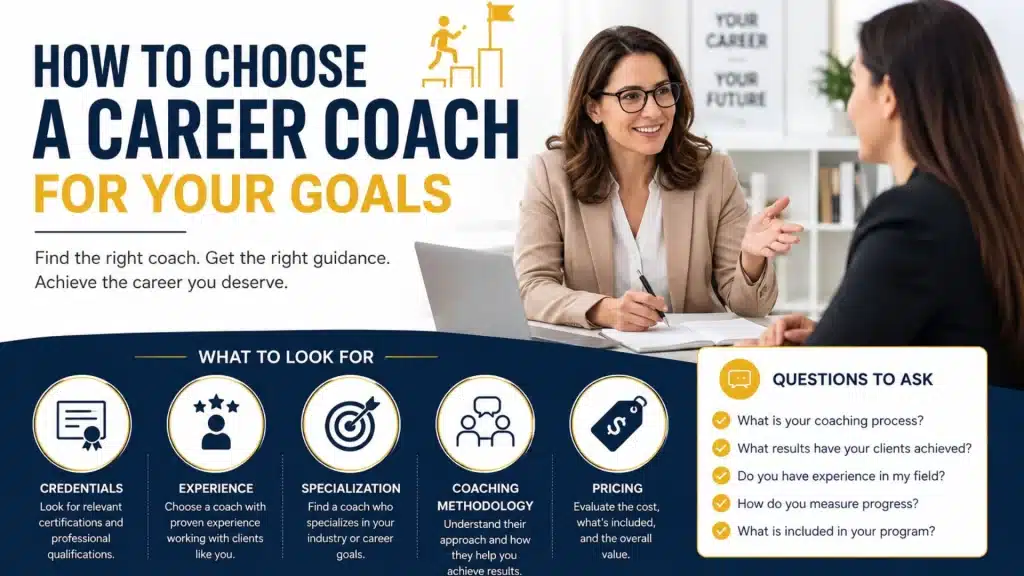
Here’s what’s actually worth looking at credentials, experience, specialization, coaching style, pricing, the right questions to ask, and a few red flags worth knowing.
Start With Your Actual Goal, Not a List of Coaches
Before you compare anyone, get specific about the problem you’re actually trying to solve.
Ask yourself:
- Am I trying to change careers entirely?
- Do I just need help finding a new job?
- Am I gearing up for a promotion?
- Do my interview skills need work?
- Is my resume the thing that’s failing me?
- Do I need help with how I present myself professionally?
- Am I honestly unsure what direction I even want?
- Am I stepping into an executive role?
- Do I struggle to explain my own value out loud?
Your answer here should genuinely shape which type of coach makes sense. Someone moving from finance into tech probably wants someone with real career-transition experience. An executive chasing a C-suite seat probably needs someone who’s actually worked in executive hiring or leadership. Someone whose interviews keep falling flat probably needs a coach who spends most of their time specifically on interview prep and employer communication.
So the first move isn’t comparing prices, it’s getting honest about the outcome you’re actually after.
Look at Their Credentials, but Don’t Stop There
Credentials are worth a glance, but they shouldn’t be the whole decision.
Some coaches hold formal coaching certifications. Others come from recruiting, HR, executive leadership, career counseling, or talent management backgrounds. Worth looking at their education, any coaching certifications, professional background, industry experience, hiring or recruiting experience, and other relevant training.
It’s also worth understanding what those credentials actually tell you. A certification shows someone’s had formal training in coaching methodology; it doesn’t automatically mean they understand your specific industry or how hiring actually works in your target market.
Practical experience tends to carry a lot of weight here too. A coach who’s spent years working alongside hiring managers, actually evaluating candidates, tends to have real insight into how employers read resumes, run interviews, and judge professional value insight that’s hard to get from certification alone.
Credentials matter. Relevant experience matters. Ideally you get both, but if you have to weigh one more heavily, real experience with people like you tends to matter more.
Dig Into Their Actual Experience
This might be the single most important factor here. Don’t just ask how many years they’ve been coaching. Ask what kinds of clients they’ve actually worked with. “I’ve coached professionals for 15 years” sounds solid, but it doesn’t tell you whether they understand your particular situation.
A sharper question: “How much of your work involves people at my career level who are trying to achieve something similar to what I’m after?”
Look for real evidence of experience with your career stage, your target industry, your type of transition, the specific challenges you’re facing, and the outcome you’re actually chasing. You don’t necessarily need someone from your exact field but they should genuinely understand the shape of the problem you’re bringing them.
Think About Specialization
Career coaching covers a lot of ground. Some coaches focus on executive coaching, career transitions, job-search strategy, resume work, interview prep, leadership development, professional branding, career exploration, returning to work, or early-career development.
Specialization genuinely matters. If you’ve got 15 years of management experience and you’re aiming for a senior executive role, a coach who mostly works with college students probably isn’t the right fit even if they’re genuinely skilled at what they do. On the flip side, an executive coach who regularly works with senior professionals likely understands the expectations around leadership roles, executive branding, and high-level hiring in a way a generalist wouldn’t.
The best coach for you is usually the one whose actual expertise matches your specific problem, not the one with the most impressive-sounding bio overall.
Understand How They Actually Work
Every coach has a different process. Some are highly structured, with exercises, assessments, and clear action plans. Others lean conversational, working mostly through questions and reflection. Some blend career strategy with hands-on resume, LinkedIn, and interview support.
Before hiring anyone, ask how their process actually works. A good methodology should genuinely move you from where you are now to where you want to be often something like clarifying your goals, reviewing your background, identifying real transferable strengths, defining your value, building a strategy, sharpening your resume and LinkedIn, developing a networking approach, prepping for interviews, and adjusting as things progress.
There’s no single “correct” methodology that works for everyone. The real question is whether their process is practical and actually suited to what you need.
Questions Worth Asking Before You Commit
A consultation is one of the best ways to actually evaluate someone. Don’t be shy about asking direct questions:
- What type of clients do you usually work with? Tells you whether they’ve genuinely dealt with people in situations like yours.
- What results do you typically help clients work toward? Listen for specifics, not vague promises.
- How does your process actually work? You should walk away understanding what happens after the first conversation.
- Will you review my resume and LinkedIn? Matters a lot if sharpening those is part of your goal.
- Do you have real experience with hiring managers or recruiters? Especially valuable if getting more competitive in the market is the point.
- How long do clients typically work with you? Gives you a sense of the actual time commitment involved.
- How do you measure progress? Good coaching should show measurable movement, even though the final hiring decision is never entirely in the coach’s hands.
- What happens if we’re not a good fit? A genuinely professional coach should be comfortable talking about this directly, not dodge the question.
Weighing the Price
Pricing varies a lot. Some coaches charge per session, others sell packages spanning weeks or months, and some run longer-term memberships or advisory programs.
What you’re paying for can depend on the coach’s experience, your career level, their specialization, session length, program duration, what’s actually included, whether you get access between sessions, and whether resume, LinkedIn, or interview support is bundled in.
Don’t automatically go for the cheapest option but don’t assume the most expensive one is automatically the best either. Compare what you’re actually getting for the price. A $150 session might sound reasonable until you realize the whole engagement ends after that one conversation. A pricier, more comprehensive program might be worth it if it includes structured guidance, document reviews, and ongoing support that a single session never could.
Ask for a clear breakdown of what’s included before you commit to anything.
Red Flags Worth Knowing
Part of choosing well is knowing who to steer clear of. Be cautious of anyone who:
- Guarantees you a specific salary
- Promises a job within some fixed number of days
- Claims to have a secret hiring formula nobody else knows
- Guarantees interviews or offers outright
- Won’t clearly explain their actual methodology
- Can’t give you clear information about their own experience
- Pressures you to buy on the spot
- Leans on vague testimonials with no real context
- Makes unrealistic claims about guaranteed outcomes
- Spends the whole conversation selling rather than understanding your actual situation
Career outcomes depend on a lot of moving pieces your experience, your industry, your location, market conditions, networking, and general employer demand all play a role. A trustworthy coach will be upfront about that. They can genuinely sharpen your strategy. They can’t control what an employer ultimately decides.
Coaching vs. Counseling — What’s Actually Different
These two get confused a lot because they sound so similar on the surface.
Career coaching tends to focus on helping you move toward specific professional goals strategy, job searching, positioning, interviews, or advancement.
Career counseling tends to involve broader exploration and decision-making, understanding your interests, strengths, values, and the paths available to you.
The right choice depends on where you’re at. If you already know what you want and just need a sharper strategy to get there, coaching’s probably the fit. If you’re genuinely unsure about direction and need deeper exploration first, counseling might serve you better. Plenty of people benefit from a mix of both at different points.
When Is This Actually Worth It?
Coaching tends to pay off when the cost of staying stuck outweighs the cost of getting real guidance.
Worth considering if you’ve been applying without landing interviews, you’re switching careers, you’re targeting a promotion, you’re moving into executive leadership, you’re not sure how to position your experience, your resume isn’t communicating your value, networking feels genuinely hard, you struggle to explain your own goals clearly, you’re prepping for high-stakes interviews, or you keep noticing the same job-search mistakes repeating.
Take a marketing director who’s applied to 30 senior roles and landed just two interviews. The issue probably isn’t a lack of experience, it’s more likely a generic resume, a LinkedIn profile that doesn’t read as executive-level, or applying to roles that don’t actually match how they’re positioned. A good coach can spot those specific gaps and build a sharper, more focused strategy from there.
Where Job Change Now Fits Into This?
Finding a coach really comes down to finding someone who understands your goals and can help you actually communicate your value clearly.
Job Change Now takes a broader career-strategy approach rather than sticking to surface-level job-search tips focused on helping professionals understand their value, sharpen their professional brand, and communicate effectively with the people actually making hiring decisions.
That broader lens matters because a real transition rarely comes down to one document. Your resume matters. Your LinkedIn matters. Your networking approach matters. How you interview matters. Your ability to explain your own value out loud matters just as much as any of it.
There’s also a strong emphasis on the hiring-manager perspective, genuinely useful for understanding how your experience actually reads from the employer’s side of the table, not just your own.
Choosing a Coach for a Career Change Specifically
A career change calls for a different approach than a standard job search. You might have strong experience without the exact title employers are scanning for.
Take an operations manager wanting to move into project management. A good coach can help identify what genuinely transfers team leadership, budget management, process improvement, stakeholder communication, project coordination, risk management, performance tracking and then reposition all of it around what project management roles actually require.
This is exactly why specialization matters so much here. A coach who regularly works with people changing careers tends to be better at spotting transferable value and building a genuinely realistic transition plan, rather than guessing alongside you.
A Simple Framework If You’re Still Stuck
If you’re still not sure how to actually choose, try this five-step process.
- Step 1: Get specific about your goal. “Find a better job” is too broad to act on. “Move from operations management into a director-level role in healthcare” gives you something to actually search against.
- Step 2: Identify what expertise you actually need. Direction? A career change? Job-search strategy? Resume work? LinkedIn? Networking? Interview prep? Executive advancement?
- Step 3: Research a handful of coaches. Compare their experience, specialization, methodology, and who they typically work with.
- Step 4: Schedule actual consultations. Use the conversation to gauge communication style and genuine fit, not just credentials on paper.
- Step 5: Compare value, not just price. Look at the full scope of what you’re actually getting.
A coach should feel like an investment toward a specific outcome, not just another line item on your monthly expenses.
Choose Based on Fit, Not Fame
Figuring out how to choose a career coach really just comes down to matching your specific goals to someone’s actual expertise.
Don’t pick someone purely because their credentials look impressive or they’ve got a wall of testimonials. Look at the whole picture: their real experience, their specialization, how their process actually works, the questions they’re willing to answer honestly, what you’re getting for the price, and whether any red flags show up along the way.
Most importantly: choose someone who genuinely understands the specific problem you’re bringing them.
The right coach should help you gain real clarity and take practical steps forward, helping you communicate your value more effectively and build a strategy that actually fits where you’re trying to take your career next.
FAQ
How do I actually pick a good career coach?
Start by nailing down your actual goal. Then look at their credentials, relevant experience, specialization, methodology, typical clients, pricing, and communication style. Talk to them directly before committing to anything longer-term.
What qualifications should they actually have?
There’s no single qualification that guarantees a good coach. Look for relevant training, real professional experience, and evidence they understand your career stage and goals specifically. Experience with hiring managers, recruiters, or your particular industry adds real weight.
How much does this typically cost?
It varies a lot based on the coach, their specialization, program length, and what’s actually included. Some charge per session, others sell packages or memberships. Compare the full scope of support, not just the hourly rate on its own.
Is career coaching actually worth it?
It can be, especially when you need an outside perspective, a sharper strategy, or help pushing past a specific obstacle. Particularly useful during career changes, job searches, promotions, and executive transitions.
What should I actually ask before hiring someone?
Their experience with people like you, how their process actually works, what’s included, expected timeline, pricing, how they measure progress, and whether resume, LinkedIn, networking, or interview support is part of it.
The best career coach was never necessarily the most expensive or the most well-known one. It’s whoever’s experience, approach, and expertise line up best with where you’re actually trying to go.
Also Read: ATS-Friendly Resume Tips