
Choosing the right career can still be genuinely hard, even after years of experience. You might know something needs to change without having a clue what “next” actually looks like. You might be applying to job after job and hearing nothing back. Or you might have simply hit a point where the career you built doesn’t feel like the right fit anymore.
This is where career counseling can actually help.
It gives you a structured way to understand your own skills, interests, experience, and goals and to make real decisions from that, instead of just guessing your way forward.
And it’s not just for college students or people entering the workforce for the first time. Adults use it while changing careers, chasing a promotion, coming back after time off, recovering from a layoff, or just trying to find work that feels like it actually matters to them.
This kind of clarity matters more given where the job market currently sits. LinkedIn’s 2026 research found that the number of U.S. applicants per open role has roughly doubled since spring 2022, and nearly 65% of people surveyed said finding a job has genuinely gotten harder.
With more competition and hiring practices shifting underneath everyone, having an actual strategy makes a real difference.
What Career Counseling Actually Is?
At its core, it’s a professional process built to help people make informed decisions about their careers.
A counselor might help you understand your own strengths and interests, weigh possible career paths, identify skills that transfer more than you’d think, set realistic goals, and build a strategy for actually reaching them.
The U.S. Bureau of Labor Statistics describes career counselors and advisors as professionals who help people make career decisions evaluating interests and abilities, setting realistic goals, teaching job-search skills, and helping people understand their employment and education options.
In practical terms, this is the kind of thing career counseling helps answer:
- What career should I actually pursue?
- Should I switch industries entirely?
- Am I actually qualified for a different type of role?
- How does my existing experience apply somewhere new?
- Why am I struggling to get interviews?
- Should I push for a promotion, or look elsewhere?
- What skills are actually worth developing?
- How should I be positioning myself in this market?
The exact process shifts depending on the counselor and what you need. Some people just need help making one decision. Others need a full, detailed plan for switching jobs or industries entirely.
Who Actually Benefits From This?
A common misconception: career counseling is mostly for students figuring out their first move.
It’s not, really.
It tends to be useful at nearly any stage of a working life whether you’re a recent graduate trying to pick a direction, a professional weighing a career change, a manager preparing to step into leadership, an executive hunting for something better, someone returning after time away, someone recovering from a layoff, someone who’s just plain stuck, or someone struggling to land interviews and not sure why.
Take an experienced marketing manager who’s spent 12 years in traditional advertising. She genuinely loves strategy and data work, but she wants to move into technology. She probably already has real transferable skills. The actual problem is she doesn’t know which tech roles fit that experience, or how to come across as a credible candidate for them.
A structured counseling process can help her narrow down realistic options and actually build a transition plan, instead of guessing.
How Does the Process Actually Work?
It usually starts with getting honest about where you are right now, and where you’re actually trying to go.
A good counseling process shouldn’t hand you a career choice on day one. It should help you understand your real options and land on a decision that fits your actual circumstances.
1. Take Stock of Where You Actually Stand
Step one is understanding your professional background, your current role, past positions, education, certifications, skills, real achievements, interests, work preferences, and whatever challenges have been getting in your way.
You’ll likely talk through what you actually like and dislike about your current work too, because your next move should be shaped by more than just a job title.
Say someone wants to become a VP because they’re chasing “growth.” Once they actually dig into it, they might realize what they value more is flexibility and autonomy, not a bigger title. That single insight can completely reshape the strategy from there.
2. Figure Out What Actually Transfers
A lot of professionals seriously underestimate how much of their experience carries into a new role.
Transferable skills can include leadership, project management, sales, communication, negotiation, financial analysis, customer management, strategic planning, team development, and problem-solving.
A counselor can help connect those to realistic career paths. A construction project manager, for instance, might have experience that translates well into operations management, program management, or consulting.
The point isn’t forcing someone into a completely unrelated field. It’s finding realistic options where their existing experience actually gives them a real edge.
Where This Helps Most: Career Changes
Switching careers can feel genuinely risky. You might worry about starting from scratch, whether employers will value your past experience, or what it does to your pay.
Career counseling can turn that transition into something a lot more manageable usually something like: defining the target career, researching the industry, identifying what actually transfers, spotting real skill gaps, building relevant experience, updating your resume, sharpening your LinkedIn profile, expanding your network, prepping for interviews, and building a genuinely targeted job-search plan.
That kind of approach tends to work a lot better than firing off hundreds of applications to unrelated roles and hoping something sticks.
It Also Helps With How You’re Communicating Your Experience
Sometimes the issue isn’t your actual experience, it’s how it’s being communicated.
Employers and recruiters are often working through huge volumes of applicants fast. LinkedIn’s 2026 research found applicants per open role have roughly doubled since 2022, and 93% of recruiters planned to lean more heavily on AI throughout 2026.
Which makes how you’re positioned matter more than it used to. Career counseling often touches on:
- Your resume: It should show accomplishments, not just responsibilities. Skip “Managed a sales team” and go with “Led a 15-person sales team and increased regional revenue by 22% over two years” the second gives an employer actual evidence of impact.
- Your LinkedIn profile: It should reinforce the same professional story your resume tells. Your headline and summary need to make clear what you do and what you’re actually going for.
- Your professional brand: This is really the way employers perceive your expertise and value and it’s meant to answer one simple question: why should this employer choose you over the next person? That question matters even more when you’re switching industries or going for something senior.
Better Decisions, Not Just a Better Job Search
Good guidance here isn’t about someone telling you what to do. It’s giving you enough real information and structure to make a sound call yourself.
Say you’re weighing two offers. Job A pays more but has limited room to grow. Job B pays a bit less but comes with real leadership responsibility and industry experience worth having.
The right call depends entirely on your longer-term goals. A counselor can help you actually weigh things like compensation, growth potential, skill development, leadership opportunity, industry stability, work environment, location, flexibility, and long-term value so you’re not just chasing the bigger number on the offer letter.
It’s Not Only About Landing the Next Job
One of the bigger benefits here is that the process can look well past your immediate job search.
Career development can also mean prepping for a promotion, building leadership skills, strengthening your professional identity, sharpening your networking, prepping for tougher interviews, negotiating pay, planning a transition, or just getting clear on longer-term goals.
The BLS reports roughly 389,500 people worked as school and career counselors and advisors in 2025, with 3% growth projected from 2025 to 2035 and about 27,800 openings a year on average over that stretch. These professionals also regularly work with people changing careers and job seekers navigating tough employment decisions. The role is genuinely broader than “help me get this one job.”
That broader lens matters because career success was never really about landing one specific role. It’s about making choices that support where you’re actually headed over time.
Counselor vs. Coach — What’s Actually Different
These two terms get used interchangeably a lot, and there’s real overlap, but the emphasis can differ.
A career counselor tends to focus on exploring career decisions, assessments, education choices, and longer-term direction.
A career coach tends to lean toward goals, accountability, performance, job-search execution, and actually taking action.
There’s no single right answer for everyone. If you’re genuinely unsure about direction, counseling tends to help more. If you already know what you want and just need help executing, coaching is often the better fit. Some professionals offer a blend of both.
Where Job Change Now Fits Into This
For professionals who need practical direction rather than just theory, Job Change Now takes a broader job-and-career advisory approach not just “submit more applications,” but understanding your actual value, sharpening your positioning, prepping you for hiring conversations, and building a more deliberate job search overall.
There are also resources for anyone wanting to understand career counseling and growth more generally, and a guide on finding the right career coach if you’re comparing different types of support.
The whole point is helping professionals move from uncertainty to an actual plan they can follow.
Location-Specific Support
Getting career support doesn’t have to mean starting completely from scratch on your own.
Job Change Now also offers location-focused resources for a few specific Ohio markets. If you’re in the Cincinnati area, there’s dedicated career counselor Cincinnati guidance covering planning, job-search strategy, branding, and transitions. Columbus professionals can look into career coach Columbus Ohio services covering similar ground. In Cleveland, career coach Cleveland Ohio resources cover goals, strategy, branding, and growth. And for Toledo, career advisor Toledo Ohio services help with planning, job searches, networking, and transitions.
These are useful starting points if you want support that’s actually anchored to your specific market, not generic advice with no local context.
A Practical Example
Take a 45-year-old operations director who’s stayed at the same company for 14 years and now feels genuinely stuck. He’s got strong leadership experience, but he hasn’t job hunted in over a decade, his resume is badly out of date, and he’s honestly not sure whether he should pursue another operations role or move into consulting.
A useful process here might start by identifying his real strengths leading large teams, improving operational efficiency, managing budgets, developing managers, and rolling out new processes. Those strengths could genuinely apply across several different paths.
Instead of applying blind, he can compare those paths directly and figure out which actually matches what he wants. Once that direction is clear, the next steps branding, resume work, networking, recruiter conversations, interview prep all follow naturally from it.
That’s really the practical value here: turning genuine uncertainty into a process, rather than staying stuck indefinitely.
How to Actually Choose a Provider
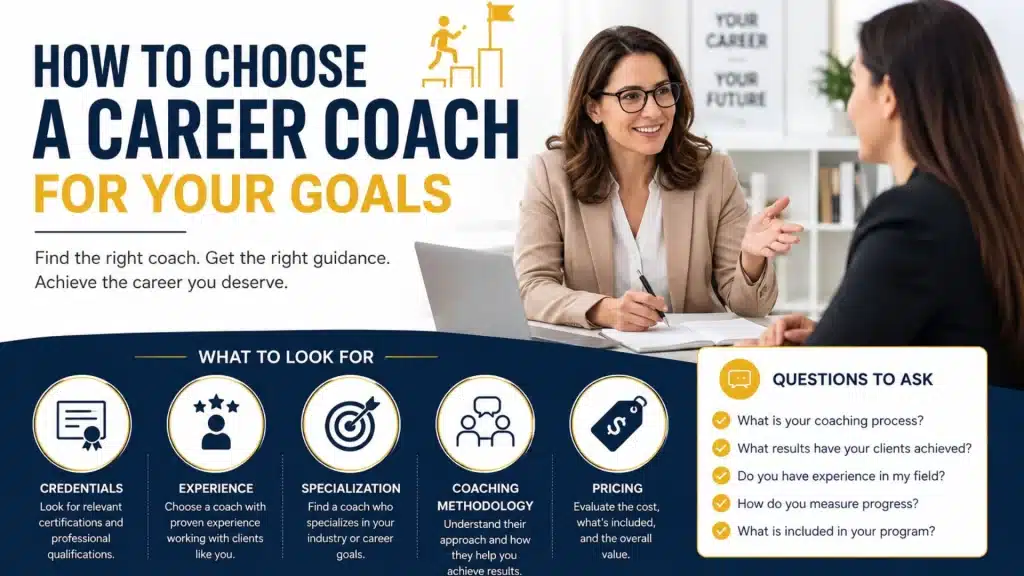
Not every career counseling service looks the same. Worth asking before committing:
- What type of professionals do you typically work with?
- Do you actually understand my industry or career level?
- Do you help with career changes specifically?
- Is the guidance practical, or mostly conceptual?
- Can you help with resumes and branding directly?
- How are sessions actually delivered?
- What does the full process look like?
- How do you measure whether things are working?
- Can you give examples of the kinds of problems you’ve helped solve?
Look for someone whose approach genuinely matches your situation. If you’re an experienced professional, for instance, you probably need more than basic resume tips. You need help positioning decades of real experience for a market that’s shifted a lot since your last job hunt.
Moving Forward With Actual Clarity
A career decision can genuinely affect your income, your growth, your confidence, and your overall quality of life. You don’t have to work through every major one of these alone.
Career counseling gives you a structured way to understand your real strengths, weigh realistic options, set actual goals, and build a plan you can follow through on.
For professionals, the value goes well beyond just picking a job title. Good guidance helps you understand your own value clearly enough to actually communicate it to employers, instead of hoping they figure it out on their own.
Whether you’re switching industries, chasing a promotion, coming back after time away, or just questioning where you’re headed, the first real step is clarity.
Once you actually know where you’re going, your resume, your networking, your interviews, and your job search can all start pulling in the same direction instead of each telling a slightly different story.
That’s really where good career counseling earns its value: turning genuine uncertainty into a plan you can actually act on.
FAQ
What’s the main point of career counseling?
To help people make genuinely informed career decisions supporting exploration, job searches, career changes, professional development, and longer-term planning.
Is this only useful if I want to change careers entirely?
No. It also helps people chasing a promotion, needing a stronger job-search strategy, returning to work, feeling stuck, or just wanting a clearer long-term plan.
How does it actually help a job search?
By clarifying your target role, identifying what actually transfers, sharpening your resume and LinkedIn, building a real networking strategy, prepping you for interviews, and creating a focused search plan instead of a scattershot one.
Is it worth it for experienced professionals specifically?
Often, yes especially if you’re struggling to communicate your value clearly, weighing a career change, targeting leadership roles, or facing a genuinely major decision.
How long does this typically take?
No fixed timeline. Some people just need a few focused sessions to get clarity on one decision. Others benefit from ongoing support across an entire transition or search. It really depends on your goals and situation.
Also Read: How to work with recruiters