
Changing careers can feel like starting over. It can also be one of the smartest professional decisions you make.
Maybe you have spent years building experience in an industry that no longer interests you. Maybe your job has stopped offering opportunities for growth. Or perhaps you have discovered that the career you chose earlier in life does not fit the person you are today.
Whatever the reason, changing careers does not mean throwing away everything you have accomplished.
Your existing experience, skills, relationships, industry knowledge, and problem-solving ability can often become valuable assets in your next career.
The key is knowing how to transfer them.
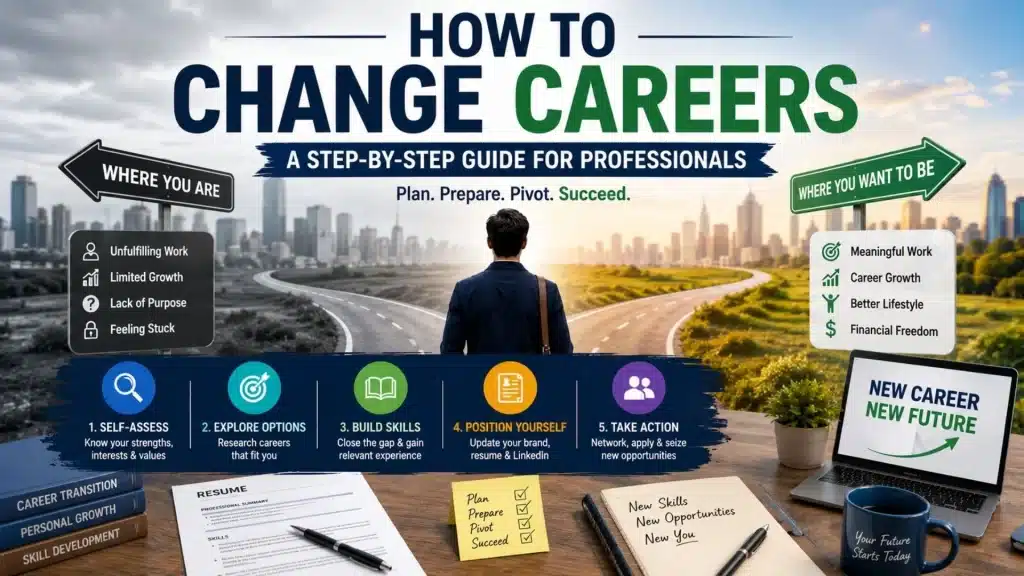
This guide explains how to change careers step by step. You will learn how to choose a realistic career direction, identify transferable skills, close skill gaps, build a transition plan, update your professional brand, and approach employers with confidence.
Career transitions are also becoming more common as the workplace changes. LinkedIn’s 2025 Work Change Report found that professionals entering the workforce today are on pace to hold twice as many jobs over their careers compared with 15 years ago. LinkedIn also estimates that 70% of the skills used in most jobs will change by 2030.
So a career change is not necessarily a sign that you made the wrong decision. It can be part of building a career that continues to fit your skills and goals.
How to Change Careers Without Starting From Zero?
The biggest misconception about a career transition is that you have to begin at the bottom. Usually, you do not.
Instead, look for the overlap between what you already know and what your target career requires.
For example, imagine a marketing manager who wants to move into product management. They may already have experience with:
- Customer research
- Market analysis
- Cross-functional collaboration
- Project planning
- Presentations
- Data analysis
- Stakeholder communication
- Product positioning
They are not starting from zero. They are repositioning existing skills for a different role. That distinction is important because employers often care about demonstrated capabilities rather than whether your previous job title perfectly matches the new one.
A simple career-change formula
Think about your transition as:
Existing experience + transferable skills + targeted learning + relevant evidence = new career opportunity
This approach is usually more practical than quitting your job first and figuring everything out afterward.
Step 1: Understand Why You Want to Change Careers
Before researching new careers, identify what is wrong with your current situation.
Ask yourself:
- Do I dislike my industry?
- Do I dislike my actual job responsibilities?
- Do I need better income?
- Do I want more flexibility?
- Am I looking for greater job security?
- Do I want more meaningful work?
- Have my interests changed?
- Do I want to move into leadership?
- Am I simply burned out?
These questions matter because you may not need a complete career change. Sometimes the better solution is a new employer, department, industry, role, or work environment.
For example, someone who says “I hate my career” may discover that they actually hate working for a company with poor management.
Someone else may discover that they enjoy their industry but want to move from an individual contributor role into leadership. Do not solve the wrong problem.
Step 2: Define Your Ideal Career Direction
Once you understand why you want to move, create a short list of possible careers. Do not choose based only on salary or what appears popular on social media. Research the actual work.
The U.S. Bureau of Labor Statistics Occupational Outlook Handbook is a useful starting point because its occupational profiles include typical duties, education and training requirements, median pay, work environment, and projected job outlook.
For each potential career, research:
- Typical responsibilities
- Required skills
- Education requirements
- Certifications
- Salary ranges
- Job growth
- Common entry-level positions
- Advancement opportunities
- Work environment
- Geographic demand
Then compare those requirements with your current background.
Use a career transition scorecard
Create a simple table and score each career from 1 to 5:
| Factor | Career A | Career B | Career C |
| Existing skills transfer | 5 | 3 | 2 |
| Salary potential | 4 | 5 | 4 |
| Job demand | 4 | 5 | 3 |
| Training required | 5 | 2 | 3 |
| Interest level | 4 | 5 | 5 |
| Long-term growth | 4 | 5 | 4 |
This does not make the decision for you. It forces you to evaluate the options logically.
Step 3: Identify Your Transferable Skills
This is one of the most important career change tips. Do not look only at your job title. Look at what you actually do.
Transferable skills can include:
- Project management
- Sales
- Customer service
- Data analysis
- Leadership
- Negotiation
- Writing
- Research
- Training
- Budget management
- Operations
- Strategic planning
- Relationship management
- Problem-solving
For example, an administrative professional may have strong skills in scheduling, coordination, vendor management, documentation, communication, and process improvement.
Those skills could transfer into operations, project coordination, customer success, or office management.
A teacher may have experience in communication, training, presentation, planning, conflict resolution, and stakeholder management.
Those skills can potentially transfer into corporate training, customer success, learning and development, recruiting, or sales enablement. Your goal is to identify the business value behind your previous job.
Step 4: Research the Skill Gap
After identifying transferable skills, determine what you are missing. Suppose you want to move into data analytics.
You might already have:
- Business knowledge
- Excel experience
- Problem-solving ability
- Presentation skills
But you may need:
- SQL
- Data visualization
- Statistics
- Power BI or Tableau
- Basic Python
Now you have a much clearer plan.
Instead of saying:
“I need to completely retrain for a new career.”
you can say:
“I need to develop four specific skills and create evidence that I can use them.”
That is much more manageable.
LinkedIn’s recent workforce research reinforces the importance of continuous skill development. Its 2025 Work Change Report estimates that 70% of skills used in most jobs will change by 2030.
The lesson is not to collect endless certifications. The lesson is to keep your skills aligned with the direction you want your career to take.
Step 5: Build Skills Through Practical Experience
Courses can help. Certificates can help. But evidence is often more persuasive.
If you are changing careers, look for ways to demonstrate your new skills before you have the new job title.
You could:
- Complete a portfolio project
- Volunteer for a project at your current company
- Take on cross-functional responsibilities
- Freelance
- Volunteer with a nonprofit
- Build a case study
- Create a sample project
- Shadow someone in your target field
- Take a relevant course
- Participate in professional communities
For example, someone moving into digital marketing could create a mock campaign for a local business. Someone moving into data analytics could analyze a public dataset and create a dashboard.
Someone moving into project management could document a complex project they already managed and present the process as a case study. You are creating proof.
Step 6: Test the New Career Before Making a Major Move
One of the smartest approaches to changing careers is to test your target career before making an irreversible decision.Talk to people already working in the field.
Ask:
- What does a typical week look like?
- What skills matter most?
- What do employers expect from career changers?
- What entry-level roles make sense?
- Which certifications actually matter?
- What do you wish you knew before entering this field?
You can also take on small projects or temporary responsibilities.
This helps you distinguish between:
“I like the idea of this career.”
and
“I actually like doing this work.”
Those are very different things.
Step 7: Create a Career Transition Plan
A career transition becomes easier when you turn it into a series of smaller actions.
Your 90-day transition plan
Days 1–30: Research
- Choose one or two target careers
- Study job descriptions
- Identify transferable skills
- Identify skill gaps
- Talk to professionals
- Research training options
Days 31–60: Build
- Start targeted training
- Complete a relevant project
- Update your LinkedIn profile
- Rewrite your resume
- Build your professional network
Days 61–90: Launch
- Begin targeted applications
- Contact recruiters
- Ask for referrals
- Attend industry events
- Practice interviews
- Track applications and conversations
This approach gives your career transition structure. If you want additional support during this stage, Job Change Now’s career transition coaching resource can fit naturally into this part of the journey.
Step 8: Rebuild Your Resume for the New Career
One of the biggest mistakes career changers make is sending the same resume to every employer.
Your resume should explain why your previous experience is relevant to the new role. Suppose you are moving from retail management into operations.
Instead of focusing heavily on:
Managed retail store employees.
Highlight the transferable value:
Led a 15-person team, managed scheduling and inventory processes, analyzed sales performance, and implemented operational improvements that reduced stock discrepancies.
The second version makes your experience easier to connect to operations roles. Your resume should tell a career transition story.
Job Change Now’s resume optimization services can be linked here as a relevant next step. You can also connect readers to the site’s standout resume guide for practical resume-writing advice.
Step 9: Update Your LinkedIn Profile
Your LinkedIn profile should not continue presenting you solely as the professional you used to be.
If you are transitioning from sales into customer success, your profile should start communicating the customer-retention, relationship-management, onboarding, and account-growth experience that supports your new direction.
Update:
- Headline
- About section
- Experience descriptions
- Skills
- Featured section
- Career interests
- Professional content
For deeper guidance, link to Job Change Now’s LinkedIn profile optimization guide. Your LinkedIn profile and resume should tell the same story.
Step 10: Build a Professional Network in Your Target Field
Networking can shorten the distance between your current career and your next one. But networking does not mean asking everyone you meet for a job.
- Start by learning.
- Connect with professionals who already work in your target industry.
- Follow companies you are interested in.
- Join relevant professional groups.
- Attend industry events.
- Ask thoughtful questions.
- When appropriate, request informational interviews.
A simple introduction might be:
“I’ve spent the last eight years managing customer relationships in financial services, and I’m exploring customer success roles in SaaS. I’d love to learn more about how your team approaches onboarding and retention.”
That is much stronger than:
“Can you help me find a job?”
Your network should understand what you are moving toward.
Step 11: Prepare Your Career Change Story
Eventually an interviewer will ask:
“Why are you changing careers?”
- Do not apologize for your decision.
- Do not criticize your previous industry.
- Do not make the answer entirely about wanting to escape your current job.
- Instead, connect the past to the future.
A strong structure is:
Past experience → What you discovered → Why the new career fits → Evidence that you are prepared
For example:
“I’ve spent the last several years in account management where I discovered that the part of my work I enjoy most is helping clients solve operational problems. That led me to explore customer success. I’ve since completed training in customer success practices and taken on onboarding responsibilities in my current role. I’m now looking for a full-time customer success position where I can combine my client-management experience with that newer expertise.”
That sounds intentional.
Career Change Example: From Finance to Technology
Consider a fictional professional named Sarah.
Sarah has worked in corporate finance for nine years. She enjoys analyzing business performance but wants to move into technology.
Instead of applying immediately for software engineering positions, she looks at adjacent roles. She discovers that technology companies need people in:
- Business operations
- Financial planning and analysis
- Product operations
- Revenue operations
- Project management
- Customer success
- Business analysis
Sarah realizes that her finance background could transfer into revenue operations.
She learns CRM analytics, improves her data skills, completes a portfolio project, updates LinkedIn, and starts networking with revenue operations professionals.
She has not abandoned her previous career. She has repositioned it. That is often the most effective form of career transition.
Should You Quit Your Job Before Changing Careers?
Usually, you do not need to quit immediately If your current job is tolerable, keeping your income while preparing for your transition can reduce financial pressure.
Before resigning, consider:
- Emergency savings
- Health insurance
- Training costs
- Household expenses
- Potential salary reduction
- Time needed to find a new role
- Whether your new career requires full-time education
The right decision depends on your financial situation and the requirements of the target career. A career change should improve your long-term position without creating an avoidable short-term crisis.
How Long Does a Career Change Take?
There is no universal timeline. A transition into an adjacent career may take several months.
A move into a highly regulated or technical profession may take much longer because of education, licensing, or experience requirements. The timeline depends on:
- How transferable your skills are
- Training requirements
- Industry demand
- Your financial situation
- Networking strength
- Geographic preferences
- Target salary
- Number of roles you are pursuing
The important thing is to measure progress by milestones rather than expecting an immediate job offer.
Common Career Change Mistakes to Avoid
Changing Careers Without Research
Do not choose a career because it looks attractive online. Research the actual work.
Collecting Certifications Without Experience
A long list of certificates does not automatically demonstrate competence. Pair learning with practical evidence.
Applying to Everything
A strategic job search is usually more effective than sending hundreds of poorly matched applications..
Hiding Your Career Change
Do not make employers guess why your background makes sense. Explain the connection clearly.
Assuming You Are Too Experienced or Too Old
Experience can be an advantage when you know how to translate it. Career paths are not necessarily linear. Your previous experience can become part of your competitive advantage.
Final Thought
Learning how to change careers is not about finding a perfect career overnight.
- It is about making a series of informed decisions.
- Understand why you want to move.
- Research where you want to go.
- Identify the skills you already have.
- Find the gaps.
- Build evidence.
- Reposition your resume and LinkedIn profile.
- Talk to people in the field.
- Then start pursuing opportunities that match your new direction.
The most successful career transitions are rarely random. They are usually built around a clear connection between where you have been and where you want to go.
If you are considering changing careers, remember that your previous experience is not automatically something you need to leave behind. It can be the foundation for your next opportunity.
And you do not have to figure it all out alone. Job Change Now can help professionals clarify their career direction, strengthen their positioning, prepare for a transition, and develop a more strategic approach to the job search. Explore the site’s career coaching services if you want structured guidance during your career transition.
Your next career does not have to erase your past. It can build on it.
FAQ
What is the best way to change careers?
The best approach is to identify a realistic target career, evaluate transferable skills, close important skill gaps, gain practical experience, update your professional materials, build a relevant network, and apply strategically.
Can I change careers without going back to college?
Yes, depending on the career. Some transitions require degrees, licenses, or formal training. Others can be made through transferable experience, targeted courses, certifications, portfolios, and practical projects. Research the requirements of your specific target occupation before deciding.
How do I explain a career change in an interview?
Explain the positive reason behind your transition. Connect your previous experience to the new career and provide evidence that you have prepared for the move.
Is changing careers risky?
There is always some risk. You can reduce it by researching the target field, testing the work, building relevant skills, networking, maintaining financial stability, and creating a transition plan before leaving your current position.
What if I don’t know what career I want?
Start with exploration rather than forcing yourself to choose immediately. Review your skills, interests, values, preferred work environment, salary needs, and previous accomplishments. Then research several careers and compare them before selecting a direction.
Also Read: How to Change Career Path at 30