
You have a good resume. You have years of experience. You apply for jobs, attend interviews, and keep trying to move forward. Yet something is not working. Perhaps you are struggling to get interviews, feel stuck in your current position, or simply do not know which career direction to take next.
At some point, you may wonder: Is career coaching worth it?
Career coaching can be a valuable investment when you need professional guidance, a clear job-search strategy, or help communicating your value to employers. However, it is not the right solution for everyone. Its value depends on your career goals, the coach’s experience, the services provided, and how actively you apply the advice.
For U.S. professionals navigating competitive job markets, career coaching can provide structure and an outside perspective when making important career decisions.
In this guide, we will explore what career coaching offers, how much it may cost, who benefits most, and how to decide whether it is worth your money.
Is Career Coaching Worth It? The Quick Answer
Yes, career coaching can be worth it when you have a specific career challenge and choose a qualified professional who offers practical, relevant guidance.
A career coach can help you:
- Identify your strengths and career goals.
- Improve your resume and LinkedIn profile.
- Prepare for job interviews.
- Identify transferable skills.
- Develop a career-change strategy.
- Communicate your professional value.
- Prepare for promotions and salary negotiations.
However, career coaching does not guarantee employment, interviews, promotions, or higher compensation.
The value comes from improving your decisions, preparation, professional positioning, and job-search approach.
What Is Career Coaching and How Does It Work?
Career coaching is a professional development service that helps individuals make informed career decisions and take practical steps toward their professional goals.
A career coach works with you to understand your experience, identify challenges, and develop an action plan.
The process often includes:
- Career assessment: Understanding your interests, strengths, experience, and professional goals.
- Career strategy: Identifying suitable opportunities and creating a realistic plan.
- Professional positioning: Improving how you communicate your skills and accomplishments.
- Job-search preparation: Developing your resume, LinkedIn profile, interview answers, and networking approach.
- Progress review: Evaluating your actions and adjusting the strategy when necessary.
Career coaching is different from simply receiving general job-search advice. Good coaching should connect recommendations to your individual background and circumstances.
What Does Research Say About the Value of Career Coaching?
There is research suggesting that structured career guidance can improve career-related outcomes, although the findings should not be interpreted as a guarantee that every commercial coaching program will produce the same results.
A 2025 meta-analysis published in the Journal of Employment Counseling examined 35 independent samples of individual career counseling. It reported a weighted effect size of 0.82 for career outcomes and 0.68 for mental health outcomes. The researchers also found that results varied across studies and that specific intervention components influenced effectiveness.
A separate 2026 meta-analysis examined online career counseling interventions. It included 14 studies involving 1,721 participants
and reported positive overall effects on outcomes such as career adaptability, decision-making confidence, and job-search confidence. The researchers also highlighted substantial differences between studies.
These findings support the value of structured career guidance. However, career counseling research is not identical to research on every private career coaching service. Results depend on the program, coach, participant, and goals.
The practical takeaway is that career guidance can help when it provides a structured process rather than vague motivation.
What are the 7 Benefits of Career Coaching?
1. You Gain Clarity About Your Career Direction
Many professionals know they want something different but cannot identify exactly what they want.
A career coach can help you examine your interests, strengths, experience, and long-term goals.
For example, imagine you have worked in customer service for eight years. You enjoy helping people but no longer want a role that involves handling complaints all day.
Through career exploration, you might discover that your communication and problem-solving skills could transfer into account management, employee training, or customer success management.
Instead of applying randomly, you have a more focused direction.
2. You Learn How to Communicate Your Professional Value
One common job-search problem is that qualified candidates struggle to explain what makes them different.
Consider two resume statements:
- Responsible for managing a sales team.
- Led a 12-person sales team and introduced a reporting process that improved pipeline visibility and team accountability.
The second statement communicates more value because it explains the work and its impact.
Career coaching can help you identify achievements that you may overlook and present them in language that makes sense to hiring managers.
3. Your Resume and LinkedIn Profile Become More Targeted
A generic resume may not clearly show why you are suitable for a particular job.
A career coach can help you identify relevant keywords, prioritize accomplishments, improve your professional summary, and align your resume with your target positions.
The same applies to LinkedIn.
Your headline, About section, skills, and experience should communicate a consistent professional identity.
4. You Become Better Prepared for Interviews
Knowing your experience is not the same as explaining it confidently during an interview.
A coach can help you prepare examples for questions about leadership, teamwork, problem-solving, conflict management, and professional achievements.
For example, you may learn to structure your answers using the STAR method:
- Situation
- Task
- Action
- Result
Practicing specific examples can help you give clearer and more relevant answers.
5. You Receive an Outside Perspective
Sometimes you are too close to your own career history to recognize your strongest abilities.
A coach can ask questions that help reveal overlooked accomplishments, transferable skills, and possible career paths.
This can be especially useful if you have been doing the same type of work for many years and are unsure how employers might view your experience.
6. You Develop a More Effective Job-Search Strategy
Submitting dozens of applications without a clear direction can become exhausting.
A career coach can help you focus on suitable opportunities and create a more organized plan.
This may include:
- Identifying target employers.
- Building professional relationships.
- Learning how to communicate with recruiters.
- Exploring opportunities beyond advertised vacancies.
- Tracking applications and follow-ups.
- Preparing for compensation discussions.
You become more intentional about where and how you spend your job-search time.
7. You Build Confidence Through Preparation
Confidence is not simply about believing that you are capable.
It also comes from knowing your strengths, understanding your achievements, and being prepared to explain them.
A structured coaching process can help you recognize what you bring to an employer and communicate that value more effectively.
This can be useful when applying for leadership positions, negotiating compensation, or changing industries.
Who Benefits Most From Career Coaching?
Career coaching is not limited to unemployed individuals. It can also help employed professionals who want to move forward.
| Professional Situation | How Coaching May Help |
| Recent graduates | Career direction and professional positioning |
| Mid-career professionals | Promotions and career development |
| Senior executives | Leadership positioning and career strategy |
| Career changers | Transferable skills and industry transition |
| Unemployed professionals | Structured job-search planning |
| Professionals returning to work | Repositioning previous experience |
| Underpaid employees | Communicating achievements and preparing for negotiations |
For example, a mid-level manager who repeatedly misses promotion opportunities may need to demonstrate strategic leadership rather than simply describe daily responsibilities.
Someone changing industries may need help connecting previous experience to a different type of position.
The coaching approach should reflect the individual’s actual challenge.
When Is Career Coaching Not Worth It?
Career coaching is not automatically a good investment. It may not be worthwhile when:
You have no clear goal: You are not yet ready to identify what you want from the process.
You only need basic resume help: A university career center, public employment service, or reputable free resource may be sufficient.
The coach offers generic advice: Paying for information you could easily find online provides limited additional value.
The program makes unrealistic promises: Be cautious of guaranteed job offers, guaranteed salaries, or claims that every member gets interviews within a specific period.
You are unwilling to take action: Coaching can provide direction, but you must complete the work and apply the recommendations.
A good coach should be honest about limitations and explain what the service can and cannot provide.
How Much Does Career Coaching Cost?
Career coaching prices vary significantly in the United States. Some professionals charge for individual sessions. Others provide packages, group programs, or annual memberships.
The total cost depends on factors such as:
- The coach’s qualifications and experience.
- The number and length of sessions.
- Whether resume and LinkedIn support are included.
- Interview preparation and follow-up.
- Access to additional resources.
- Whether ongoing support is available.
Do not judge a program by its price alone.
Compare what you receive against your actual needs. A lower-cost service may be sufficient for a focused resume review, while someone changing industries may need more extensive support.
Is the Investment Worth the Cost?
A useful way to evaluate career coaching is to compare its total cost with the potential value of achieving your goal.
Ask yourself:
- Will this service help solve a specific career problem?
- Are the deliverables relevant to my situation?
- Can I afford the investment without financial pressure?
- Is the coach’s experience appropriate for my target role?
- What would make the coaching engagement successful?
Remember that a higher salary or faster job offer should not be treated as a guaranteed return.
The value may also come from better career decisions, stronger professional communication, and a clearer long-term direction.
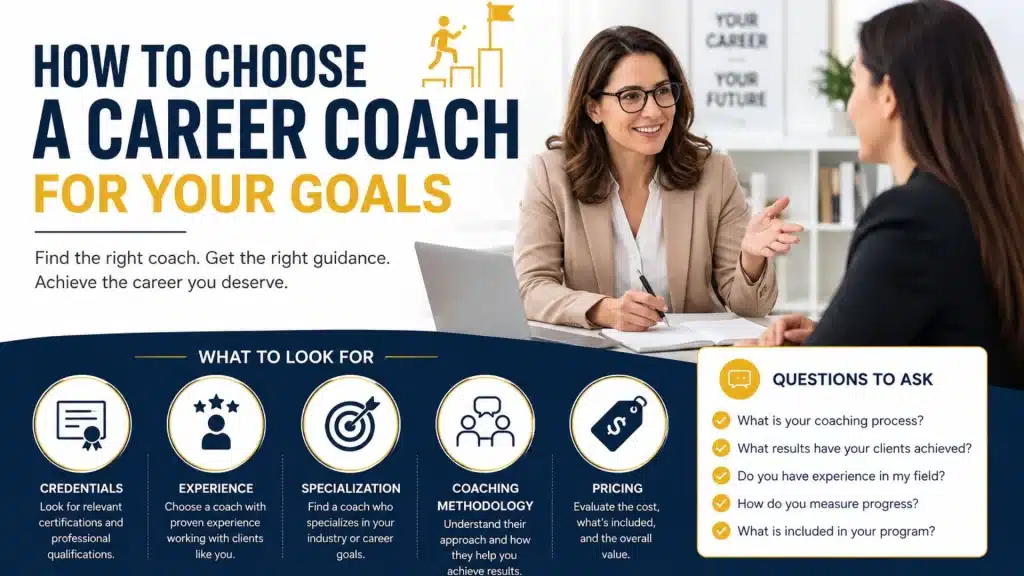
How to Choose the Right Career Coach?
Before paying for any program, evaluate the person or organization carefully.
Check Their Experience
Find out whether they understand your industry, career level, or particular challenge.
A coach who specializes in executive transitions may not be the best fit for someone seeking their first internship.
Review Their Qualifications
Coaching is not a universally licensed profession in the United States. Credentials can nevertheless provide useful evidence of training and professional standards.
Ask About the Coaching Process
Before enrolling, understand:
- What services are included?
- How will progress be measured?
- Is support individual, group-based, or asynchronous?
- Who will provide the guidance?
- What is the cancellation or refund policy?
The ICF Code of Ethics also emphasizes transparency about qualifications, confidentiality, financial arrangements, and the scope of coaching relationships.
Look for Specific Deliverables
A useful program should explain what you will actually receive. Examples include a career action plan, resume feedback, LinkedIn guidance, interview preparation, and structured progress reviews.
Avoid choosing a coach based only on attractive marketing claims.
Is Job Change Now Worth Considering?
For U.S. professionals who want help communicating their professional value, Job Change Now is one option worth evaluating.
The company describes itself as a career advisory service for professionals, executives, and career changers. Its approach focuses on helping members present their skills, achievements, and experience from a hiring manager’s perspective.
Its annual membership currently lists:
- One year of access to hiring-manager advisors.
- Email access for career advice and document feedback.
- Resume, LinkedIn, and professional document guidance.
- Twelve digital Member Reports.
- A printed 111-page Member Handbook.
- Interview, recruiter, networking, and salary negotiation strategies.
The website currently lists the annual membership at $499 as a one-time payment, with a 30-day refund policy stated in its FAQ. Check the latest membership benefits and pricing before enrolling because program details and pricing can change.
One distinctive part of its approach is the development of a Value Statement. This is a one-page presentation of your skills, achievements, professional highlights, and measurable results.
You can also explore its professional development coaching guidance to understand how it approaches professional positioning and communication.
Whether you choose Job Change Now or another provider, compare the actual services against your career goals rather than relying on promotional promises.
Frequently Asked Questions
Is career coaching worth it for someone who already has a job?
Yes, it can be useful for employed professionals seeking promotions, higher compensation, leadership opportunities, or a career transition. Coaching is not only for people who are unemployed.
How long does career coaching take to work?
There is no universal timeline. Some people gain clarity after a few sessions, while others need several months to develop skills, reposition their experience, and pursue new opportunities. Results depend on individual goals and the actions taken.
What is the difference between a career coach and a career counselor?
A career coach generally focuses on goals, professional positioning, and action plans. Career counselors may provide more formal career assessment and counseling support, depending on their qualifications and professional setting. Their services can overlap, so check the provider’s background and scope.
Can a career coach guarantee me a job?
No responsible career coach can guarantee that an employer will hire you. A coach can help you improve your preparation and approach, but hiring decisions depend on employers, market conditions, qualifications, and competition.
Conclusion
So, is career coaching worth it?
It can be a worthwhile investment when you need more than generic career advice. The right professional guidance can help you understand your strengths, develop a realistic career strategy, improve your resume and LinkedIn presence, prepare for interviews, and communicate your value to employers.
However, coaching is not a shortcut to employment or guaranteed career success.
Before investing, identify the problem you want to solve, compare providers, review their qualifications, and understand exactly what is included.
If you are serious about moving forward, start by writing down your three biggest career challenges and the outcomes you want to achieve.
Then decide whether you have the knowledge and resources to address them independently or whether professional guidance could help you make better progress.
Your career is an important long-term investment. Choose support that helps you make thoughtful decisions and take practical action toward the professional future you want.
Also Read: Signs It’s Time to Change Careers