
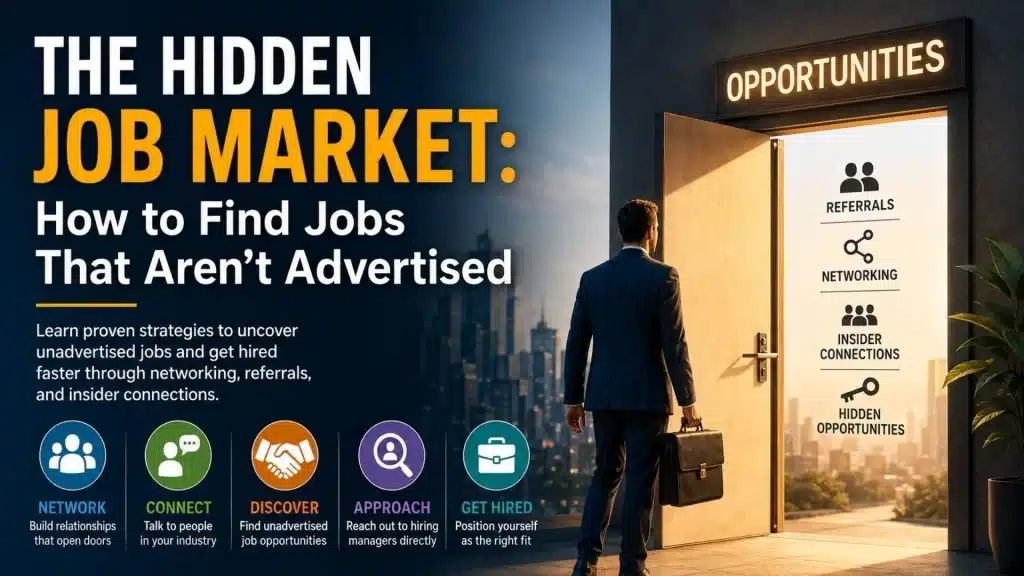
Job searching can start to feel like a numbers game after a while. Find a posting, tweak your resume, hit submit, wait. Repeat. Repeat again. Repeat until it feels less like a search and more like a chore.
But here’s the thing a lot of people don’t think about: some of the best roles never make it to a job board at all.
That’s the hidden job market.
The phrase refers to positions that companies fill without ever advertising them publicly through referrals, recruiters, internal moves, professional networks, or conversations that happen well before anyone writes a formal job description. It’s not that these jobs exist in some secret vault. It just means that if you’re only working from public listings, you’re leaving a lot of the actual hiring activity untouched.
The overall market is still fairly active, for what it’s worth. The Bureau of Labor Statistics reported around 7.4 million job openings in June 2026, alongside 5.3 million hires. But hiring has also gotten more selective in a lot of industries lately, which is exactly why it’s worth thinking beyond just clicking “Apply” and hoping for the best.
If you’re wondering how to actually find these hidden jobs, the short answer is this: get visible to the people who already know where the openings are before, or instead of, those openings ever going public.
What the Hidden Job Market Actually Is?
It’s the slice of hiring activity that companies never actively promote through public postings.
It shows up in a bunch of different ways:
- A manager asks a current employee if they know anyone good.
- A recruiter reaches out to someone already in their network.
- A company builds a role around a strong candidate they happened to meet.
- Someone hears about an opening informally, before it’s ever posted.
- An employee leaves unexpectedly and the company needs a fast replacement.
- A hiring manager crosses paths with a great candidate before the position is even open.
- A company quietly starts looking for a replacement for someone still on the payroll.
You’ll sometimes see claims about the exact percentage of jobs that are “hidden” worth taking those with a grain of salt. There’s no single, authoritative government number that tells us precisely what share of jobs are never advertised.
What’s actually useful here isn’t a statistic. It’s a reminder that not every hiring process starts with a public listing and that a huge share of job seekers spend nearly all their energy competing for the postings everyone else can see too.
Why Does This Matters More Than It Used To?
Online applications made it dramatically easier to apply for jobs. They also made it dramatically easier for employers to get buried in applications.
You can spend hours tailoring a resume and cover letter, hit submit, and get either an automated rejection or total silence. It’s a frustrating loop, and it’s become the default experience for a lot of job seekers.
Meanwhile, employers still need to find people with the right skills and the right fit that hasn’t changed.
Which creates a real opening if you shift how you think about it.
Instead of only asking:
“Where are the jobs?”
Start asking:
“Who actually knows where the jobs are?”
That reframe is really the whole foundation of a hidden-job-market strategy.
Openings existing doesn’t automatically mean any given candidate can get in front of them timing, qualifications, relationships, and what the employer actually needs in all shape who gets a real shot.
How to Actually Find Hidden Jobs?
This kind of search looks pretty different from the standard apply-and-wait routine. Instead of sitting back and waiting for a posting to appear, you’re building relationships and putting your value out there proactively.
Here’s what tends to actually work.
1. Build Relationships Before You Need Them
Networking is probably the single most effective way into jobs that never get advertised — but it doesn’t mean blasting a hundred strangers with “Can you help me find a job?”
Start with people who already have some connection to you:
- Former coworkers
- Past managers
- College alumni
- Clients or vendors you’ve worked with
- Industry peers
- People from professional associations
- Friends and family
- Recruiters you’ve dealt with before
- People you met once at a conference and never followed up with
The goal isn’t to ask for a job right out of the gate. It’s to start an actual conversation.
Something like:
“I’m exploring opportunities in operations leadership and would genuinely love to hear what you’re seeing out there. Any companies you know of expanding their ops teams lately?”
That kind of question can surface information no job board will ever give you.
2. Reach Out to Companies Before They Even Post
Put together a list of 20 to 30 companies you’d genuinely want to work for. Then dig into things like:
- Their growth plans
- Recent leadership changes
- New office locations
- New product launches
- Acquisitions
- Funding rounds
- Expansion into new markets
- Any department that seems to be scaling up
These are the kinds of signals that tend to precede hiring needs.
Say you’re a sales operations manager and you notice a company just doubled the size of its sales team over the past year. That’s worth acting on reach out to the VP of Sales or an ops leader there and explain how your background could help them build out scalable processes as they grow.
You’re not waiting around for a posting anymore. You’re showing up right when a business problem exists, which is a fundamentally different position to be in.
3. Treat LinkedIn as a Relationship Tool, Not Just a Job Board
A lot of people only use LinkedIn to scroll listings, which honestly leaves a lot on the table.
Use it instead to find:
- Hiring managers
- Department heads
- Recruiters
- Alumni from your school
- Former colleagues
- Industry voices worth following
- People currently working at your target companies
Then engage with what they’re posting before you ever ask them for anything. Leave a thoughtful comment. Share something genuinely useful. Congratulate someone on a promotion. Show up in industry conversations because you’re interested, not because you’re angling for something.
Job Change Now leans into this same idea treating LinkedIn as a visibility and relationship-building tool rather than just a search engine for postings. If you want more on that, our guide on optimizing your LinkedIn profile for career growth digs into it further.
4. Make Recruiters Part of the Plan, Deliberately
Recruiters can absolutely get you in front of roles that never reach a public board but sending your resume to every recruiter you can find isn’t much of a strategy.
Look for recruiters who actually specialize in your:
- Industry
- Function
- Seniority level
- Geographic market
- Specific niche
Then make sure they understand your value fast. A recruiter should be able to grasp what you do, at what level, and what kind of role you’re after almost immediately.
Compare:
“I am looking for a new opportunity.”
with:
“I’m a supply chain leader with 12 years of experience reducing procurement costs and improving inventory performance across multi-site operations. Right now I’m exploring VP and director-level roles in manufacturing.”
The second one gives a recruiter something to actually work with. We’ve got more on this in our piece on handling recruiters and getting the best offers, if you want to go deeper.
5. Write a Value Statement That Actually Says Something
One of the most common mistakes people make is describing themselves purely by their responsibilities, not their impact.
Skip:
“Managed a customer service team.”
Go with:
“Managed a 25-person customer service team and cut average response time by 31% while improving customer retention.”
The second version gives someone an actual reason to remember you which matters even more in the hidden job market, since you might be introducing yourself to someone who hasn’t even written a job description yet. Your value statement is what convinces them the conversation is worth having in the first place.
6. Talk to People Who Just Started Somewhere New
Someone who recently joined a company can be a surprisingly good source of information. They often know:
- Why the company was hiring in the first place
- Which teams are actually growing
- Which leaders are building out headcount
- What skills have been hard for them to find
- Whether more hiring is planned soon
Instead of “Can you get me a job there?” try:
“How’s the new role been going? What kinds of skills is your team looking for as it grows?”
A normal, low-pressure conversation like that can surface openings well before they ever go public.
7. Get Involved in Professional Associations
These tend to get overlooked, but they’re a solid way to meet people who already understand your industry’s hiring patterns.
Worth looking into:
- Industry-specific associations
- Local business groups
- Trade organizations
- Alumni networks
- Conferences
- Leadership groups
- Niche online communities
Don’t show up to one event and immediately start asking for referrals that rarely works and can feel transactional. Build familiarity over time instead. People recommend the people they actually know and trust, not someone they met once for five minutes.
8. Use Informational Interviews on Purpose
An informational interview is just a conversation aimed at learning about someone’s role, company, or industry and it can be a genuinely great way to surface jobs that don’t exist yet publicly.
Good questions to ask:
- What skills matter most in your department right now?
- What’s your team currently struggling with?
- What kinds of backgrounds tend to do well here?
- Is the company growing in any specific area?
- Given my background, what would you focus on?
Don’t turn it into a pitch. Actually listen. What you learn from these conversations can point you toward exactly where your skills are needed.
What Does This Look Like in Practice?
Take Sarah, a marketing director trying to move from a large corporation into a growing tech company.
She spends two months applying to public postings and barely gets any interviews out of it. Frustrating, but not unusual.
So she changes tack. She identifies 25 tech companies that have recently expanded their marketing teams. She reconnects with former colleagues and two industry contacts who now work at some of those companies, and she talks to a recruiter who specializes in marketing leadership roles.
During one of those conversations, she finds out a company is quietly considering hiring a senior marketing leader but hasn’t posted anything yet. She researches the company, figures out where her background fits, and sends a short, specific message to the executive who’d be leading that department.
Nothing about this guarantees an offer. But it changes the competition entirely. Instead of being applicant number 300 for a listing everyone else can see, she’s now having a real conversation about an actual business need.
That’s the hidden job market working the way it’s supposed to.
Mistakes That Undercut This Strategy
A solid approach can fall apart if the networking part gets too transactional. Watch out for:
- Vague, generic outreach: “Hi, I’m looking for a job, let me know if you hear of anything” gives the other person almost nothing to act on.
- Blasting a lot of people with no research: Fewer, well-targeted conversations beat mass outreach almost every time.
- Making it all about what you want: Lead with the value you can offer, not just what you’re hoping to get.
- Being vague about your target: If you say you’re “open to anything,” people genuinely don’t know how to help you — it’s not that they don’t want to.
- Ignoring your own online presence: Before reaching out to recruiters or hiring managers, make sure your resume and LinkedIn actually back up whatever story you’re telling them.
Is the Hidden Job Market Better Than Applying Online?
Not really and it’s not an either/or choice anyway.
The strongest approach almost always combines both. Use job boards and company career pages to find what’s out there. At the same time, build relationships with the people who can pull you into conversations that never show up on those boards in the first place.
Think of it as two lanes running in parallel:
Public job market: Job boards, company sites, applications, recruiters.
Hidden job market: Networking, referrals, direct outreach, professional relationships, recruiter conversations.
You don’t have to pick a lane. Run both at the same time.
Where Job Change Now Fits In?
Finding roles outside the usual postings takes more than just networking; you also need to know how to communicate your value once someone actually opens the door for you.
Job Change Now focuses on exactly that: helping people build a clear sense of their professional value, sharpen their brand, communicate effectively with hiring managers, work smarter with recruiters, and navigate career transitions. Our membership resources cover networking, the hidden job market, recruiter relationships, interviewing, and broader career planning.
If you feel stuck somewhere between applications and interviews, a more structured approach like this can help turn a reactive, exhausting search into something a lot more deliberate.
Conclusion
The hidden job market isn’t some secret database only insiders can access. It’s really just a different way of approaching your career search.
Instead of sitting back and waiting for the perfect posting to appear, you can identify the companies you actually want to work for, understand what they’re dealing with, build relationships with the people making decisions, communicate your value clearly, and end up part of the conversation before a role is ever publicly listed.
Start small. Pick 10 companies. Find five relevant people at each one. Reach out with something specific, not generic. Reconnect with people from your past. Talk to a recruiter who actually specializes in your space. Tighten up your LinkedIn. And above everything else, get genuinely clear on the value you bring to the table.
This isn’t about giving up on applying to jobs. It’s about not depending on applications alone.
Run the public job market and the hidden job market together, and you end up with more paths toward your next role and a real shot at getting considered before the competition gets crowded.
FAQ
What exactly is the hidden job market?
It’s the set of job opportunities companies never advertise publicly. They fill these through referrals, recruiters, professional networks, direct outreach, internal moves, or existing relationships.
How do I actually find these jobs?
Start by identifying target companies and the people you already know connected to your industry. Build real relationships, talk to recruiters, reconnect with former colleagues, get involved in industry events, and reach out directly to companies where your skills clearly solve a problem they have.
Is it true that most jobs are hidden?
There’s no reliable government statistic confirming a specific percentage. Be skeptical of anyone claiming an exact figure. The real takeaway is simply that some jobs get filled without ever being advertised widely not that all or even most of them are.
Can LinkedIn actually help with this?
Yes it’s useful for identifying hiring managers, recruiters, alumni, and industry contacts. It works best when you use it to build relationships and stay visible, rather than treating it purely as a search engine for listings.
Should I stop applying to posted jobs altogether?
No. Public postings are still an important piece of the puzzle. The stronger move is combining applications with networking, recruiter relationships, referrals, and direct outreach — not replacing one with the other.