You can have exactly the right experience, genuinely strong skills, and a solid career behind you and still not be landing interviews. Nine times out of ten, the actual problem isn’t your qualifications. It’s how your resume is presenting them.
Getting a handle on the most common resume mistakes can make a real difference in your job search. A resume has to work for two different audiences at once. First, it needs to be readable by an applicant tracking system (ATS). Then, assuming it clears that hurdle, it needs to give an actual recruiter enough reason to keep reading past the top of the page.
This matters even more given where hiring stands right now. Monster’s 2026 State of Resumes report found 49% of job seekers are now using resumes longer than one page, with 30% running two pages or more. The same research also found a lot of candidates are increasingly anxious about getting filtered out by ATS screening before a human ever sees their name.
The genuinely encouraging part: most of these problems are fixable, usually without needing a total rewrite.
Whether you’re applying for your first real professional role, switching careers, or going for something senior, dodging these common mistakes can help you present the experience you already have a lot more clearly.
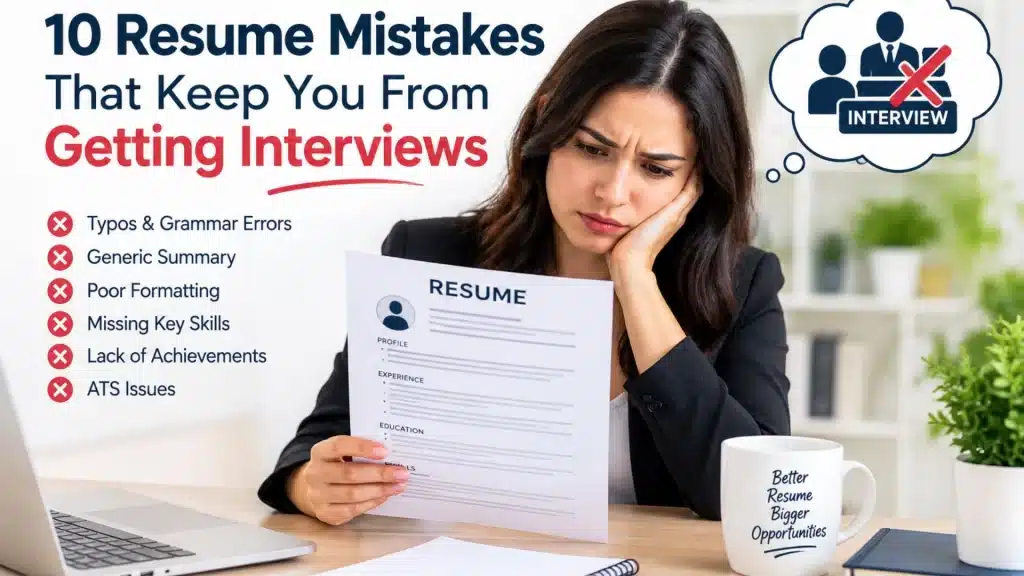
10 Resume Mistakes That Are Quietly Costing You Interviews
The most common problems tend to be: using the exact same resume for every job, writing a generic professional summary, listing duties instead of actual achievements, ignoring ATS-friendly formatting, stuffing the resume with keywords, making it too long or too short, including too much irrelevant information, leaning on weak or vague language, letting spelling and grammar errors slip through, and probably the biggest one underneath all of these — failing to clearly show your actual value.
Let’s go through each one, and more importantly, how to actually fix it.
1. Using the Same Resume for Every Job
One of the biggest pitfalls out there is sending the exact same document to every employer, unchanged.
Your resume shouldn’t just describe your career in the abstract, it should make the case for why your background fits this specific position.
Say you’re a marketing manager applying for two roles: a Digital Marketing Director position, and a Brand Marketing Manager position. Your actual experience might be relevant to both. But what you lead with should shift.
For the first, you might highlight digital acquisition, marketing analytics, paid media, conversion optimization, and team leadership. For the second, you’d lean instead into brand strategy, customer research, campaign development, positioning, and cross-functional collaboration.
You don’t need to rewrite the whole thing from scratch for every application, just adjust your summary, your skills section, and the achievements you’re leading with.
The fix: Read the job description carefully. Pin down what the employer’s actually prioritizing, and make sure your resume clearly shows where you meet it.
2. Writing a Generic Professional Summary
A summary like:
“Hardworking professional with excellent communication skills seeking a challenging position.”
does almost nothing to help a recruiter understand your value. It describes what you want, not what you actually bring to the table.
A stronger version ties your experience directly to what the employer probably needs:
“Operations leader with 12+ years of experience improving service delivery, reducing operating costs, and leading cross-functional teams across multi-site organizations.”
That gives a recruiter something concrete to actually evaluate.
The fix: Your summary should quickly answer three things: what do you do, what are you particularly good at, and what measurable value have you created? If you’re struggling to nail that down, building a real value statement can help connect your experience to what employers are actually looking for.
3. Listing Duties Instead of Achievements
This is probably the single most common mistake in resume writing, full stop.
Weak: “Responsible for managing a sales team and developing sales strategies.”
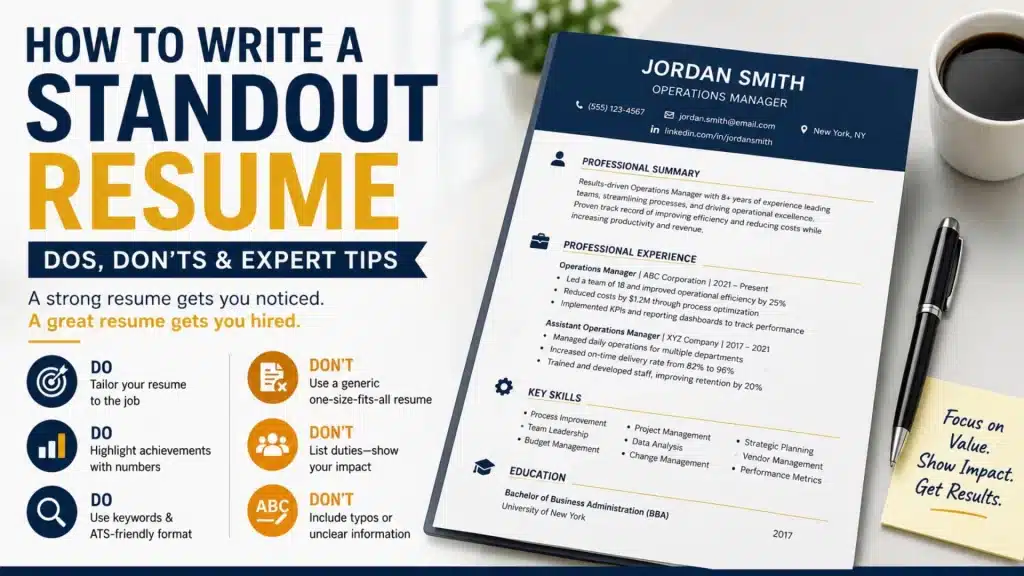
Stronger: “Led a 14-person sales team that increased annual revenue by 23% through territory restructuring and improved pipeline management.”
The first tells an employer what your job requires of you. The second shows what you actually did with it. Recruiters want evidence, not a job description.
Wherever you genuinely can, tie your work to revenue, cost savings, productivity, customer growth, retention, efficiency, time saved, team performance, or quality improvements.
A simple formula helps: action + task + measurable result. Something like: “Reduced customer response time by 35% by redesigning the support escalation process.”
You don’t need a headline-grabbing achievement behind every single bullet — but your resume as a whole should carry enough real evidence to show your work actually produced something.
4. Ignoring ATS-Friendly Formatting
Applicant tracking systems are a genuinely major part of hiring now. A 2026 Jobscan report flags several formatting habits that can trip up how a resume gets parsed complex columns, graphics, text boxes, unusual fonts, and important details tucked into headers or footers where software can miss them entirely.
That doesn’t mean every ATS behaves identically. It does mean unnecessarily complicated formatting creates a genuinely avoidable risk.
Skip multiple columns, skill bars and graphics, information hidden inside images, decorative icons standing in for actual words, unusual section names, heavy design flourishes, text boxes carrying critical info, and fonts that are hard to read at a glance.
Stick instead with standard headings like “Work Experience” and “Education,” clear job titles, consistent dates, simple bullet points, a clean structure overall, and relevant keywords written out in normal text.
5. Stuffing the Resume With Keywords
There’s a real difference between using relevant keywords and just stuffing them in for the sake of it.
Say a job description keeps mentioning “project management.” You should genuinely use that phrase wherever it accurately reflects your experience. But writing “project management, project management, project management” over and over doesn’t make your resume any stronger, it just makes it read unnaturally and irritating for an actual person to get through.
The better approach: identify the important terms tied to job titles, technical skills, certifications, industry knowledge, software, business functions, and leadership capability. Then weave those in naturally through your summary, skills section, and achievement bullets. The goal was never tricking an ATS, it’s making your real qualifications easy to spot.
6. Making the Resume Too Long or Too Short
“Your resume has to be exactly one page” is genuinely outdated advice at this point. The right length depends heavily on your experience and where you are in your career.
A recent grad might have plenty of relevant material for one page. Someone with 15 years of experience might reasonably need two. A senior executive with a long track record might need to think it through even more carefully.
The real question was never “how many pages should this be.” It’s: does every single section actually help make a stronger case for this specific job? If a bullet isn’t demonstrating relevant experience, skill, or achievement, it’s probably worth cutting.
7. Including Too Much Irrelevant Information
One of the easiest ways to quietly weaken a resume: including basically everything you’ve ever done, regardless of relevance.
Your resume isn’t a complete employment record, it’s a targeted document built around a specific goal. If you’re applying for a senior financial analyst role, your future employer almost certainly doesn’t need five bullet points about a part-time retail job from 15 years ago.
Older experience can still have a place if it genuinely helps explain your career trajectory just give the most real estate to whatever actually supports where you’re headed now.
This matters even more for career changers specifically. If you’re moving between industries, lean into transferable skills rather than giving every past responsibility equal weight regardless of relevance. Indeed’s 2026 resume guidance makes the same point — emphasize what transfers when you’re switching industries or roles, rather than trying to represent everything equally.
8. Using Weak or Vague Language
Words like “helped,” “worked on,” “responsible for,” and “assisted” aren’t automatically wrong — but leaning on them constantly makes your experience sound passive, like things happened around you rather than because of you.
Compare:
“Helped improve the company’s hiring process.”
with:
“Redesigned the interview scheduling process and reduced average scheduling time by 40%.”
The second gives the reader a much clearer sense of your actual contribution. Use stronger action verbs wherever they’re genuinely accurately led, developed, increased, reduced, negotiated, built, launched, improved, managed, streamlined, implemented, delivered and then back each one with real evidence, not just a stronger-sounding word.
9. Letting Spelling, Grammar, or Formatting Errors Slip Through
One typo probably won’t sink your career. Repeated errors, though, start to quietly raise doubts about your attention to detail especially for roles where communication, documentation, accuracy, or client interaction is central to the job.
Before you submit anything, check spelling, check grammar, verify company names and job titles, double-check employment dates, confirm your phone number and email are current, keep punctuation consistent, review your bullet formatting, and make sure nothing’s accidentally duplicated.
Don’t lean entirely on automated grammar tools actually read through the document yourself. Even better, hand it to someone else. A fresh set of eyes tends to catch the awkward sentence or missing word you’ve stopped noticing after reading the same page for the fortieth time.
10. Failing to Clearly Show Your Value
This might genuinely be the root cause behind most of the other nine mistakes on this list.
Your resume needs to answer one simple question: why should this employer bother interviewing you specifically? Experience matters, sure but experience on its own doesn’t automatically communicate value.
Say two candidates both have 10 years of project management experience. Candidate A writes: “Managed projects from beginning to end.” Candidate B writes: “Managed 25+ technology projects with budgets up to $2.5 million while consistently meeting major delivery milestones.”
Candidate B is giving the employer real evidence to work with. This is really the whole idea behind resume optimization not making a document look prettier, but making a candidate’s genuine value easier to actually see.
A Few Funny Resume Mistakes, for Good Measure
Not every resume slip is a serious one. Some are just unintentionally funny.
There’s the classic someone writing “I am an excellent attention to detail” without a hint of irony. Or a resume that promises “references available upon request,” attached to an accidental leftover reference list from a completely different job application.
Good for a laugh, but the underlying lesson is genuinely serious: proofread before you hit send. Even small slip-ups can distract from the actual case you’re trying to make.
One trick worth trying: read your resume backward, starting from the final bullet and working up. It’s a lot easier to catch individual awkward words or typos when you’re not just autopilot-reading a document you already know by heart.
A Quick Self-Check Before You Submit
- Content. Does this match the target role? Is my summary genuinely specific? Have I shown measurable accomplishments? Is my strongest material easy to find at a glance?
- ATS. Is the formatting simple? Am I using standard section headings? Are important keywords woven in naturally? Is anything critical hidden inside a graphic or text box?
- Readability. Are the bullets concise? Is the most relevant experience easy to spot quickly? Have I cut anything unnecessary? Does the whole document look visually consistent?
- Accuracy. Any spelling errors left? Are the dates right? Are job titles correct? Is my contact info current?
If most of these come back “yes,” you’ve already eliminated the majority of the most common resume problems out there.
Fixing These Before Your Next Application
Knowing about these 10 mistakes only actually helps if you go back and act on them.
Start with the basics. Tailor your resume to the specific role. Swap generic duties for measurable achievements. Keep the formatting clean and genuinely ATS-friendly. Weave in relevant keywords naturally, not by force. Cut anything outdated. Proofread it properly, and make sure your value is obvious at a glance, not buried somewhere in paragraph three.
Above everything, remember your resume was never meant to be a simple record of your career. It’s a marketing document, built to help an employer quickly understand what you can actually contribute.
If your applications aren’t turning into interviews, don’t automatically assume you need more experience first. Look hard at the resume itself before anything else. Fixing even a handful of these issues can make your qualifications easier to find, easier to understand, and genuinely more relevant to whoever’s reading it.
Your next interview probably doesn’t require a completely different career. It might just require a better way of presenting the one you already have.
FAQ
What’s the single biggest resume mistake to avoid?
Using a generic, one-size-fits-all resume for every application. It should be adjusted each time to highlight the skills, experience, and accomplishments most relevant to that specific role.
Can an ATS actually reject a resume purely over formatting?
Poor formatting can genuinely interfere with how an ATS parses your information. Complex layouts, graphics, unusual headings, text boxes, and info buried in headers or footers can all create problems. A simple, clean structure is generally the safer bet.
How long should a resume actually be?
There’s no universal page limit. One page can work well early in a career; experienced professionals often need two or more. Relevance matters a lot more than the raw page count.
Should every job I’ve ever had be on there?
No include what genuinely supports your current goal. Older roles can be shortened or dropped entirely once they stop adding meaningful evidence for what you’re going after now.
Should I use AI to help improve my resume?
It can genuinely help with brainstorming, grammar, structure, and spotting gaps. But the resume itself needs to stay accurate and genuinely reflect your actual experience, never invent accomplishments or lean on tricks meant to manipulate screening software.