Landing the interview is one hurdle. Landing the offer is a completely different one, and it takes more than rattling off technically correct answers. What hiring managers are really trying to figure out is how you think, how you communicate, how you solve problems, and whether you’d actually be good to have on the team.
That’s why the interview tips worth following go beyond memorized responses. You need to show that you get the role and that you can draw a straight line from your experience to what the employer is actually trying to solve.
The market isn’t exactly easy right now, either. The U.S. Bureau of Labor Statistics reported roughly 7.4 million job openings and 5.3 million hires in June 2026. LinkedIn’s 2026 research adds another data point worth knowing: the number of U.S. applicants per open role has roughly doubled since spring 2022.
Translation: showing up prepared matters more than it used to. Whether this is your first real professional interview, a career pivot, or a shot at something more senior, these 15 strategies should help you walk in and actually make an impression instead of just answering questions.
What Is a Hiring Manager Actually Evaluating?
Before getting into the specific tactics, it’s worth understanding what’s going on in the interviewer’s head.
Most of the time, they’re quietly working through questions like:
- Can this person actually do the job?
- Do they understand what the role really requires?
- Can they explain themselves clearly?
- Can they solve problems without being micromanaged?
- Will they mesh with the rest of the team?
- Do they show decent judgment under pressure?
- Are they genuinely interested, or just applying to everything?
- Can they point to results, not just describe their job duties?
Indeed’s current guidance on hiring-manager interviews puts it plainly: interviewers want proof that a candidate can handle the actual work, and that their background genuinely lines up with what the role requires.
So your goal isn’t to deliver some flawless, textbook answer. It’s to make it easy for the person across the table to picture you actually helping their team.
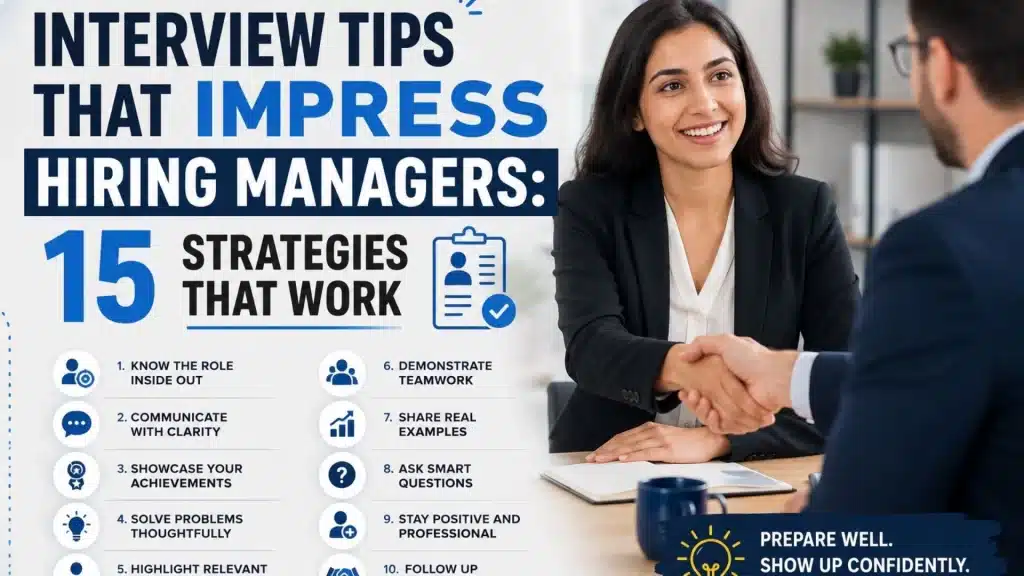
15 Interview Tips That Actually Move the Needle
1. Go Deeper Than the Company’s Homepage
This one gets skipped constantly, and it’s genuinely one of the highest-leverage things you can do: research the company properly, not just superficially.
Don’t stop at “About Us.” Dig into things like:
- Recent announcements or news
- Their actual products or services
- Who their main competitors are
- Leadership and recent changes
- Challenges they’ve been dealing with publicly
- Company culture, as best you can tell
- Broader trends in their industry
- The specific team or department you’d be joining
Then actually connect what you found to the role you’re going for.
Skip the generic:
“I really like your company.”
Go with something that shows you did the homework:
“I noticed you’re pushing into B2B accounts more aggressively lately. In my last role, I helped improve lead conversion by 18%, so this position caught my eye for that reason specifically.”
That’s the difference between sounding interested and sounding prepared.
2. Read the Job Description Like You’re the One Hiring
The job posting is basically a cheat sheet for what the employer cares about. Most people just don’t read it that way.
Go through it a few times and look for what keeps repeating. Pay attention to:
- Required skills
- Preferred (but not required) qualifications
- The core day-to-day responsibilities
- What “good performance” seems to mean here
- Any leadership expectations
- Specific tools or technology mentioned
- Industry-specific experience they’re hoping for
A simple trick: build yourself a three-column sheet mapping requirements to your own background.
| Job Requirement | Your Experience | Example |
| Project management | 5 years | Led a $500K project |
| Team leadership | 8 employees | Improved productivity |
| Customer retention | SaaS experience | Reduced churn by 12% |
It sounds basic, but having this mapped out ahead of time makes it much easier to answer questions with something concrete instead of scrambling for an example on the spot.
It also matches where employers’ heads are these days. LinkedIn found that more than nine in ten talent-acquisition professionals see accurately assessing candidate skills as central to hiring well.
3. Nail Your “Tell Me About Yourself” Answer
This is almost always the opening question, and it trips people up constantly. Please don’t just read your resume out loud. Nobody wants that, including you.
Try a simple structure instead: Present → Past → Future.
- Present: What you’re doing right now
- Past: The experience that’s most relevant to this specific role
- Future: Why this opportunity makes sense as your next move
Something like:
“I’m currently a marketing manager focused on B2B demand generation. Over the last six years I’ve worked across content, paid acquisition, and SEO, and helped push qualified leads up by 35%. I’m looking now for a role with broader ownership over growth strategy — which is exactly what pulled me toward this position.”
Aim for roughly 60 to 90 seconds. Long enough to say something real, short enough that you don’t lose the room.
4. Use STAR for Behavioral Questions
You’ll recognize these questions immediately:
- “Tell me about a time when…”
- “Give me an example of…”
- “Describe a situation where…”
- “How did you handle…”
The STAR structure works well here:
- Situation — what was going on
- Task — what you were responsible for
- Action — what you personally did (not “we”)
- Result — what actually happened
The Action and Result parts carry the most weight. Don’t just say:
“We improved customer retention.”
Instead:
“Churn had crept up for two straight quarters. I dug into the cancellation data and found onboarding was the real issue. I redesigned the first 30 days of the customer journey and added weekly check-ins. Churn dropped 14% within two quarters.”
That’s a story with actual evidence in it, not just a claim.
5. Quantify Whatever You Can
Numbers just make answers more believable. Compare:
Weak: “I managed a large sales team and improved performance.”
Better: “I managed a team of 12 sales reps and grew quarterly revenue by 22%.”
Use whatever’s relevant and true percentages, revenue, cost savings, time saved, customer counts, team size, budget size, conversion rates, productivity gains. You don’t need to force a number into every single answer, but when a real one exists, use it.
6. Be Specific About Why This Job
Hiring managers can usually tell when someone’s applying everywhere versus actually interested in the specific role. Skip:
“I’m looking for a new challenge.”
Try tying together your background, the company’s actual needs, and where you’re trying to go:
“I’ve spent the last five years in customer success, mostly with SaaS clients. This role stood out because your team is expanding into enterprise accounts, which lines up directly with the larger-account experience I’ve been building.”
It reads as intentional, because it is.
7. Think About Their Problems, Not Just Your Goals
This might be the single most underused tip on this list. It’s natural to focus on what you want out of the job. But flip it: think about what the hiring manager actually needs from whoever fills this seat.
If the posting mentions things like:
- Improving reporting
- Reducing churn
- Building out a sales pipeline
- Managing a team
- Launching new products
- Tightening up operations
…then have real examples ready that speak directly to those. The underlying question you’re answering, whether they say it out loud or not, is basically: “Why should I trust this person to handle this?”
Reframing your prep around their problems instead of your own wish list tends to sharpen your answers a lot.
8. Show, Don’t Just Claim
Anyone can say “I’m a great problem solver.” It’s meaningless without something behind it.
Tell a short, concrete story instead:
“Our monthly reporting process was eating up about three days each cycle. I mapped out the workflow and found a lot of duplicated data entries. I automated it, and the reporting time dropped to about four hours.”
Notice nowhere in there did the person say “I’m good at solving problems.” They just showed it. That’s usually a more convincing move than the direct claim.
9. Prepare for the Uncomfortable Questions Too
Don’t just rehearse the questions you’re hoping to get. Think through the ones you’re dreading.
You might need to explain:
- A gap in employment
- A career change that looks unusual on paper
- A short stint somewhere
- Missing industry experience
- Being “overqualified”
- A project that didn’t go well
- A rough situation at a previous job
- Why you left your last employer
Keep the explanation honest and forward-looking rather than defensive:
“I stepped away from full-time work for a while to care for a family member. During that time I finished a professional certification and kept my skills sharp through freelance work. I’m ready to jump back into a full-time role now.”
No need to over-explain or apologize repeatedly. State it, add context, move on.
10. Practice — Just Don’t Memorize Word for Word
Practicing matters. Memorizing full scripts tends to backfire, though, because it makes you sound like you’re reciting a speech instead of having a conversation.
Better approach: build bullet-point outlines for five to seven core stories covering things like:
- A major win
- A tough problem you had to untangle
- A mistake or failure (and what you learned)
- A conflict you navigated
- A time you led something
- A time you had to adapt quickly
- A time you exceeded what was expected of you
Practice talking through each one out loud, but let the exact wording shift a little each time. That’s what keeps it sounding like you, not a script.
If you want more structured help with this, working with a job interview coach can be useful for practicing out loud and spotting weak points before it counts.
11. Bring Genuinely Good Questions
The interview isn’t a one-way evaluation; you’re sizing up the employer too, whether you consciously think of it that way or not.
Whatever you do, don’t end with “No, I think I’m good.”
Have at least three solid questions ready. Some that tend to work well:
- “What would success look like in the first six months?”
- “What’s the biggest challenge whoever takes this role needs to solve?”
- “How does the team measure performance day to day?”
- “What separates your strongest performers from everyone else?”
- “What’s the team focused on over the next year?”
These aren’t just fillers, they can genuinely tell you something about the role, and they signal that you’re thinking seriously about whether this is the right fit.
12. Actually Listen
Strong candidates aren’t just waiting for their turn to talk. If the hiring manager brings up a specific challenge, engage with it instead of steamrolling into your next prepared point.
Something as simple as:
“That’s interesting we ran into something similar at my last company. We found that…”
turns the interview into an actual conversation instead of a rapid-fire Q&A. It also helps you avoid one of the most common interview traps: giving a long, meandering answer that never quite gets to what was actually asked.
13. Keep It Tight
It’s tempting to turn every answer into a five-minute story. Resist that urge.
A decent rule of thumb: Answer → Example → Result → Stop.
If they want more, they’ll ask for a follow-up. For most standard questions, one to two minutes is plenty. Behavioral questions naturally run a bit longer since there’s more to explain.
Watch for cues too if the interviewer starts shifting toward the next topic, that’s usually your sign the answer landed and it’s time to wrap up.
14. Take Virtual Interviews Seriously
Remote interviews are just standard now across a lot of industries, but that doesn’t mean you can wing them.
Before it starts:
- Test your camera and mic ahead of time
- Check your internet connection
- Pick a quiet spot
- Keep your background reasonably professional
- Close any tabs or apps you don’t need open
- Have your resume within reach
- Silence your phone
- Log on a few minutes early
Look into the camera when you’re talking rather than watching yourself on screen the whole time. It’s a small thing, but it reads as much more engaging. Keeping a few short notes nearby is fine too, as long as you’re not obviously reading off them.
15. Send a Real Thank-You, Not a Formality
The interview doesn’t necessarily end when the call does. A short follow-up message can genuinely reinforce your interest but only if it’s specific.
Reference something that actually came up in the conversation:
“I really enjoyed hearing about the team’s plans to expand into enterprise accounts, it reinforced my interest in the role, since a lot of my background is in building exactly those kinds of customer relationships.”
Keep it brief. You’re not writing a second cover letter, you’re just reminding them why the conversation mattered.
If You Don’t Have a Ton of Experience Yet
Not everyone walking into an interview has a decade of relevant history, and that’s fine. If you’re a recent grad, switching careers, or moving into a new industry entirely, lean into transferable skills instead of apologizing for what you don’t have.
A teacher moving into corporate training, for example, can point to presentation skills, curriculum design, stakeholder communication, leadership, and conflict resolution.
A customer service rep moving into sales can lean on relationship-building, communication, handling objections, CRM familiarity, and general problem-solving.
You don’t need to pretend your past experience is irrelevant, you just need to explain, plainly, how it actually transfers. This is also somewhere a career coach service can genuinely help, since an outside perspective is often better at spotting transferable strengths than you are on your own.
Mistakes That Quietly Sink Good Candidates
Even people who are genuinely qualified trip themselves up sometimes. Watch out for:
- Showing up late
- Vague, generic answers
- Trash-talking a former employer
- Skipping company research
- Bringing up salary too early
- Interrupting the interviewer
- Talking way too much
- Taking sole credit for team wins
- Claiming skills you can’t actually back up
- Having zero questions at the end
One subtler mistake worth naming: trying to sound impressive instead of trying to be useful. What most hiring managers actually need is evidence you can solve problems, work well with others, and deliver. Keep coming back to that.
The Day Before: What to Actually Do
Don’t try to cram everything the night before. Instead, review what you’ve already prepared.
Research
- Revisit the company
- Reread the job description
- Look into the interviewer if you know who it is
Prep
- Run through your intro
- Review your five to seven STAR stories
- Refresh your memory on your biggest wins
- Finalize your questions
Logistics
- Confirm the time
- Double-check the location or meeting link
- Test your tech if it’s virtual
- Sort out what you’re wearing
- Keep resume copies handy
Mindset
Don’t aim to eliminate nervousness completely, that’s not realistic for most people. Aim to be prepared enough that the nerves don’t run the show.
The Interview Is Your Chance to Make the Case
The interview tips that actually work aren’t about clever phrasing or trying to guess every question in advance. They’re about preparation, plain and simple.
Know the employer. Understand the role. Have real stories ready. Put numbers behind your wins where you can. Listen more than you’d expect. Keep your answers focused. Ask questions that show you’re paying attention. And above everything else, show the hiring manager how your experience actually helps solve their problems.
That clarity matters more than ever right now. LinkedIn’s 2026 research found that 65% of job seekers say finding work has gotten harder, while 66% of recruiters say the same about finding qualified people.
Which, oddly enough, is an opening for anyone who shows up genuinely prepared. So before your next interview, don’t just go hunting for more sample questions to memorize.
Build your story. Know your numbers. Understand what problems this employer is actually trying to solve. And practice explaining, clearly, why you’re the person who can solve them.
If you want extra support getting ready for interviews or thinking through your next career move, Job Change Now can help you walk in with a clearer strategy and a lot more confidence.
FAQ
What’s the single best interview tip?
Connect your experience directly to what the employer actually needs. Specific examples and measurable results do more work than any clever phrasing ever will.
How do you actually impress a hiring manager?
Research the company, understand what the role really requires, back up your answers with specific examples, and show clearly how your experience solves their problems. Ask good questions and let genuine interest come through.
What should I say for “tell me about yourself”?
Keep it concise using present-past-future: what you do now, the most relevant piece of your past, and why this role is a logical next step.
How long should my answers actually be?
Most answers land well around one to two minutes. Behavioral questions can run longer since there’s more ground to cover. Trim anything that doesn’t serve the point.
What questions should I ask them?
Ask about success metrics, expectations, challenges, team priorities, and performance — something like “What would success look like in the first six months?” It signals you’re thinking past just getting the offer.
Also Read: How to Change Careers