When people search for a job description, they are usually trying to understand a simple but important part of the hiring process: what does the employer actually expect from the person they hire?
The standard term is job description. It explains what a role involves, what qualifications may be expected, and what responsibilities the employee will handle. For job seekers, learning how to read one properly can make a big difference.
A job description is not just a list of duties. It can give you clues about what the employer values, which qualifications matter most, and whether the role fits your experience and career goals.
This matters in a U.S. job market where career paths continue to change. The Bureau of Labor Statistics projects about 886,600 openings each year on average in business and financial occupations from 2025 to 2035.
That means job seekers will continue to encounter thousands of different roles with different expectations.
So, what is a job description, why does it matter, and what should a job description include? Let’s break it down in simple terms.
What Is a Job Description?
A job description is a written explanation of a position. It usually describes the purpose of the role, primary responsibilities, required or preferred qualifications, skills, and other details that help explain what the job involves.
A company’s own job description will usually be more specific than an occupational profile because it is written for a particular position.
For example, a Marketing Manager job description might include:
- Developing marketing campaigns
- Managing digital channels
- Reviewing campaign performance
- Working with sales teams
- Managing outside vendors
- Preparing reports for leadership
The same title can look very different from one employer to another. That is why reading the details matters more than relying on the title alone.
Why Job Descriptions Matter for Job Seekers?
A job description can help you answer three important questions:
- Can I realistically perform this job?
- Does my background match what the employer needs?
- How should I position myself when I apply?
This third question is especially important. A strong application does not simply repeat everything you have ever done. It connects your experience to the needs of the employer.
For example, suppose a job description says the employer needs someone who can:
- Manage a team of 10 employees
- Improve operational efficiency
- Analyze performance data
- Prepare executive reports
If your resume only says:
Responsible for daily operations.
You may be qualified, but you are not showing enough evidence.
A stronger version might say:
Managed a 10-person operations team and improved workflow efficiency by redesigning weekly scheduling and performance reporting.
The second statement gives the hiring manager a clearer reason to continue reading. This is also where Job Change Now can be relevant for professionals who need help connecting their experience to what employers are looking for. Its career coaching approach focuses on communicating professional value, strengthening personal branding, and helping job seekers present their experience more effectively.
What Should a Job Description Include?
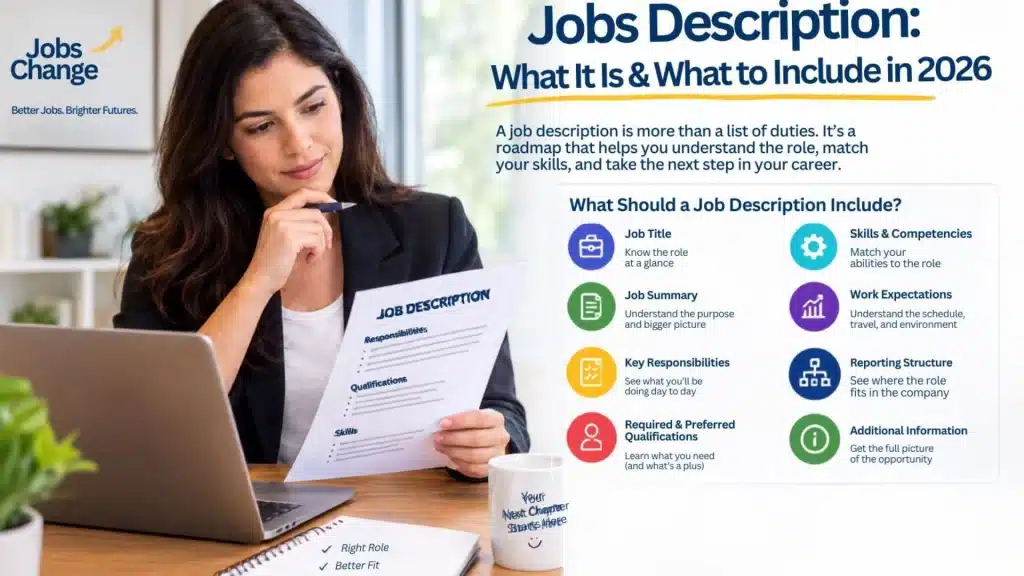
A good job description should make the role easier to understand. While formats vary by company, most useful descriptions contain several core elements.
1. Job Title
The title tells you what position the company is hiring for.
Examples include:
- Operations Manager
- Registered Nurse
- Software Developer
- Financial Analyst
- Human Resources Specialist
Pay attention to the title, but do not make a decision based on it alone. Different companies may use different titles for similar work.
2. Job Summary
The summary provides a brief explanation of the position. A useful summary should tell you:
- Why the position exists
- What the employee will be responsible for
- Where the role fits within the organization
- Who the employee may work with
Think of this section as the quick answer to:
“What would I actually be doing here?”
3. Key Responsibilities
This is one of the most important parts of a job description. Look for the duties that appear repeatedly or receive the most detail.
For example:
Operations Manager
- Manage daily operations
- Track key performance indicators
- Lead process improvement efforts
- Supervise department employees
- Coordinate with senior management
These responsibilities can help you identify which parts of your experience should receive the most attention in your resume and interview.
4. Required Qualifications
Required qualifications are usually the employer’s baseline expectations. They can include:
- Education
- Professional experience
- Certifications
- Technical knowledge
- Industry experience
- Licensing
- Specific software experience
Read this section carefully. There is a difference between required and preferred qualifications.
If a posting says a certification is preferred, that does not necessarily mean applicants without it are automatically excluded.
5. Skills and Competencies
Many employers list both technical and interpersonal skills. Technical skills might include:
- Excel
- Salesforce
- SQL
- Project management
- Financial analysis
Other skills may include:
- Communication
- Leadership
- Problem solving
- Collaboration
- Organization
- Adaptability
How to Read a Jobs Description Like a Hiring Manager?
A job description is more useful when you stop reading it as a checklist and start looking for patterns.
Ask yourself:
What problem is this company trying to solve by hiring this person?
Suppose the posting repeatedly mentions:
- Increasing revenue
- Managing key accounts
- Improving retention
- Building sales relationships
The employer may care more about business results than simply years of experience.
Look for verb sounds such as:
- Lead
- Build
- Manage
- Develop
- Analyze
- Improve
- Reduce
- Increase
- Coordinate
- Deliver
can reveal what the employer expects the person to actually do.
Separate Must-Haves From Nice-to-Haves
A common mistake is treating every line as equally important. Try dividing the description into three groups:
Essential
Requirements you clearly need to address.
Preferred
Qualifications that strengthen your application but may not be mandatory.
Context
Information that helps you understand the organization, team, reporting structure, or working environment.
This makes the job description easier to interpret and helps you prioritize your application.
Match Your Resume to the Job Description
Once you understand the role, compare the description with your resume.
Make a simple two-column list.
| Job Description | Your Experience |
| Manage 8-person team | Managed 12 employees |
| Budget management | Managed $2M annual budget |
| Process improvement | Reduced processing time by 20% |
| Executive reporting | Prepared monthly leadership reports |
This exercise can quickly show you where you have a strong match and where you may need to explain transferable skills.
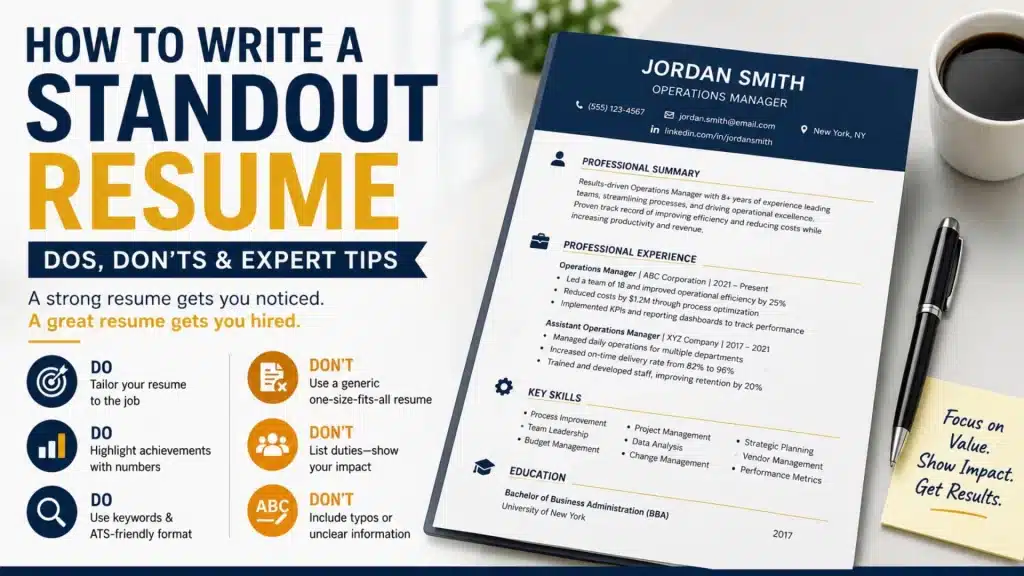
It also helps avoid one of the most common resume mistakes: writing a generic resume for every application. Your resume should reflect the role you are targeting.
Use the Job Description for Interview Preparation
The value of a job description does not stop once your resume is submitted. Use it to prepare for your interview.
Take each major responsibility and ask:
“What example from my experience proves I can do this?”
For example:
Requirement: Lead process improvement.
Your example: You redesigned a workflow that reduced customer response time by 25%.
Now you have a practical interview story.
You can build answers using a simple structure:
Situation → Task → Action → Result
This gives your answers evidence instead of vague statements.
It also helps you move from saying:
“I am a strong leader.”
to:
“I led a 14-person team through a workflow redesign that reduced turnaround time by 25%.”
The second answer demonstrates the skill.
Watch for Essential Job Functions
Not every duty in a posting has the same legal or practical significance.
The EEOC explains that essential job functions are the basic duties a qualified employee must be able to perform, with or without reasonable accommodation. The agency also notes that a written job description prepared before recruiting or interviewing can be evidence of which functions are considered essential.
This is one reason job descriptions should be written carefully and reviewed regularly by employers.
The EEOC also states that federal laws prohibit discrimination in job advertisements and recruitment based on protected characteristics covered by applicable laws.
For job seekers, this means you should focus on legitimate job requirements and understand the distinction between essential duties, preferred qualifications, and unnecessary wording.
When a Job Description Seems Too Broad?
Sometimes a posting appears to describe one job while actually combining responsibilities from several roles.
For example, a company may ask one employee to:
- Manage a team
- Run social media
- Handle customer service
- Build financial reports
- Develop strategy
- Manage vendors
That does not automatically mean the role is bad. But it is a reason to ask questions during the interview.
You might ask:
- What are the top three priorities for this position?
- How will performance be measured?
- Which responsibilities take up most of the employee’s time?
- What does a typical week look like?
- Why is the position open?
- What resources will the employee have?
Good questions help you determine whether the actual role matches the written description.
How Job Change Now Can Help You Use Job Descriptions More Effectively?
Reading a job description is one step. Turning it into a strong career strategy is another.
Career coaching services can be useful when you are trying to determine which roles fit your background and how to communicate your value to employers.
Job Change Now says its approach includes developing a professional value proposition, refining brand identity, and helping professionals communicate their experience from a hiring manager’s perspective.
For professionals making a significant career move, career transition support can also be relevant when you are changing industries, targeting a promotion, or repositioning your experience for a new type of role.
The goal is not to apply to every job that looks interesting. The goal is to understand which opportunities fit your experience and then present that experience clearly.
Quick Checklist Before You Apply
Before submitting an application, ask:
- Does my experience match the main responsibilities?
- Have I addressed the most important qualifications?
- Does my resume use relevant language from the posting where it is accurate?
- Have I included measurable accomplishments?
- Can I explain how my experience solves the employer’s needs?
- Can I give an example for each major responsibility?
- Do I understand what success in this role looks like?
If several answers are no, spend more time tailoring your application.
Conclusion
A job description is more than a list of responsibilities. It is a window into what an employer needs, what problems the role is expected to solve, and what qualifications may matter most during the hiring process.
When you understand what a job description is and what a job description includes, you can make better decisions about which opportunities to pursue.
Read the title. Study the responsibilities. Separate required qualifications from preferred ones. Look for repeated themes. Then compare those requirements with your own experience.
Most importantly, use the information to communicate your value.
For professionals who are changing careers, pursuing promotions, or trying to make their experience more relevant to employers, professional development coaching can provide another layer of structured support. Job Change Now specifically focuses on helping professionals communicate their value and position their experience more effectively.
The next time you search for a job description, do not just ask whether you qualify.
Ask a better question:
“Can I clearly show this employer that I can solve the problems this role was created to handle?”
That question can turn a generic job search into a much more focused career strategy.
Frequently Asked Questions
What is the job description?
A job description is a written explanation of a position’s responsibilities, qualifications, skills, expectations, and other relevant details. It helps employers communicate what they need and helps candidates evaluate whether a role fits their experience.
What should a job description include?
A useful job description should generally include the job title, summary, primary responsibilities, required and preferred qualifications, important skills, work expectations, reporting relationships, and relevant job-specific information.
Is a job description the same as a job posting?
Not always. A job description can be an internal document that defines a position. A job posting is usually written for external candidates and may include additional information such as compensation, benefits, application instructions, and employer branding.
How should I use a job description when writing my resume?
Use it to identify the employer’s most important responsibilities and qualifications. Then highlight relevant experience, skills, accomplishments, and measurable results from your background. Do not copy the posting word for word. Translate the requirements into evidence from your own experience.
What if I do not meet every requirement in a job description?
Do not assume you are automatically disqualified. Separate required qualifications from preferred ones and consider whether your transferable experience demonstrates the underlying capability. If a requirement is clearly mandatory due to licensing, certification, or another specific condition, treat it more seriously.
Also Read: ATS-Friendly Resume Tips